
Herbs thrive across North Carolina, but the state stretches from coastal marsh to 6,000-foot peaks, and that geography changes almost everything about when you plant and what survives winter. The short answer: soil temperature, not the calendar, tells you when to start, and winter cold, not summer heat, decides which herbs stay in the ground year-round.
When the soil is warm enough in North Carolina
Every gardener wants a single date. North Carolina doesn’t offer one, but the Piedmont reference station in Charlotte gives a working target: the last spring frost falls between March 23 and April 5, based on NOAA’s 1991-2020 Climate Normals and their 30-70% freeze probability band for 32°F. That’s a probability window, not a guarantee, and it applies to the Piedmont. The Blue Ridge Mountains to the west run several weeks behind that window, while the coastal plain tends to warm up earlier.
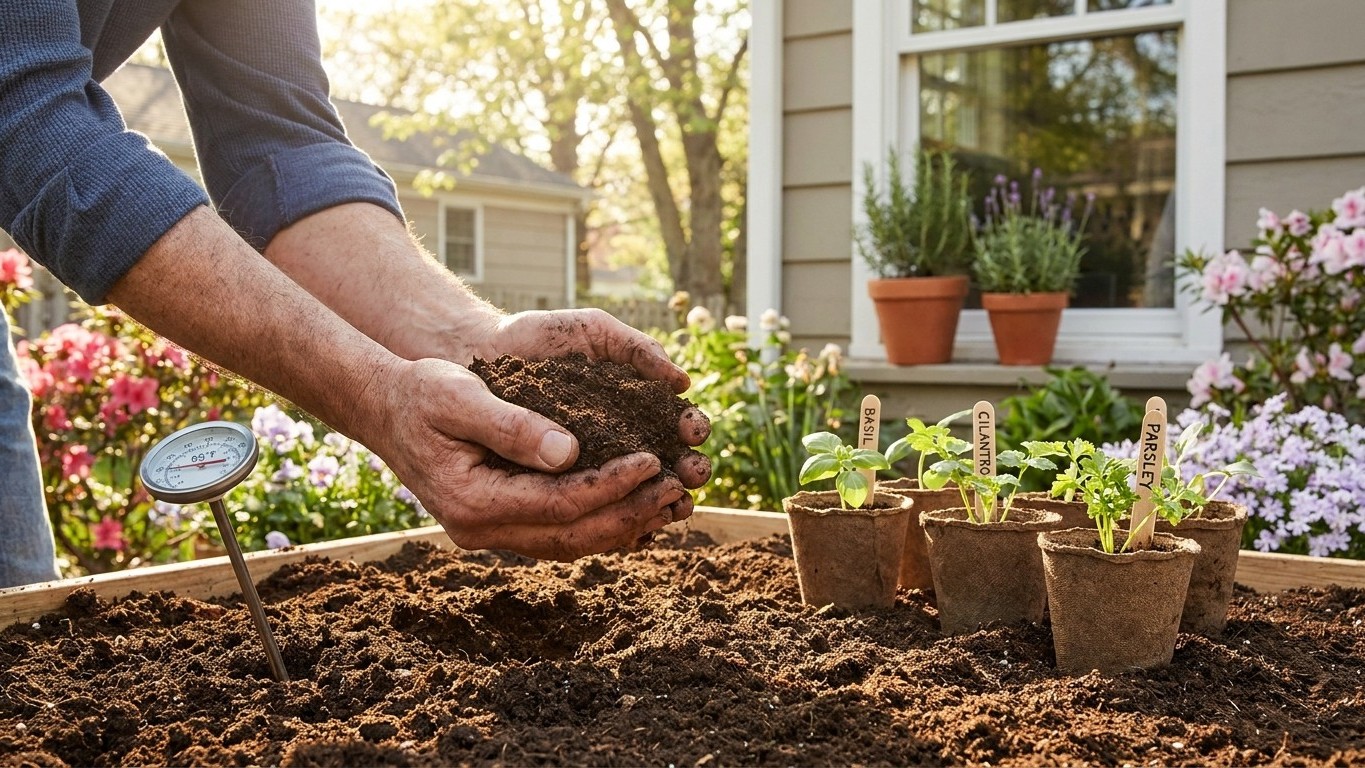
Here’s the part that trips people up: frost date is a proxy, not the actual trigger. Herbs don’t respond to frost risk directly, they respond to soil temperature. Soil lags behind air temperature by days, sometimes weeks, especially in clay-heavy Piedmont ground that holds cold longer than it holds heat. A frost-free morning in early April can still sit over soil too cold for basil or other tender annual herbs to germinate reliably. That’s why experienced growers wait past the frost date rather than racing to it, letting the ground itself catch up.
What this means for different herb types
Hardy perennial types in the mint and allium families tolerate a much wider range of soil temperatures and can go in earlier, sometimes before the frost window closes, because established roots handle a late cold snap that would kill a seedling. Tender annual types, the ones native to Mediterranean or tropical climates, need soil that’s been reliably warm for a stretch, which in the Piedmont usually means waiting into mid-to-late April even though the statistical frost date sits earlier.
One more note on geography: because Charlotte anchors this frost data, anyone gardening in Asheville, Boone, or other mountain communities should treat these dates as a starting reference and expect to push planting back. Anyone near Wilmington or the Outer Banks can often move earlier. Neither adjustment is exact, both are directional, and local observation of your own soil beats any regional average.
A few popular herbs carry long-standing medicinal reputations in folklore and traditional practice. This page doesn’t evaluate those claims one way or the other, culinary and garden use is the scope here, so we’ll leave that where it stands and move on to timing.
How long the season lasts here
Subtract the two frost windows and North Carolina’s Piedmont growing season runs from the March 23–April 5 last spring frost to the October 30–November 8 first fall frost, both figures from the same NOAA 1991-2020 Climate Normals dataset for the Charlotte reference station. That’s roughly seven months of frost-free ground, which puts North Carolina solidly in the “long enough for succession planting” category rather than the short-window states where growers get exactly one shot per year.
What that length actually buys you is worth spelling out. A seven-month window means an early sowing of a fast annual herb can finish, get pulled, and be followed by a second sowing of the same or a different type before the fall frost risk climbs back up. It also changes how you think about transplants versus direct-seeding. In a short-season territory, transplanting is almost mandatory because there’s no room to waste weeks on slow germination outdoors. Here, with months to spare, direct-seeding becomes a real option for annual herbs, and the decision comes down to whether you want an earlier first harvest or you’re comfortable letting the soil do the germinating.
Where the timing gets tighter
That seven-month figure is a Piedmont number. Mountain gardeners working with a frost season that opens later and closes earlier lose real weeks off both ends, which shrinks the case for a second sowing and makes the first planting the one that has to count. Coastal gardeners generally gain time on both ends, which strengthens the case for succession sowing even further.
If you’re planning multiple plantings of the same herb through the season, it’s worth reading a dedicated succession sowing guide before committing bed space, since the spacing between sowings depends on more than just frost dates.
Heat and water in North Carolina
North Carolina’s Piedmont summers run hot and humid enough that most annual herbs handle them without much fuss, but the real story for this territory isn’t the summer count of 90-degree days or how much rain falls in July, it’s what happens in January. For herbs specifically, winter is the number that reorganizes the whole planting plan, because it separates the herbs that can live in the ground permanently from the ones that have to spend cold months in a pot on a windowsill.
Two figures from NOAA’s Climate Normals do that separating. The mean daily minimum temperature during the coldest month, referenced at Charlotte, sits at 31.8°F. That’s not the record low and not a monthly average, it’s the typical overnight floor during the coldest stretch of winter, and it’s the number that determines whether a woody perennial herb’s roots and stems survive a normal winter here, not just an unusually mild one. Pair that with the USDA Plant Hardiness Zone Map’s 2023 update, which places North Carolina across zones 5b to 8b, built on the average annual extreme minimum temperature. That’s a five-zone spread across one state, which is enormous. A herb rated hardy to zone 7 lives outdoors year-round in the Piedmont and coastal plain but dies back or dies outright in the higher mountain counties sitting closer to zone 5b.
Reading your own zone before you plant
Because the range is so wide, the single most useful thing a North Carolina gardener can do before choosing perennial herbs is look up their own county on the USDA map rather than relying on a statewide number. A gardener in the Piedmont near Charlotte is working with a materially different winter than a gardener in the higher elevations of the Blue Ridge, even though both are technically “North Carolina.”
Summer humidity does matter here, just not in the way heat does elsewhere. Rather than the plant struggling to survive the heat, the risk in a humid Piedmont or coastal summer runs toward fungal pressure: powdery mildew on crowded foliage, root rot in beds that don’t drain, and general slow decline in herbs planted too close together without airflow. That’s a disease-management issue, not a heat-tolerance issue, and it changes which traits matter most when picking varieties, a point worth carrying into the next section.
Which herbs suit North Carolina
Given a long frost-free window but a winter cold enough to erase the difference between “perennial” and “annual” for many species, the practical approach is to sort herbs by type rather than by name. Hardy perennial types in the allium and mint families generally tolerate the coldest-month minimum across most of the state’s lower-elevation zones and can stay in the ground year after year. Tender perennial types with Mediterranean origins are the ones that split the state in two: they often survive winter outdoors in the coastal plain and lower Piedmont, but need container culture and an indoor spot for the coldest months anywhere pushing toward the 5b-6a end of the hardiness range.
Fast annual types, the ones grown from seed each year regardless of hardiness, sidestep the winter question entirely and instead need to be matched to the season length discussed earlier: a short mountain season favors annual types known for quick establishment, while the long Piedmont and coastal windows tolerate slower-starting types without penalty.
Disease resistance as the deciding factor
Given the humidity pattern described above, disease resistance deserves to be the first filter for annual herb types in a humid summer climate, ahead of flavor intensity or growth habit. A type known for holding up against foliar disease in trial gardens will outlast a more vulnerable type by weeks in a wet Piedmont August, even if both started the season identically.
This page won’t name a specific cultivar, and that’s a deliberate choice, not an omission. Variety trials run by land-grant universities test named cultivars against local disease pressure, local soil, and local humidity every year, and those results are the only variety recommendations that actually mean something for a given county. North Carolina State University’s extension service, at ces.ncsu.edu, publishes exactly that kind of localized trial data and can point to the specific types performing best in your county this growing season, something a general territory page never can.