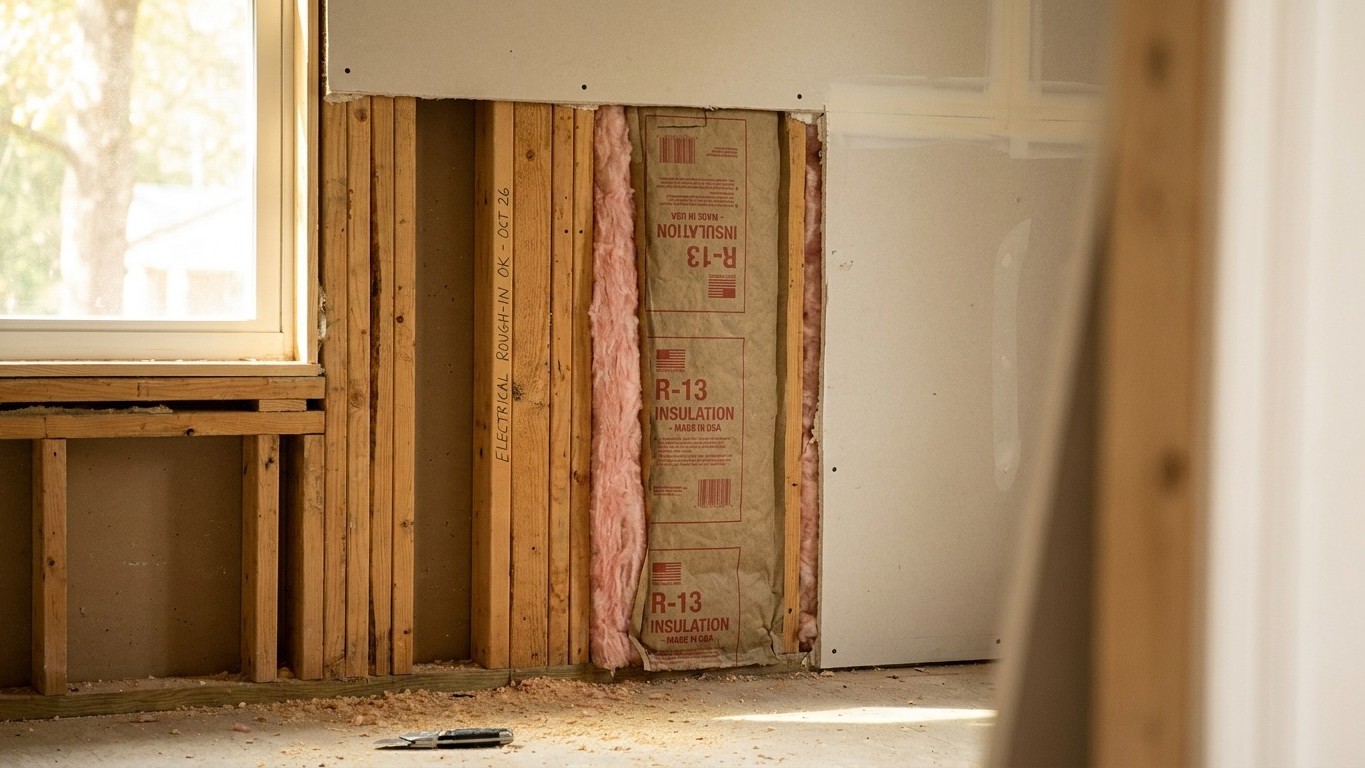

Yes. North Dakota’s counties sit in IECC climate zones 6A and 7, and neither zone falls under the code’s exception for warm climates, so a vapor retarder on the interior side of framed walls is required statewide. What changes county to county isn’t whether you need one, but which class the local building department will accept, and why the whole logic of the rule depends on which direction the moisture is traveling.
What the code asks for in North Dakota

The 2021 International Residential Code, Section R702.7, states it plainly: a vapor retarder of the class given by Table R702.7(2) shall be provided on the interior side of frame walls. That’s the baseline rule adopted, in some form, by most jurisdictions across the country. The code then carves out four situations where the requirement doesn’t apply, and the one that matters most nationally reads: “A vapor retarder shall not be required in Climate Zones 1, 2 and 3.”
North Dakota doesn’t touch any of those zones. Of the state’s 53 counties, 37 sit in zone 6A and 16 sit in zone 7, according to the IECC’s climate zone table. Both are cold-climate zones, both sit well outside the 1-2-3 exception, and both fall under the general rule requiring an interior vapor retarder. That’s a different situation from a state that straddles, say, zone 3 and zone 4, where a resident two counties apart could get opposite answers from the code. In North Dakota, the zone split changes which row of the insulation table applies and how the county is treated for energy code purposes, but it doesn’t flip the vapor retarder answer from required to not required anywhere in the state.
That’s worth sitting with for a second, because it’s the exception to the exception this whole silo is built around. Somewhere in the Gulf Coast, the same code section tells a builder they don’t need a Class I retarder at all. In North Dakota, nobody gets that break. The reason isn’t arbitrary, and it isn’t bureaucracy protecting itself. It comes down to which side of the wall the water vapor is trying to get through, and in a place with a heating season as long as this one, that direction is almost always the same.
None of this tells an individual homeowner what to install in their own wall assembly. The code names a class, not a product, and the class that applies to a specific project depends on the wall assembly, the insulation type, and the exterior cladding, all of which a local building department reviews on a case-by-case basis. A wall built with the wrong vapor control doesn’t announce the mistake with a leak or a stain. It rots quietly behind the drywall, and the homeowner usually finds out only when a remodel or a sale opens the wall up years later.
Why the answer is the opposite in a warm climate
Picture the physics, not the paperwork. In a cold climate like North Dakota’s, the warm, moisture-laden air lives inside the house, heated by furnaces and humidified by showers, cooking, and simple breathing. That warm air wants to migrate outward through the wall toward the cold. If it reaches the cold sheathing on a January night and hits a surface below the dew point, the water vapor condenses right there, inside the wall cavity. A vapor retarder on the interior side stops that migration before it starts, which is exactly why R702.7 asks for one in a zone like 6A or 7.
Flip the climate, and the logic flips with it. In a warm, humid region, the moisture isn’t coming from inside the house. It’s arriving from outside, driven by heat and humidity into the wall assembly, often through masonry, siding, or air leaks in the cladding. Air conditioning keeps the interior cool, which means the coolest surface in that wall system is now on the inside, not the outside. If a Class I retarder sits there, it becomes exactly the kind of surface that cold sheathing was in the northern example: a cool, impermeable plane where outdoor moisture condenses instead of drying out.
The U.S. Department of Energy’s Building America program describes what happens next in blunt terms: “If the wall contains a vapor retarder on the interior side of the insulation, the water vapor will condense on this cool, impermeable surface,” resulting in “ruined insulation, mold, and structural rot of framing members.” That’s not a hypothetical footnote. It’s the reason the code doesn’t require a vapor retarder in Climate Zones 1, 2 and 3, and it’s the reason nobody should read that exception as some kind of oversight or shortcut. It’s the direction of the water that decides the rule, and the direction reverses somewhere between a warm coastal county and a place like Fargo.
This is the single fact that makes vapor barrier rules impossible to generalize across the country. A contractor who’s only ever worked in Florida and one who’s only ever worked in North Dakota can both be following the code correctly and still tell a homeowner the exact opposite thing, because they’re solving for opposite moisture directions.
The three classes, and why the word matters
The code doesn’t talk about “vapor barriers” as a single product category. It talks about three classes, defined strictly by how much moisture passes through them, measured in perms. That distinction is the whole disagreement in miniature: whether a builder needs a retarder isn’t really the question in most cold zones, it’s which class the assembly calls for.
| Class | Example materials | Perm range |
|---|---|---|
| Class I | Sheet polyethylene, nonperforated aluminum foil | 0.1 perm or less |
| Class II | Kraft-faced fiberglass batts, vapor retarder paint | Above 0.1, up to 1.0 perm |
| Class III | Latex or enamel paint | Above 1.0, up to 10.0 perm |
Sheet polyethylene is a real, common material, but calling it simply “a vapor barrier” skips the part that actually matters to a building inspector: it’s a Class I retarder, the least permeable of the three, and code officials in some assemblies restrict its use because it’s too effective at blocking drying in both directions. A wall that can’t dry either way is a wall with nowhere for accidental moisture to go.
Most homeowners already own a vapor retarder without knowing it. Ordinary latex or enamel wall paint qualifies as a Class III retarder under the code’s own perm ranges. It’s not dramatic, it’s not a special product, and it’s already on the walls of a huge share of American homes. That’s often enough to satisfy the code in an assembly that doesn’t need anything more restrictive, which is part of why the vapor retarder conversation gets confused with insulation upgrades that have nothing to do with it.
One more distinction worth keeping straight: a vapor retarder is not an air barrier. One controls water vapor diffusing through a material; the other stops bulk air movement through gaps and cracks. Some products do both jobs at once, but the code treats them as separate requirements, and conflating the two is a common source of confusion on job sites.
Where the rule stops
R702.7 lists specific situations where the interior vapor retarder requirement doesn’t apply. In North Dakota, since the climate-zone exception for zones 1, 2 and 3 doesn’t come into play, these are the exceptions that actually matter for local walls:
- Basement walls
- The below-grade portion of any wall
- Construction where accumulation, condensation or freezing of moisture will not damage the materials
The basement exception is the one most homeowners actually run into, because it contradicts the intuition built by the rest of the code. A poured concrete or block foundation wall holds groundwater moisture for years, releasing it slowly through the concrete itself long after the house is built. If that assembly gets sealed with an impermeable interior sheet, the wall has no path to dry inward, and moisture that would otherwise pass through harmlessly gets trapped against the framing and finish materials instead. The below-grade portion of any wall faces the same soil-moisture reality, which is why it gets the same treatment. Readers dealing with a foundation or basement finishing project specifically should look at the basement wall guide on this site, since that assembly follows a different logic than the above-grade walls this page covers.
Who actually decides, in North Dakota
Model codes like the IRC are written by a national body, but they don’t take effect anywhere until a state or local jurisdiction formally adopts them, sometimes with amendments, sometimes years after a new edition is published. The 2021 IRC language described here is the model text; what actually governs a specific project in a specific North Dakota county or city is whichever edition that jurisdiction has adopted, amended, and is currently enforcing. That’s not a small caveat. It’s the difference between reading the right rule and reading a rule that no longer applies where the house is being built.
Fargo, at the state’s Hector International Airport weather station, averages about 8,806 heating degree days a year against a base of 65°F, compared with roughly 542 cooling degree days. That’s not a temperature reading; it’s a measure of heating demand, tallying how far below 65°F the daily mean temperature falls, added up across the entire year. A ratio that lopsided, over sixteen times more heating demand than cooling demand, is exactly the kind of climate profile that makes an interior vapor retarder something the code takes seriously here, rather than an afterthought.
None of that substitutes for a call to the local building department before framing goes up. The department that issues the permit knows which code edition is in force, which class of retarder it expects for a given wall assembly, and how local amendments might have changed the baseline IRC language. A wall built on a guess instead of that confirmation doesn’t fail an inspection on the spot. It sits quietly behind the drywall, and whatever mistake was made shows up only when someone opens that wall years later.