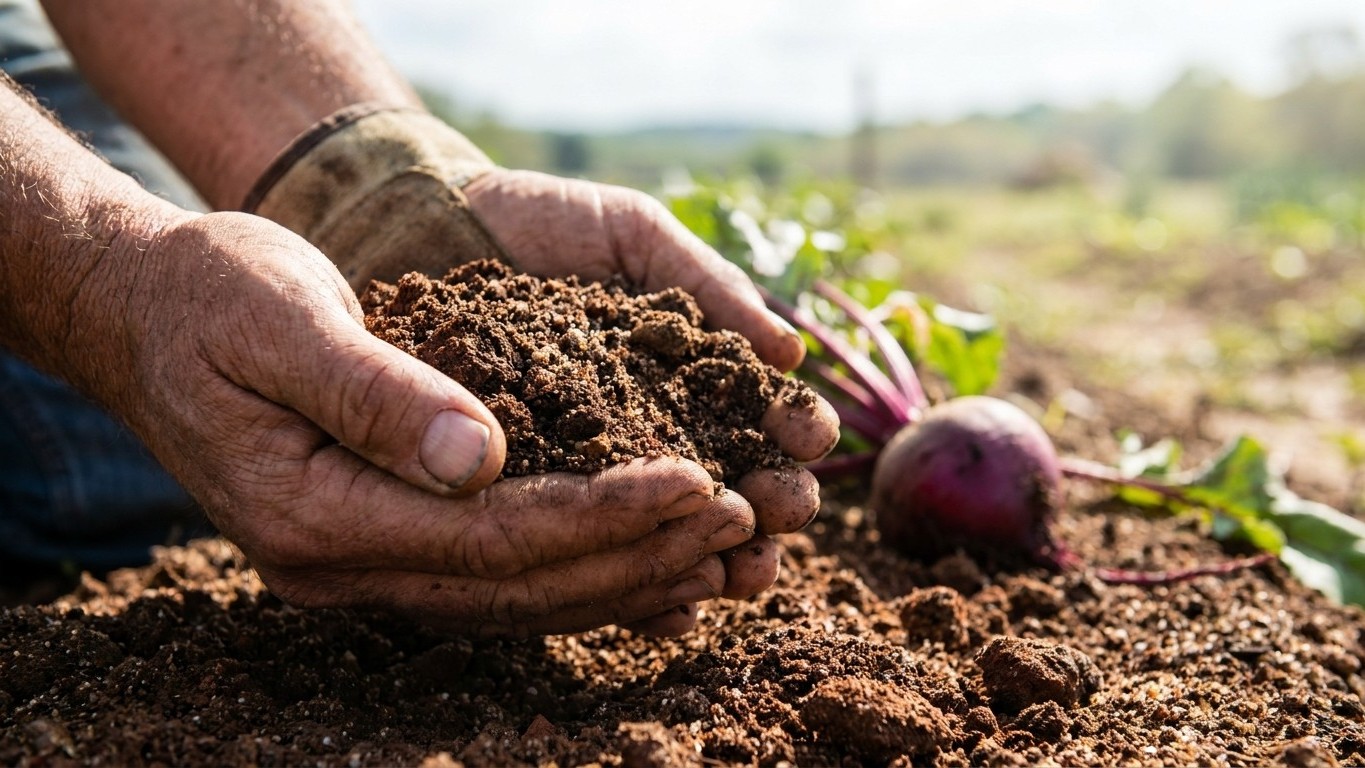

North Dakota’s benchmark soil, the Williams series, is a deep, well-drained loam built for grain, not for a tender root vegetable that resents dry starts. Beets there succeed less because of the dirt itself and more because of what a grower does in the six weeks after seeding, when the state’s swinging spring decides whether the crop bolts or holds.
The short answer
The soil USDA lists as representative of North Dakota is the Williams series, a Mollisol, the dark, organic-rich prairie soil that built the Corn Belt farther south and east. Its surface horizon runs 38 percent sand, 22 percent clay and 40 percent silt, a loam to silt loam blend, with organic matter around 4.0 percent and a surface pH near 7.2, essentially neutral. It’s classed well drained.
For a beet, that combination reads as mostly good news. Utah State University Extension’s guidance for the crop asks for deep, sandy, well-drained ground rich in organic matter, and the Williams series checks most of those boxes on paper: it drains rather than holds, and it already carries a healthy organic-matter load without needing to be built up from nothing. Where it falls short of the ideal is texture. A soil carrying 22 percent clay isn’t the loose, sandy profile beets grow fastest in; it will crust after rain and resist the swelling root more than a true sandy loam would, especially in a bed that hasn’t been worked deep or loosened before sowing.
The neutral pH is close enough to leave alone. The organic-matter figure, about 4.0 percent, sits well under any number that would flag a peat or muck soil, so a gardener working a bed that matches this description can treat it as ordinary cultivated ground and follow the Extension’s cap of no more than 1 inch of composted organic matter per 100 square feet, rather than assuming the soil needs a heavy amendment program before beets go in.
Heat is the other half of the equation, and it’s worth separating from the soil question entirely. The Extension source is specific that heat above 85 F combined with water stress is what turns a beet root woody, a different failure from the bolting that early-season drought causes. A precise count of how many days a year any given North Dakota location crosses 90 F isn’t published in the sources behind this page, so no such number appears here. What can be said is that Williams-series ground, being well drained rather than moisture-retentive, will dry out faster in a hot stretch than a heavier clay soil would, which raises the odds of hitting that 85 F-plus, water-stressed combination if watering lapses during a summer heat run.
None of this describes any one garden with certainty. North Dakota spans hundreds of mapped soil series, and river-bottom ground, hill country, and any lot a builder has cut, filled or graded will differ from the Williams profile in ways a visual guess can’t catch. This is a starting point for what the region’s ground tends to do, not a stand-in for a soil test pulled from the actual bed.
The six weeks that decide it here
Beets are sown directly in place, never transplanted, and the standard timing is 2 to 3 weeks before the last spring frost. At the reference weather station behind the frost data on this page, that last-frost window (the 30 to 70 percent probability band for a 32 F freeze) falls between May 4 and May 15. Sowing on that schedule lands the first six weeks of a beet’s life, the stretch when early water stress triggers premature flowering, squarely in North Dakota’s spring, and that season has a reputation worth taking seriously.
North Dakota’s spring is known for swinging hard rather than settling into one pattern. A stretch of cool, damp weather can give way within days to dry wind and rapidly warming soil, and that kind of whiplash is exactly the setup that stresses a young beet’s shallow root system before it has built the depth to buffer against a dry week. The risk here isn’t a single dry season type; it’s the swing itself, because a bed that seemed adequately moist on a Monday can be parched by Friday if wind and warmth arrive together.
That matters because the bolting mechanism doesn’t wait for a heat wave. A beet reads water stress in those first six weeks as a signal that the season is ending, and it responds by trying to flower and set seed rather than keep building a root. That response can happen even while daytime highs are still mild, well short of the 85 F threshold tied to woodiness later in the season. Bolting is an early, cool-weather-adjacent risk driven by dry soil; woodiness is a mid-to-late-season risk driven by heat plus dry soil. They come from the same underlying cause, thirst, but they show up at different points in the plant’s life and neither one substitutes for watching the other.
The practical takeaway for a grower sowing in that early-to-mid May window on Williams-series or similar well-drained ground is to treat the six weeks after seeding as the period where a skipped watering carries outsized consequences, regardless of whether the calendar says the weather has turned warm yet. A soil that drains well, which is generally a strength, becomes the exact soil that dries out fastest if a windy, dry spell hits during that swing.
What goes wrong here
- Crusted surface blocking germination. The Williams series’ 22 percent clay fraction can seal into a crust after a rain-then-dry cycle, which is tough for a beet seedling’s fine root to push through. Rake the surface lightly right before sowing and again if a hard rain crusts it before seedlings emerge, and keep the top inch consistently damp until germination is complete.
- Bolting from a dry stretch in the first six weeks. Because sowing 2 to 3 weeks ahead of the May 4 to May 15 last-frost window puts early growth inside North Dakota’s swing-prone spring, an unwatched dry spell during that period is the single most common trigger for premature flowering. Check soil moisture at root depth, not just the surface, at least twice a week through that window and water before the bed feels dry to the touch.
- Woody roots from a hot, dry summer stretch. Once above-ground growth is established, a run of days above 85 F combined with lapsed watering is what coarsens the root’s texture, a separate problem from bolting and one that shows up later in the season. Deep, even watering through any extended heat stretch is the remedy, not just a light daily sprinkle that wets the surface and little else.
- Compaction resisting root expansion. The clay-and-silt majority in this soil type can compact under foot traffic or heavy rain, restricting how well the swelling root can push outward. Loosen the bed to a full spade’s depth before sowing and avoid walking on planted rows.
- Over-amending organic matter. With organic matter already around 4.0 percent in the representative Williams profile, piling on more compost than the Extension’s 1-inch-per-100-square-foot guideline risks excess nitrogen that pushes leafy top growth at the expense of the root. Stick to that cap even on a bed that looks like it could use richer ground.
Common questions
Is the Williams series the soil in every North Dakota garden?
No. It’s the series USDA lists as representative of the state under its State Soils program, but North Dakota contains hundreds of mapped soil series, and river bottoms, hill country, and any disturbed or filled lot will differ from it. Treat it as a regional starting point and confirm the actual bed with a soil test.
How many days above 90 F should I expect, and does that matter for beets?
That day count isn’t published in the sources behind this page, so no figure is given here. What does matter, per Utah State University Extension, is that temperatures above 85 F combined with water stress make beet roots woody, so the relevant question for a grower is whether watering is keeping pace during any hot stretch, not the exact tally of hot days in a season.
Should I sow beets before or after the last frost date?
Standard timing is 2 to 3 weeks before the last frost, which at the reference weather station falls between May 4 and May 15 based on NOAA’s 1991-2020 climate normals. Suburban and rural gardens away from that station often see a later last frost, sometimes by one to two weeks, so check local county timing rather than relying solely on the airport figure.
Does this soil need extra organic matter before planting beets?
Generally no. The representative surface horizon of the Williams series already carries about 4.0 percent organic matter, within the range of ordinary cultivated ground rather than a peat or muck soil. Utah State University Extension recommends capping any addition at 1 inch of composted organic matter per 100 square feet, and a bed matching this profile doesn’t need more than that ceiling.