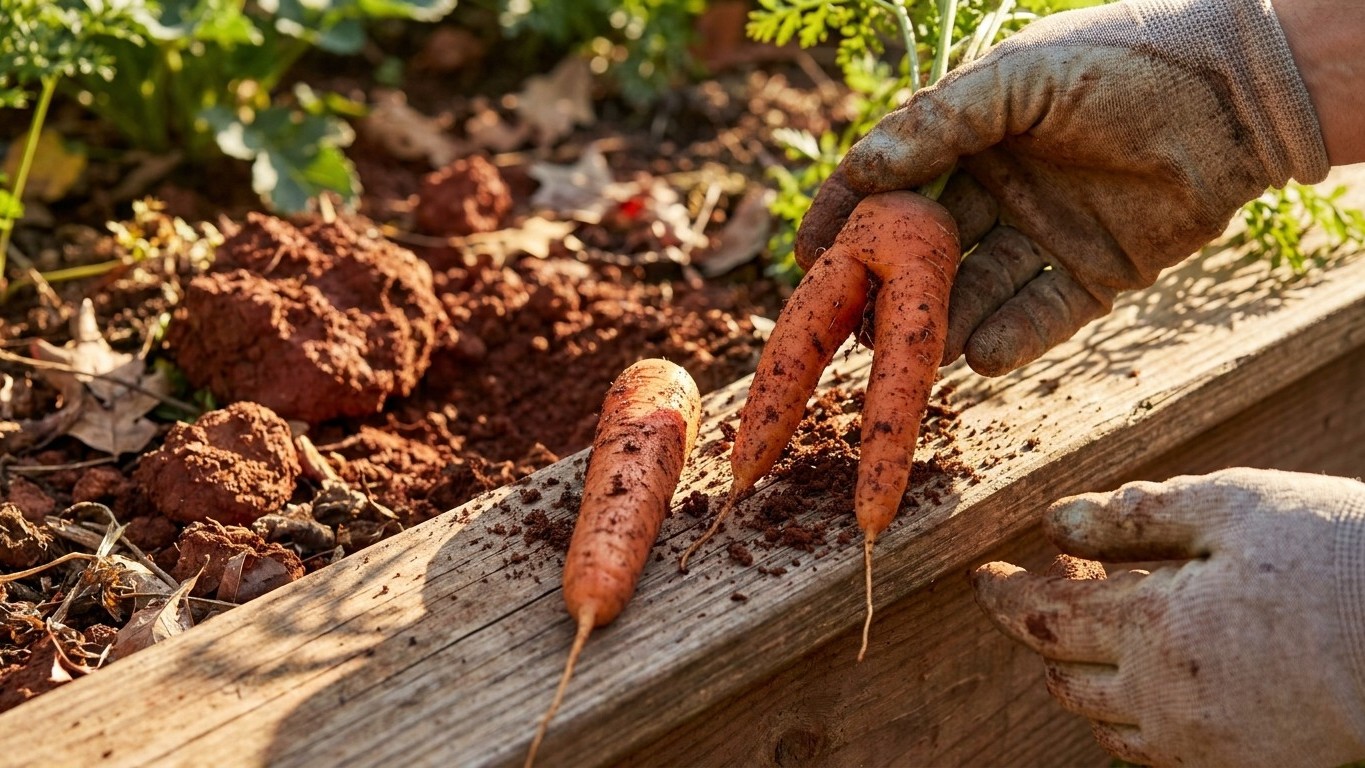

North Dakota’s benchmark soil, the Williams series, is a well-drained prairie loam that generally treats carrots kindly rather than twisting them into forks. That’s the state average, though, not your yard. Whether your carrots come up straight or forked depends on the dirt under your own boots, and there’s a simple way to find out before you plant a single seed.
The short answer
The soil USDA lists as representative of North Dakota is the Williams series, a Mollisol, which is the deep, dark, organic-rich prairie soil that built the Corn Belt further south and does the same work here. Its surface horizon runs a near-neutral pH around 7.2, with a texture close to loam or silt loam: 38 percent sand, 22 percent clay, and 40 percent silt. Organic matter sits around 4.0 percent, and drainage is classed as well drained. These are representative values from USDA NRCS Soil Data Access, drawn from measurements of 549 mapped components of the Williams series.
Set that against what a carrot actually wants. Utah State University Extension puts it plainly: carrots need deep, sandy, well-drained soil rich in organic matter to grow long and straight. Heavy or rocky ground is what makes the root fork, because the taproot hits resistance and splits around it instead of pushing on down. On paper, the Williams series checks most of those boxes. A sand-silt-clay split that leans loam rather than clay, combined with good drainage and a healthy 4.0 percent organic matter, is closer to carrot-friendly ground than to the compacted, rocky soil that produces forked roots.
That doesn’t mean every garden in the state is in the clear. Clay content at 22 percent is moderate, not negligible, and any compaction from foot traffic, heavy equipment, or a long history of tillage can tighten that soil enough to slow a taproot down. Where that happens, the fix Utah State recommends is the same regardless of location: work in plenty of compost to loosen the structure, and double dig the bed so the taproot has open ground to travel through instead of a wall of packed clay. In truly stubborn or rocky ground, a raised bed filled with loose, amended soil sidesteps the problem instead of fighting it.
Here’s the catch worth repeating before you grab a shovel: North Dakota spans hundreds of soil series, not one. The Williams series is what USDA names as representative of the state as a whole, useful as a starting point for guessing how the region’s ground tends to behave, not a diagnosis of the dirt behind your house. River bottoms run sandier and drain faster. Hill country can turn stony fast. Any lot a builder graded, filled, or scraped flat before a house went up may bear no resemblance to native prairie soil at all. The organic-matter and pH figures above describe the surface horizon as mapped in the wild, not a bed that’s been tilled, watered, and cropped for years. Treat this section as context, then go check your own ground.
The test that settles it in your own garden
Soil maps tell you what the region tends toward. Only digging in your own bed tells you what’s actually there. None of the steps below need lab equipment, just a shovel, a bucket of water, and about twenty minutes.
- Dig a hole at least a foot deep where you plan to grow carrots. Note how easy or hard the digging is; soil that resists a shovel at six inches is signaling compaction a taproot will also fight.
- Look at what comes out. Check the depth of loose, dark topsoil before you hit denser subsoil, and count any rocks, gravel, or hardpan chunks in the pile. Rocky spoil in the top foot is the clearest sign a carrot bed here will need clearing or a raised bed instead.
- Feel the texture. Grab a handful of moist soil and squeeze it. Sandy soil falls apart and won’t hold a shape. Clay-heavy soil balls up tight and stays that way, feeling slick and sticky, which is the texture Utah State flags as the one that forces roots to fork around resistance instead of growing through it.
- Run a drainage check. Refill the hole with water and time how long it takes to soak in, then repeat once more right after. Water that lingers for hours instead of draining steadily points to heavy, poorly drained ground, exactly the condition compost and double digging are meant to correct.
- Compare the four observations together. Loose digging, decent topsoil depth, a texture that crumbles rather than balls up, and steady drainage all point to soil close to what carrots want. Any one of the opposite signs, especially rocks or standing water, is your cue to amend the bed or build it up rather than plant straight into what’s there.
What goes wrong here
Even soil that leans favorable on paper can trip carrots up in specific, predictable ways. Knowing the failure ahead of time makes the fix a lot less mysterious once it shows up in the row.
- Forking in heavy or compacted ground. Wherever clay content runs higher than the state average, or years of foot traffic and tillage have packed a bed tight, the taproot meets resistance and splits into two or more legs instead of growing straight down. Utah State University Extension’s remedy is direct: work in generous amounts of compost and double dig the bed before sowing, loosening the soil well below where the root will travel. On truly heavy or rocky ground, building a raised bed with loose, amended soil is the more reliable fix.
- Poor germination during a hot, dry spell. Carrot seed is small and sits shallow, and a crusted, dried-out surface layer keeps it from sprouting evenly no matter how good the soil is a few inches down. Keeping the top inch of the seedbed consistently moist through germination, rather than soaked once and left to dry, gives seedlings a fair shot at coming up together.
- Splitting from uneven watering. Roots that get a long dry stretch followed by a heavy soak tend to swell fast and crack open along the side. Since carrots are sown directly in place and grow for 70 to 100 days from seeding with no transplanting involved, that’s a long stretch for watering habits to drift. A steady, even watering routine across the whole season protects against splitting far more than any one fix applied late.
- Stunted or twisted roots from buried debris. Old roots, construction scraps, or a layer of gravel left over from grading can sit just below the surface in a lot that’s been built on, and a carrot taproot will bend or stop cold when it hits one. The dig-and-inspect check in the previous section is what catches this before a whole row comes up deformed.
Common questions
Does the Williams series mean my carrots definitely won’t fork?
No. It means the soil USDA lists as representative of North Dakota tends toward a loam texture and good drainage, both favorable for carrots. Your own garden may sit on a completely different soil series, especially near a river, in hill country, or on a lot that’s been graded or filled.
What’s the fastest way to fix heavy, forking-prone soil?
Utah State University Extension recommends working in plenty of compost and double digging the bed so the loosened soil runs deep enough for the taproot to grow through without hitting resistance. Where the ground is especially rocky or compacted, a raised bed filled with loose, amended soil is the more dependable route.
Should I start carrot seeds indoors and transplant them?
No. Carrots are sown directly in the ground where they’ll grow, never transplanted. The 70 to 100 days to maturity are counted from the seeding date, not from any transplant date, because there isn’t one.
Is the pH figure for the Williams series my garden’s actual pH?
Treat it as a regional reference point, not your number. It’s the representative surface pH USDA recorded across 549 mapped components of that series, describing native ground as surveyed rather than a cultivated bed that’s been tilled, fertilized, and watered for seasons. A simple soil test on your own bed is the only way to know your actual pH.