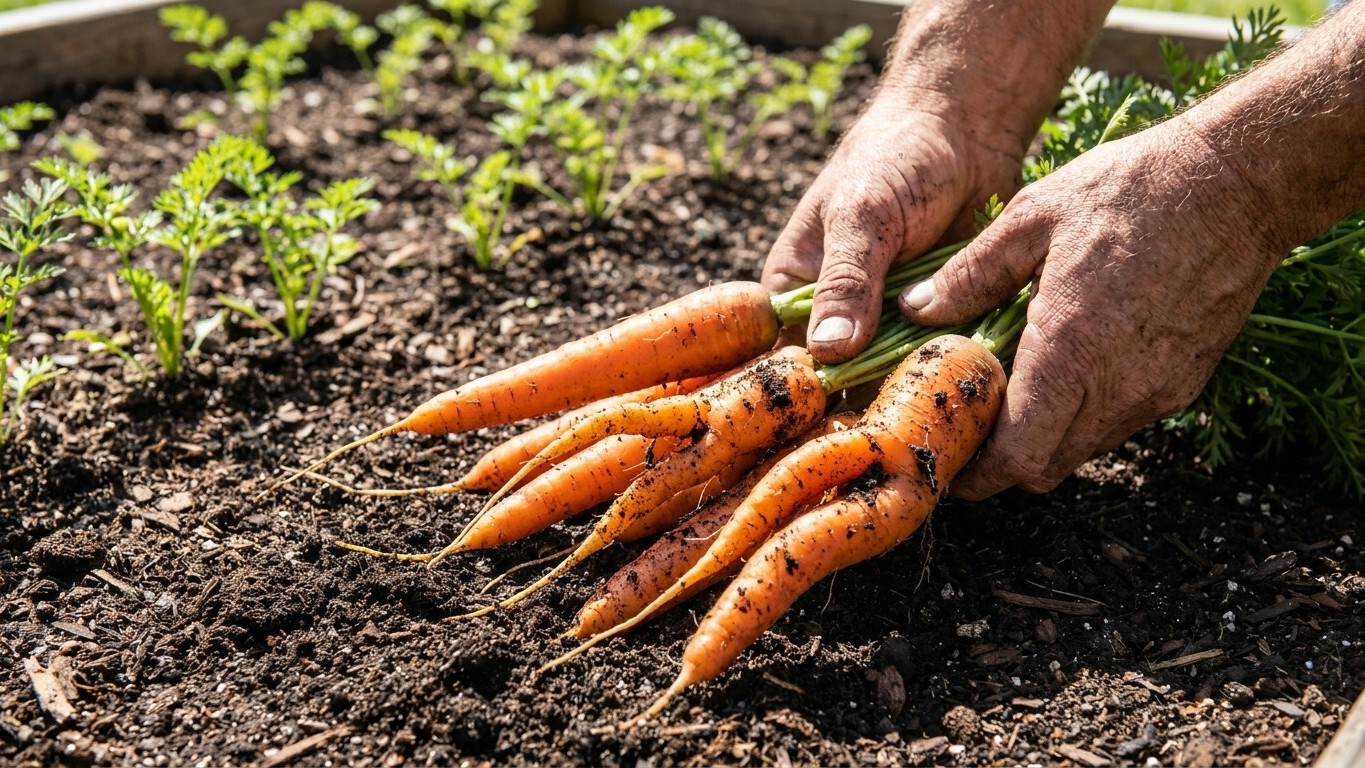

North Dakota’s representative farmland soil, the Williams series, is a well-drained loam built from four percent organic matter over centuries of prairie grass. That’s a decent starting point for a straight carrot root, but “decent starting point” is not the same as “guaranteed.” What actually decides whether your carrots come out arrow-straight or twisted like a corkscrew is the specific patch of dirt in your own yard, not the county average, and that’s the piece most seed packets never tell you how to check.
The short answer
The soil USDA lists as representative of North Dakota is the Williams series, a Mollisol, which is the deep, dark prairie soil type that also underlies much of the Corn Belt further south and east. Its surface horizon runs close to neutral, about pH 7.2, and texturally it lands right in the loam-to-silt range: 38 percent sand, 22 percent clay, and 40 percent silt. Organic matter sits around 4.0 percent, and drainage is classified as well drained.
On paper, that’s a workable profile for root vegetables. Carrots want deep, loose, well-drained ground with plenty of organic matter, and the Williams series checks the drainage box and the organic-matter box without much argument. The clay share is the number to watch. Twenty-two percent clay isn’t the heavy, sticky ground that stops a shovel cold, but it’s enough to compact under foot traffic or a wet spring, and compacted ground is exactly what makes a carrot root hit resistance, split its energy sideways, and fork into two or three stubby legs instead of pushing straight down.
What that means for planting
If your garden bed resembles this profile, plain compost worked into the top foot of soil, plus a season or two of avoiding walking on wet beds, should be enough insurance. If the ground under your feet is denser than that, either because it’s been driven over, built on fill, or simply compacted from years of tilling at the same depth, double digging the bed before sowing, or building a raised bed filled with a loose, sifted mix, solves the forking problem at the root instead of fighting it every year.
None of this should be read as a soil report on your specific garden. North Dakota spans hundreds of mapped soil series, and the Williams series is simply the one USDA names as representative for the state as a whole under its State Soils program. A garden along the Red River, a plot in the Missouri Coteau’s rolling hill country, or a yard on ground a contractor scraped and refilled during construction can all differ completely from this baseline, sometimes within the same block. Treat these numbers as a reasonable guess at what the region’s ground tends to do, not as a diagnosis of the bed you’re about to plant.
The test that settles it in your own garden
State averages are a guess. A shovel is proof. Before you decide whether your bed needs compost, double digging, or a raised frame, spend fifteen minutes finding out what’s actually down there.
- Dig a test hole at least a foot deep in the spot you plan to sow. Carrots need loose ground for their full length, so anything that stops your shovel or trowel well short of that depth, a rock layer, a hardpan, or dense clay, is a sign the bed needs loosening or raising before seed goes in.
- Look at what comes out. Note any stones, gravel, or construction debris mixed into the soil. Rocky ground is one of the classic causes of forked carrots, since the root simply splits around the first obstruction it meets.
- Feel the texture. Grab a handful of moist soil from the hole and squeeze it into a ball. Soil that stays in a slick, sticky ribbon when pressed between your fingers leans heavy on clay. Soil that crumbles apart and won’t hold a shape at all leans sandy. Something in between, holding a loose shape but breaking easily, is closer to a workable loam.
- Watch how water moves through it. Fill the hole with water and let it drain completely, then fill it a second time and time how long it takes to disappear. Water that lingers for hours signals poor drainage, ground where roots sit wet and are more prone to rot and splitting. Water that vanishes almost immediately signals sandy ground that will need more frequent watering to keep growth even.
Run this test in more than one spot if your garden is large or you’ve noticed uneven growth in past seasons. Two beds ten feet apart can behave completely differently, especially in yards with any history of grading, fill, or old foundations nearby.
What goes wrong here
- Forking in heavy ground. Any bed with a meaningful clay fraction, rock, or a compacted layer at digging depth can turn a straight carrot into a two- or three-pronged one, since the root diverts around resistance instead of driving through it. The fix is working generous compost into the full depth of the bed, double digging to break up compaction, or switching to a raised bed filled with a loose, sifted mix if the native ground won’t cooperate.
- Poor germination during a hot, dry stretch. Carrot seed is small and slow to sprout, and a surface that crusts over in a dry spell can seal in moisture-starved seed before it ever breaks through. Keeping the top inch of the seedbed consistently damp with light, frequent watering until seedlings emerge solves most of this, and a thin scattering of straw or fine mulch over the row helps the surface hold moisture between waterings.
- Splitting from uneven watering. A root that grows through a dry stretch then gets hit with a heavy soaking, or a hard rain after weeks of drought, can crack along its length as the interior swells faster than the skin can stretch. Even, regular watering on a set schedule, rather than letting the bed dry out and then flooding it, keeps growth steady and roots intact.
Common questions
Do I need to add sand to heavy garden soil before sowing carrots?
Not necessarily. Sand alone can make clay-heavy soil worse by creating a cement-like mix if it isn’t blended thoroughly. Compost is the more reliable fix for loosening dense ground and adding the organic matter carrots respond to.
Can I sow carrots straight into a soil that failed the drainage test?
You can, but expect trouble. Ground where water sits for hours after a soak tends to rot roots and encourage forking. Raising the bed a few inches with a looser mix, or working in enough compost to open up the structure, addresses the problem before you plant rather than after.
Does the state’s representative soil tell me my exact pH?
No. The pH figure for the Williams series describes the surface horizon USDA maps as representative for North Dakota as a whole, not the bed in your yard. A home soil test is the only way to know your actual number.
Are carrots transplanted like tomatoes to get a head start?
No. Carrots are sown directly in place and never transplanted, since disturbing the taproot at any stage tends to cause forking or stunted growth. Any days-to-maturity figure you see, typically in the range of 70 to 100 days, counts from the seeding date, not from a transplant date.