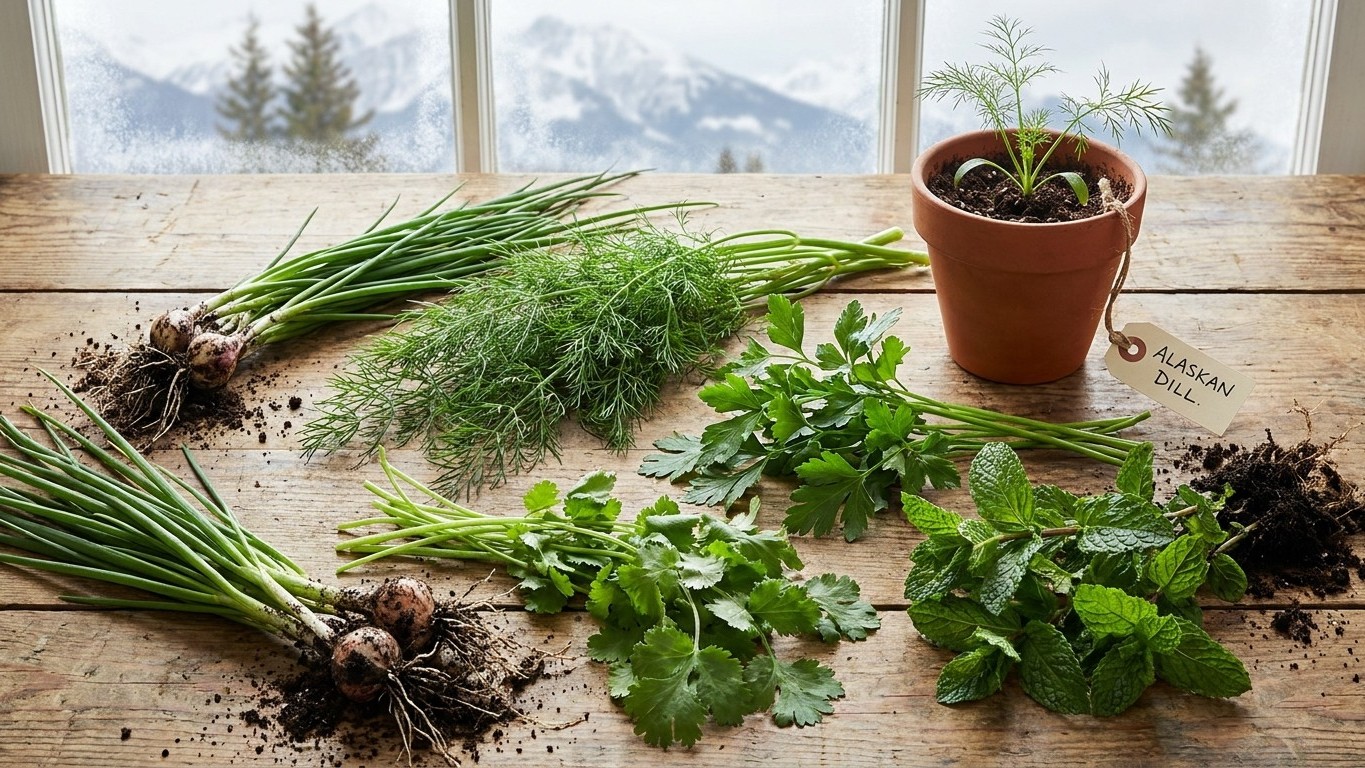

The short answer: stick to cold-hardy perennials like chives, thyme, and oregano for the beds that survive winter, and treat basil, dill, cilantro, and parsley as fast annuals sown after the soil warms. North Dakota’s short season and brutal winters make that split, not personal taste, the real deciding factor.
The short answer for North Dakota
North Dakota’s growing season runs on a narrow clock. Using the reference station’s 1991-2020 normals, the last spring frost falls between May 4 and May 15, and the first fall frost arrives between September 25 and October 5. Stack those windows together and the frost-free stretch lands somewhere between roughly 133 and 154 days, depending on which end of each range a given year lands on. That’s the number every herb choice has to answer to.
Fast, cold-tolerant annuals fit that window without complaint. Dill, cilantro, and parsley germinate in cool soil, shrug off a light frost on either end of the season, and mature well before the first fall freeze shows up. These are the herbs a North Dakota gardener can direct-sow with confidence.
Perennial herbs are a different calculation, because surviving one summer isn’t the test, surviving winter is. The coldest month here averages a daily minimum of just 0.2°F. That figure, not the record low and not a seasonal average, is what decides whether a perennial herb roots deep enough to come back. Chives sail through that number without issue. Cold-hardy strains of thyme and oregano generally do too, provided they’re planted in well-drained soil and given a winter mulch. Mint survives almost everywhere in this state, sometimes too well, since it spreads by rhizome and doesn’t care how cold the ground gets.
Heat-loving herbs are where the plan has to bend. Basil is not frost-tolerant at any life stage, so it has no business in the ground before the last spring frost window closes, and it needs to be started from transplants rather than direct-seeded if it’s going to produce a real harvest before the fall frost shuts things down. Given the hardiness zone range of 3a-4b for this state, under the USDA Plant Hardiness Zone Map’s 2023 update, rosemary and other tender perennials are functionally annuals here unless they’re wintered indoors or in an unheated but insulated space. The zone number reflects average annual extreme minimum temperatures, and it rules out leaving a Mediterranean shrub outside through a North Dakota January.
What will not work here
Rosemary outdoors, full stop. A coldest-month average minimum of 0.2°F is nowhere near what rosemary needs to survive a winter unprotected, and neither the mildest corner of the state’s 3a-4b range changes that math. The same goes for bay laurel and other woody Mediterranean herbs that are hardy only into zone 7 or 8 territory. If a gardener wants these, they need pots that come indoors before the first fall frost, not a spot against a south-facing wall.
Lemongrass and other tropical herbs fail for a simpler reason: the season is too short to matter how they’re wintered, because they never finish growing to begin with. A 130-to-150-day window doesn’t give a slow tropical grass enough warm days to bulk up, let alone survive the shoulder seasons on either end.
French lavender struggles here for a reason that has nothing to do with cold tolerance on paper and everything to do with what’s actually in the ground. Many North Dakota garden soils run heavy and hold spring moisture longer than lavender’s roots can tolerate, and a plant that’s rated hardy on a zone map can still rot at the crown before it ever gets the chance to face a winter. This is a drainage problem dressed up as a hardiness problem, and it trips up gardeners who checked the zone number and stopped there.
Basil planted too early is the most common self-inflicted failure. Sowing or transplanting before the last spring frost window has closed, particularly in a year that lands at the May 15 end of that range, means losing the crop to a frost event that was always statistically likely. The fix isn’t a better variety, it’s waiting.
Herbs that demand steady weekly watering also run into trouble in a state where wind and low humidity pull moisture out of soil fast between rain events. A weekly watering schedule that works in a wetter climate can leave basil and cilantro stressed and bolting here, because the soil dries out well before the next scheduled soak.
What changes across North Dakota
North Dakota isn’t a single garden, and its hardiness zone range makes that plain: the USDA map places the state across zones 3a through 4b. That’s not a rounding error, it’s a real spread in average annual extreme minimum temperatures from one part of the state to another, and it means a perennial herb that reliably overwinters in the mildest 4b pockets can die outright in a 3a location just a county or two away.
A gardener working in the colder end of that range should lean harder on the herbs that tolerate the coldest-month minimum with room to spare, chives and hardy mint chief among them, and treat marginal perennials like some oregano and thyme cultivars as candidates for extra mulch or a protected microclimate rather than an open bed. Someone gardening in the milder end of the state’s range has more room to experiment with borderline perennials, but still not enough to risk rosemary or bay outdoors year-round.
Elevation and local terrain shift things further within any given zone. A low spot that collects cold air overnight behaves colder than the map number for that area suggests, and a site with more thermal mass nearby, like near a foundation or a windbreak, can run noticeably milder. None of this shows up on a statewide hardiness map, because that map is built on one variable, average annual extreme minimum temperature, and doesn’t account for the microclimates layered on top of it.
This page can’t tell an individual reader which zone they’re standing in, and it shouldn’t try. What it can say is that the spread from 3a to 4b is wide enough to change which perennial herbs are a safe bet, and that the right move is checking the current USDA Plant Hardiness Zone Map for the specific address, not assuming a number based on the nearest city.
Where to check this for your own county
This page describes North Dakota at the state level, built from one reference station’s frost dates and one statewide hardiness zone range. A county recommendation will always beat a state one, because it accounts for local soil, local microclimate, and years of trial plots that a statewide normal simply can’t capture.
The place to find that county-level detail is North Dakota State University’s Extension service. Two things are worth pulling up there specifically. The first is a local planting calendar, which will reflect actual frost history for a given county rather than the airport-station range used on this page. If a county’s calendar runs later or earlier than the May 4 to May 15 window described above, that local figure should take priority every time.
The second is variety trial information. Extension programs regularly test herb and vegetable varieties under local conditions, and their published results say which oregano, thyme, or basil cultivars actually held up to a specific county’s soil and summer heat, rather than which ones simply survived somewhere in the state. That’s a different and more useful piece of information than a statewide hardiness range can offer.
Extension offices also field direct questions from gardeners, and a phone call or email describing a specific yard, its soil, its sun exposure, and its history of frost, often produces a more useful answer than any published calendar. That kind of specific back-and-forth is exactly what a state-level page like this one can’t replace.
Checking this against your own garden
Every date on this page is a probability built from thirty years of airport-station data, and a reader’s own garden will talk back with better information than any of it, provided they know what to watch for.
Soil warmth by feel is the first check. Herb seed, dill and cilantro especially, germinates poorly in soil that’s still cold to the touch even if the calendar says the last frost has passed. Pushing a bare hand into the top few inches of a bed and feeling for real warmth, not just above-freezing temperature, is a better signal than the date on a seed packet.
The first true leaves on a direct-sown herb are the second signal worth tracking. Seedlings that emerge and then sit stalled, showing only their initial cotyledon leaves for a stretch of unusually cool days, are reporting that the season is running behind the statewide average for that particular yard. That’s useful information for timing the next round of plantings or for deciding whether a tender transplant needs another week under cover.
The third is watching when perennial herbs like chives break dormancy and put up their first new growth in spring. A yard where chives are up and growing well before the stated frost window closes is running warmer than the reference station, likely thanks to a protected spot or good southern exposure, and that same yard can probably push basil transplants out a little earlier than the state’s average would suggest. A yard where chives lag is running colder, and that’s the signal to wait, regardless of what the calendar says the date should be.