
By November, North Dakota’s growing season is closed. The first fall frost typically lands between September 25 and October 5, so by the time this month opens, most gardens have already seen hard freezes for weeks. The only outdoor planting left is garlic and shallots if the soil is still workable, plus cold-frame and dormant options. Everything else moves indoors or waits for spring.
What goes in the ground in November

The decision here isn’t the calendar. It’s soil temperature and whether a shovel still goes into the ground without hitting concrete. Once the first fall frost has passed (and in most of the state that happened in late September or the first days of October), the window for direct-sowing or transplanting anything tender has already closed. That’s not a guess, it’s what the freeze-probability data for the region shows.
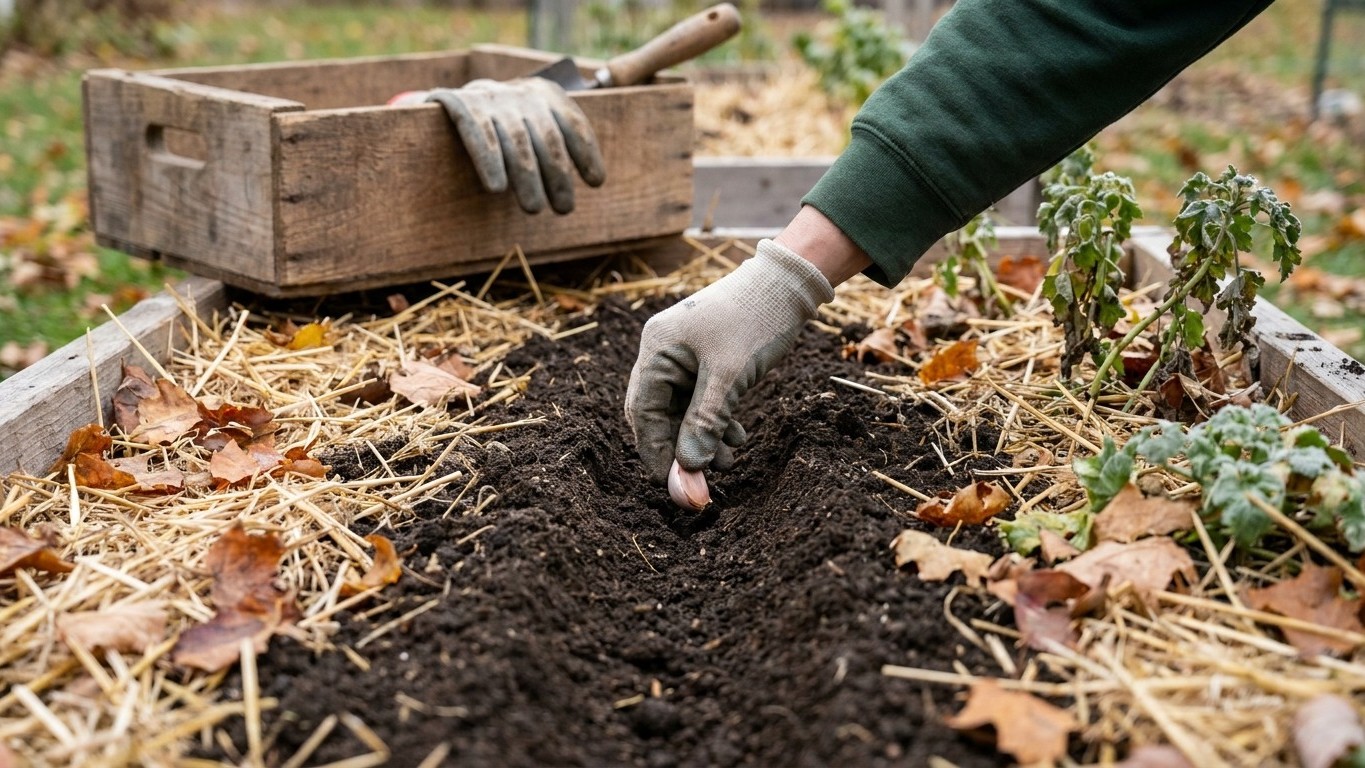
So the honest answer for most of November: nothing tender goes into open ground. But that’s not the same as nothing to plant. If a warm stretch has kept the topsoil workable, garlic cloves and shallot sets can still go in, ideally with a heavy mulch layer over them before the ground locks up for good. These are the two crops built for this exact timing: planted in fall, they root before freeze-up and push growth again in spring.
Beyond alliums, a few narrow options remain:
- Cold frames and low tunnels: spinach, mâche, and claytonia can still be seeded under cover if there’s enough residual soil warmth to germinate them, though germination slows hard below the mid-40s.
- Bare-root and dormant plantings: fruit trees, shrubs, and canes sold as bare-root stock can be planted while the ground is workable, then mulched heavily. Dormant wood doesn’t care about air temperature the way active growth does.
- Forcing crowns indoors: rhubarb and chicory roots dug now can be brought inside for forcing, giving fresh growth through winter with no outdoor risk at all.
Everything else, including peas, hardy greens started earlier in fall, and any of the crops that tolerate light frost, needed to already be in the ground weeks before November opened. Planting them now is not a gamble so much as a guaranteed loss. The USDA Plant Hardiness Zone Map places most of North Dorothy in zones 3a to 4b, based on average annual extreme minimum temperatures, which tells you how brutal the coldest nights get, not when it’s safe to plant. That’s a separate question the frost windows answer better.
What to start under cover
Indoor seed starting in November isn’t about this month’s weather. It’s about counting backward from next spring’s last frost, which for the reference climate station runs from May 4 to May 15. Anything started now is aimed at a transplant date months away, and the math matters more than the urge to get seeds in trays early.
Work backward from that frost window. Onions and leeks, which need 10 to 12 weeks of indoor growth before transplant, are the main crop where a November start makes sense for gardeners who want a long head start, since transplanting happens close to the frost date itself, not before it. Start them now and they’ll be a reasonable size by the time the ground firms up and warms in spring.
Most everything else (tomatoes, peppers, brassicas) should not go into trays yet. Start peppers 8 to 10 weeks before transplant and tomatoes 6 to 8 weeks before, counting from a mid-May transplant target. Starting them in November means 12, 14, even 16 weeks of indoor growth before they can go outside. That’s the first failure mode: seedlings get rootbound, leggy, and stressed long before the ground is ready for them, and a leggy tomato start rarely catches up once it’s transplanted.
The second failure mode runs the other direction, and it shows up more in December and January: gardeners who wait too long on onions and leeks and end up transplanting undersized starts that never bulk up properly in a short growing season. November is the sensible middle for that specific pair of crops. For nearly everything else, the seed packets stay closed a while longer, and the better use of this month is prepping the setup, lights, trays, and a heat mat, so the timing is right when it actually starts.
What is ready to pick
Outdoors, there’s little to nothing left standing by November across most of the state. Whatever wasn’t harvested before the ground froze solid is likely finished for the season. That’s just the reality of a first fall frost that lands in late September to early October, followed by weeks of hard freezes before this month even begins.
The exceptions are crops bred for exactly this punishment. Kale, especially the curly and Siberian types, can sit under snow cover and still be pulled for eating, since a blanket of snow actually insulates the leaves better than bare exposure to wind. Leeks behave the same way: heavily mulched rows can be dug out through much of the winter as long as the ground isn’t frozen too deep to get a fork into it. Neither improves in flavor from the cold, exactly, but both hold their quality far longer than most people expect.
Indoors, a cold frame with spinach or mâche seeded earlier in fall may still be producing small, slow harvests on sunny days when the frame traps enough heat to keep growth ticking over. Sprouts and microgreens on a counter are the most reliable fresh green this month, ready in one to two weeks with no outdoor risk at all.
The other job this month is inspection, not harvest. Stored squash, potatoes, and onions from earlier in the season need a hands-on check: soft spots, a sweetish smell, or sprouting eyes on potatoes all mean that item gets pulled and used now, before it spreads rot to the rest of the bin. A single soft squash left in a crate can take out its neighbors within a couple of weeks.
The jobs that matter this month
November carries more real work than most gardeners expect, and skipping it costs the following season, not this one.
Dormant pruning and tree care
Fruit trees and cane berries can be pruned once they’re fully dormant, and doing it now, rather than waiting for a late-winter thaw, means the cuts have all winter to callous over before spring sap flow starts. Wait too long and pruning cuts into active growth, which stresses the plant and invites disease into fresh wounds.
Seed orders and planning
Seed catalogs move fast. The most popular short-season varieties, the ones bred to mature before a mid-September frost risk, sell out earliest, and ordering in November beats competing with every other short-season gardener in the region come February. This is also the month to sketch next year’s rotation while this season’s layout is still fresh in memory, not guessed at from a faded notebook entry.
Soil, compost, and tools
A soil test taken now gives results back in time to plan amendments before spring planting, rather than scrambling in April. Turning a compost pile before it freezes solid keeps the decomposition process from stalling completely over winter. Cleaning and sharpening tools, then oiling metal parts before they sit unused for months, prevents rust that otherwise shows up as a nasty surprise in spring.
Beds, fencing, and stored crops
Raised bed frames and fencing take their hardest hits from freeze-thaw cycling over winter, so repairs made now, while the ground is still workable enough to reset a post, are far easier than the same repair attempted in frozen soil. And storage crops need a second look partway through the month: the check described above for squash, potatoes, and onions isn’t a one-time task, it’s a recurring one until spring.
What not to do in November
The most common mistake is trusting a warm afternoon over the calendar of freezes already behind you. A 55-degree day in early November doesn’t undo the fact that the first hard freeze already happened weeks earlier. Planting anything tender because the air felt mild is planting into soil that’s still cold at root depth, and the plant loses that fight regardless of how the afternoon felt.
A close second: uncovering mulched beds or cold frames after a mild stretch, only to have temperatures drop hard again days later. Mulch and row cover aren’t decorative, they’re doing a specific job of buffering soil temperature swings, and pulling them back exposes crowns and roots to a freeze they were otherwise protected from. If a warm spell tempts you to check on plants, vent the cover briefly rather than removing it.
Nitrogen timing trips people up too. Feeding nitrogen to fruit trees, shrubs, or perennial beds this late pushes soft new growth right before the coldest part of winter, and that new growth has no time to harden off before it gets hit by extreme cold. Trees don’t need encouragement to grow right now, they need to finish shutting down for the season. If a soil test flags a real deficiency, correct it with amendments meant for slow winter release, not a fast-acting nitrogen feed meant for active growing months.
Last, don’t ignore stored crops on the assumption that cool storage means safe storage. A basement or root cellar that’s cool but not cold enough still lets rot spread, and checking in only in spring means finding an entire bin gone rather than one bad potato caught early.
Checking this against your own county
Everything above is a state-wide starting point, not a fixed instruction for every yard in North Dakota. Elevation, proximity to the Red River Valley, and the real difference between the northern and southern parts of the state can shift these frost windows by a couple of weeks in either direction. A garden in a low-lying valley pocket can see frost settle in earlier and linger longer than one on higher, better-drained ground just a few miles away.
For a planting calendar built around actual county-level conditions, the NDSU Extension Service is the reliable next stop, along with the state’s own published planting calendar for more precise local timing.
Common questions
Can you still plant garlic in North Dakota in November?
Yes, as long as the ground is still workable and hasn’t frozen solid. Get it in with a heavy mulch layer as insurance once the ground does lock up.
Is it too late to start seeds indoors in November?
For most vegetables, yes, since counting forward to a May transplant date means seedlings would spend far too many weeks indoors and turn leggy. Onions and leeks are the main exception, since their long indoor growing period lines up well with a November start.
What can still be harvested from a North Dakota garden in November?
Very little outdoors beyond cold-hardy kale and mulched leeks. Cold frames may still offer small harvests of spinach or mâche, and indoor sprouts or microgreens are the most reliable fresh green this time of year.
Why does the USDA hardiness zone matter less than the frost dates for planting decisions?
The hardiness zone measures average annual extreme minimum temperature, useful for knowing which perennials survive winter, but it says nothing about safe planting windows. Frost date ranges answer that question directly.