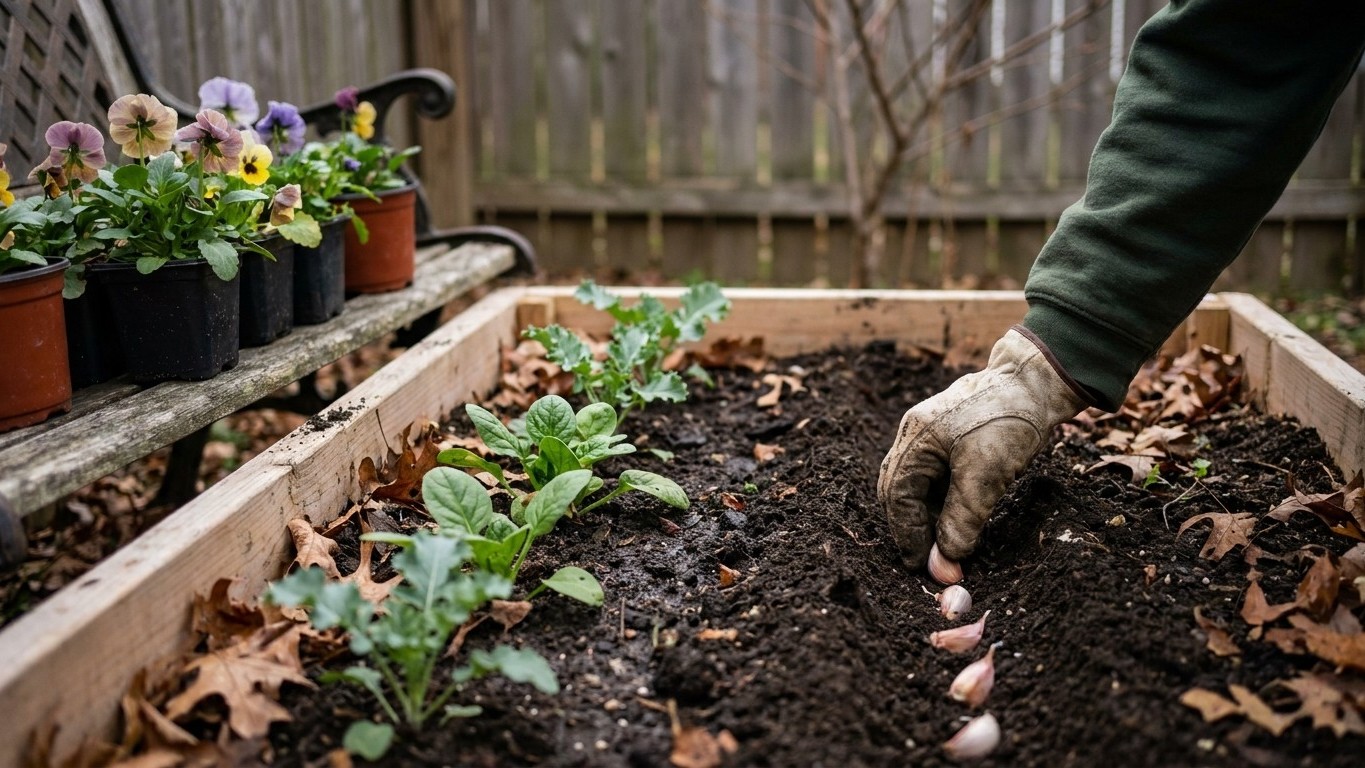

October in North Dakota is a garlic-and-cover month, not a transplanting month. The state’s first fall frost lands between September 25 and October 5 in the reference climate record, so by the time October opens, most gardens have already taken a hit. The open-ground work left is garlic and shallots, protecting what is still standing, and closing the season down right.
What goes in the ground in October

The calendar says October, but the soil doesn’t care what the calendar says. What matters is whether the ground is still workable and whether the crop can tolerate what’s coming. In North Dakota, the first fall frost arrives between September 25 and October 5 at the reference station used by NOAA’s Climate Normals, which means October usually opens after that first freeze has already happened, not before it. That flips the usual planting logic: this isn’t a month for starting anything tender. It’s a month for finishing.
Garlic and shallots are the exception, and they’re worth doing right. Both go into the ground four to six weeks before the soil freezes solid, giving roots time to establish before winter locks everything down. Push individual cloves root-down, two to three inches deep, then cover with four to six inches of straw or shredded leaf mulch once the ground has cooled but before it’s frozen hard. That mulch layer is what gets the cloves through a Zone 3a to 4b winter without heaving out of the soil.
What still has a shot
Spinach sown now, under a cold frame or low tunnel, can overwinter as small plants and resume growing at the first thaw, giving an early harvest well before anything direct-sown in spring is ready. Cold frames and low tunnels buy real insurance here, holding soil temperature a few degrees higher and cutting wind exposure, which matters more than the thermometer alone in this region.
Beyond garlic, shallots, and cold-frame greens, there isn’t much else that belongs in open ground in North Dakota during October. Padding the list with lettuce, peas, or brassica transplants would be setting the reader up to lose plants to a freeze that, statistically, has already arrived by the time they’d be sowing.
What to start under cover
With the outdoor season effectively closed, “starting under cover” in October means two different things: extending a harvest indoors, and getting ahead on next year’s color. Both are worth doing, and both run on a different clock than spring seed-starting.
Microgreens and sprouts are the fastest payoff. Sown on a windowsill or under a basic grow light, most varieties are ready to cut in one to three weeks, which means a tray started in early October is producing salad greens well before the month is out. There’s no frost math involved here at all; it’s simply a matter of light and steady moisture.
Herbs for the kitchen windowsill are the second easy win. Chives, parsley, and basil can all be started indoors now from seed or brought in as potted divisions from the garden before the ground freezes, giving fresh herbs through the darker months when nothing outdoors is producing.
The third project is forcing bulbs for winter bloom, amaryllis and paperwhite narcissus chief among them. These are potted indoors now specifically because they need six to ten weeks of growth before flowering, so an October start lines up with a bloom window in the heart of winter, when a patch of color indoors matters more than usual.
The failure mode to watch for isn’t starting too early, it’s forgetting that indoor light is weaker than outdoor sun. Seedlings and herb starts kept too far from a window or grow light stretch thin and pale fast. Rotate pots, keep lights close, and don’t expect windowsill starts to behave like a greenhouse crop.
What is ready to pick
October is a harvest deadline more than a harvest month. Anything tender still in the ground, tomatoes, peppers, winter squash left on the vine, needs to come in before a hard freeze settles in, since the first fall frost at the reference station has already fallen in the September 25 to October 5 window and a harder freeze typically follows within weeks.
Winter squash and pumpkins are ready when the rind resists a fingernail and the stem has started to dry and turn brown; cure them in a warm, dry spot for one to two weeks before moving to cool storage, and they’ll keep for months. Root crops, carrots, beets, potatoes, actually improve in flavor after a light frost touches the foliage, so there’s no rush to pull them the moment the temperature drops, only before the ground itself starts to freeze.
Brassicas follow the same rule. Kale, Brussels sprouts, and cabbage all sweeten after frost converts some of their starches to sugar, which is one of the few genuine upsides of a North Dakota October. Leave them standing as long as the leaves look intact.
Apples on late-ripening trees are the last outdoor crop of note; check for the fruit separating easily from the branch with a gentle twist. Once harvested, everything, apples, squash, roots, needs a dry cure and cool storage check within the next few weeks, since a single soft or bruised piece left among stored crops will spread rot through the whole bin.
The jobs that matter this month
The garden work that pays off in October has almost nothing to do with planting and everything to do with protection and planning. Skip it now, and the cost shows up as winter-killed perennials, rotted stored crops, or a spring scramble for seed varieties that sold out months earlier.
Dormant pruning on fruit trees and cane berries can begin once leaves drop and the plant has gone fully dormant, since cutting into active tissue invites disease in a way that cutting dormant wood doesn’t. Raspberry and currant canes, apple and plum branches, all take well to a clean cut now rather than waiting for late winter, when a thaw-freeze cycle can complicate the timing.
Tender bulbs, dahlias, gladiolus, cannas, need to be lifted before the ground freezes, since none of them survive a Zone 3a to 4b winter in the soil. Dig, brush off loose soil, let them cure for a few days out of direct sun, and store in slightly damp peat or sawdust somewhere cool and dark.
Soil testing is worth doing now rather than in spring, since results come back in time to plan amendments over winter instead of scrambling once the ground thaws. Turning finished compost into beds, cleaning and oiling tools before they sit unused for months, and repairing fencing or raised-bed frames all belong on the same list, because none of these jobs get easier once snow is on the ground.
Seed ordering deserves its own line item. The varieties that sell out first, particular tomato lines, open-pollinated squash, regionally adapted corn, tend to go early in the ordering season, and a gardener who waits until late winter to order often finds the short list already gone.
What not to do in October
The most common October mistake in North Dakota is trusting a mild afternoon over the calendar’s warning. A warm stretch in early October can feel like an invitation to leave tender crops uncovered one more night, but the first fall frost at the reference station falls between September 25 and October 5, meaning that by the time a gardener is enjoying a 60-degree afternoon, a freeze has often already occurred once and can recur with little notice. Cover tender plants at the first frost warning rather than waiting to see if the mild weather holds.
A related error is uncovering cold frames or low tunnels too early after a warm spell, assuming the season has turned a corner. It hasn’t. Ventilate on mild days if plants are overheating, but keep the cover in place and ready to close again by evening.
Fertilizing with nitrogen this late is another classic misstep. Nitrogen pushes soft new growth right when the plant should be hardening off for winter, and that new growth is the first thing a freeze destroys. If soil needs amending, do it with compost or a soil test’s specific recommendations, not a general nitrogen feed.
Watering habits need to shift too. Established perennials and newly planted garlic still need moisture going into winter, since a plant that goes into freeze-up bone dry is more vulnerable to winter injury, but that means a deep watering before the ground locks up, not the frequent light watering that suited summer’s heat.
Checking this against your own county
Every figure here comes from one reference weather station, and North Dakota is a big, uneven state. Elevation, proximity to the Missouri River or Devils Lake, and the simple distance between the state’s northern and southern counties can shift a frost date by a week or two in either direction, sometimes more. A garden in a low-lying valley will frost earlier than one on an open ridge just a few miles away.
Treat the dates and zone range in this article as a starting point, not a guarantee. For a planting calendar built around local conditions, the NDSU Extension Service is the reliable next stop, with county-level guidance that accounts for the variation this state-wide article can’t.
Common questions
Is it too late to plant garlic in North Dakota in October?
No, October is generally within the window, since garlic wants four to six weeks in the ground before a hard freeze locks the soil. If the ground is still workable, garlic can still go in; once it’s frozen solid, it’s too late for that season.
Can I still start a fall vegetable garden this late?
Open-ground fall crops are essentially closed out by October in North Dakota, since the first fall frost typically falls in late September to early October. Cold frames and low tunnels are the workaround, letting hardy greens like spinach hang on and even grow slowly through the cooler weeks ahead.
What USDA hardiness zone is North Dakota, and does it matter for October tasks?
North Dakota spans USDA zones 3a to 4b under the current Plant Hardiness Zone Map. It matters most for choosing which perennials, bulbs, and cane fruits can survive the winter outright without protection, information that shapes decisions like whether to lift dahlias or leave a shrub uncovered.
Should I cover my garden overnight if a frost warning comes in October?
Yes, for anything still producing, tomatoes, peppers, tender herbs. A sheet, frost cloth, or row cover thrown over plants before sunset traps ground heat and can buy several more days of harvest, even after the season’s first frost has already passed through.