
Apple maggot flies show up in North Dakota orchards from roughly mid-July through early September, with the heaviest activity in late July and August. The insect isn’t stopped by any single product but by timing sanitation, trapping and treatment to match when adult flies are actually active in your specific yard, not by a fixed date on a calendar.
That distinction matters more in North Dakota than in warmer apple-growing states. Cooler spring soil temperatures push adult emergence later here than in places like Michigan or New York, and a single hard frost in September can shut activity down almost overnight. Growers who spray on the same weekend every year, regardless of what’s happening in the orchard, either waste money spraying too early or miss the window entirely.
What Apple Maggot Damage Actually Looks Like

The adult fly itself is easy to miss. It’s about the size of a housefly, with a black body, white bands on the abdomen, and dark zigzag markings on clear wings. Most homeowners never spot the fly at all. They notice the damage instead, usually at harvest, when it’s too late to do anything about that season’s crop.
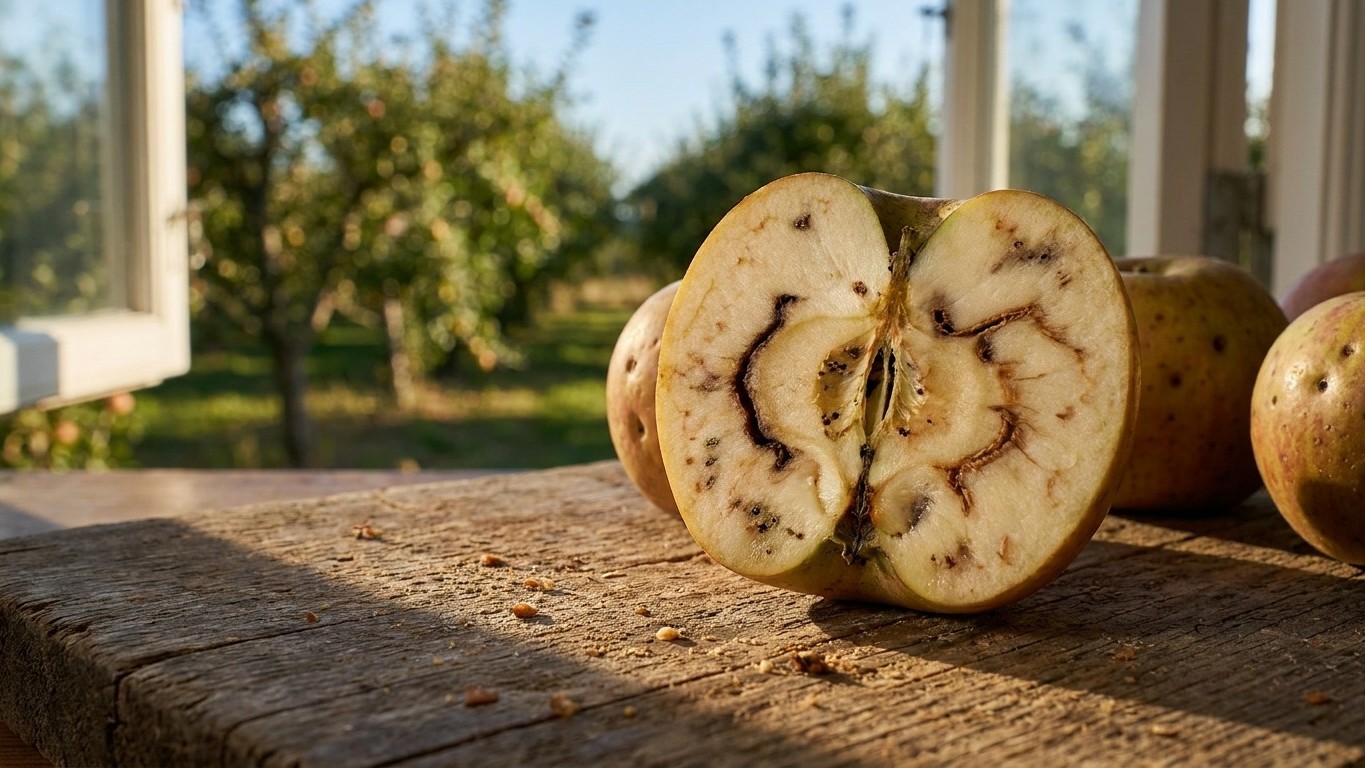
Female flies puncture the skin of developing apples to lay eggs, leaving small dimples that can look like hail damage or minor bruising early on. As the larvae hatch and tunnel through the flesh, the fruit develops brown, thread-like trails just under the surface. Cut open a badly infested apple and the flesh looks streaked with rot, sometimes with a slightly fermented smell. Infested fruit often drops early, weeks before it should, which is one of the more reliable field signs in a backyard tree.
This damage is cosmetic and internal at once. An apple maggot larva won’t hurt you if eaten, but nobody wants to bite into brown tunnels, and infested fruit stores poorly. Commercial growers reject it outright. Home growers usually end up composting a big share of the harvest in a bad year.
North Dakota’s Timeline: When the Flies Actually Emerge
Apple maggot overwinters as pupae in the soil beneath host trees, not as eggs or adults. Adults emerge from that soil once conditions warm up enough in early summer, then spend one to two weeks feeding before females start laying eggs. Extension entomologists across the northern Plains generally track emergence using accumulated degree-days above a 50°F base starting January 1, and first significant fly activity tends to show up once that count reaches roughly 900 to 1,000 degree-days. In North Dakota, that threshold is typically crossed sometime between early and mid-July, depending on the season and where in the state you’re located.
The Red River Valley, with its longer, more humid growing season, generally sees flies a little earlier than orchards in the western part of the state. Sites near shelterbelts, shade, or heavy mulch also warm more slowly than open, sun-exposed plantings, which can shift emergence by a week or more even within the same town. That’s why relying on a neighbor’s spray schedule, or a date printed in a gardening calendar written for a different region, tends to backfire here.
Peak fly activity in North Dakota usually runs through late July and August, tapering as temperatures cool in September. A hard fall frost effectively ends the season, though in a mild year some activity can straggle into early October. There’s one generation per year in this climate, unlike some southern states where partial second generations occur, which simplifies the control window considerably once you know when it opens.
Trap-Based Monitoring Beats Guessing
The most reliable way to know when flies are active in your own trees is trapping, not a regional average. Two trap styles work well for backyard and small orchard use.
Red sphere traps, coated in sticky adhesive and sometimes baited with an apple-scented lure, mimic a ripening fruit and draw females looking for a place to lay eggs. Yellow sticky panel traps baited with ammonium carbonate work through scent rather than sight, attracting both sexes searching for food. Many growers hang one of each per tree, or per small block of trees, on the sunny, outer edge of the canopy where flies are most likely to land.
Once you catch even one to five flies on a trap over the course of a week, that’s generally treated as the signal that egg-laying is underway or about to start. Extension guidance for northern apple-growing regions typically recommends beginning treatment within about seven to ten days of that first meaningful catch, then continuing coverage on a roughly two-week schedule through the rest of the flight period. Traps should be checked at least weekly and lures refreshed according to the product label, since a dried-out lure gives a false sense of security.
This approach turns a fuzzy calendar guess into an actual data point from the tree in question. It also prevents the common mistake of spraying in early June, before flies have even emerged, which does nothing but kill beneficial insects for no benefit.
What Actually Stops Apple Maggot in North Dakota Yards
No single tactic eliminates apple maggot on its own. The combination that consistently works involves reducing where pupae can survive, cutting off egg-laying opportunities, and timing any insecticide use to trap catches rather than habit.
Sanitation is the least glamorous step and the one most often skipped, yet it does the most long-term work. Apple maggot larvae exit dropped fruit and burrow into the soil to pupate, often within a few feet of the trunk. Picking up and disposing of dropped and infested apples at least once or twice a week during the fly season, rather than letting them sit under the tree, interrupts that cycle before larvae reach the soil. Fruit should be bagged and put in the trash or buried deeply, not composted in an open pile, since standard backyard compost rarely gets hot enough to kill the larvae.
Removing or managing nearby unmanaged host trees matters too. Wild apple trees, abandoned homestead plantings, and hawthorn shrubs all serve as reservoir hosts that keep local fly populations going even if a homeowner treats their own tree diligently. In rural North Dakota, where old farmstead apple trees are common along shelterbelts and property lines, these untended hosts are frequently the source of pressure on a well-managed backyard tree nearby.
Bagging Individual Fruit for Backyard Trees
For homeowners with just one or two trees who want to avoid spraying altogether, physical exclusion works surprisingly well. Slipping a nylon footie, a small mesh bag, or even a paper bag over individual young fruit shortly after petal fall, and leaving it in place until harvest, physically blocks females from reaching the fruit surface to lay eggs. It’s labor-intensive on a large tree but entirely practical on a backyard specimen with a manageable fruit load, and it produces maggot-free apples without any insecticide application.
Where spraying is used, timing it to trap catches rather than the calendar is what separates effective treatment from wasted product. Insecticides labeled for apple maggot on homeowner fruit trees, including spinosad-based products often marketed for organic use, need to be applied after the first trap catch and reapplied on a schedule that matches the residual period listed on the label, typically every ten to fourteen days through the flight period. Kaolin clay, applied as a fine particle film starting near egg-laying time, works differently by making fruit surfaces unrecognizable and unattractive to egg-laying females, and it’s a common choice for growers trying to avoid conventional insecticides.
No apple variety grown in North Dakota is truly resistant to apple maggot, but early-ripening varieties that mature and get harvested before peak fly pressure in August can sometimes dodge the worst of the damage simply by finishing their season early. Combined with weekly cleanup underneath the tree and a trap or two to flag when flies actually arrive, that timing advantage is often enough to keep a backyard harvest clean without much chemical input at all.