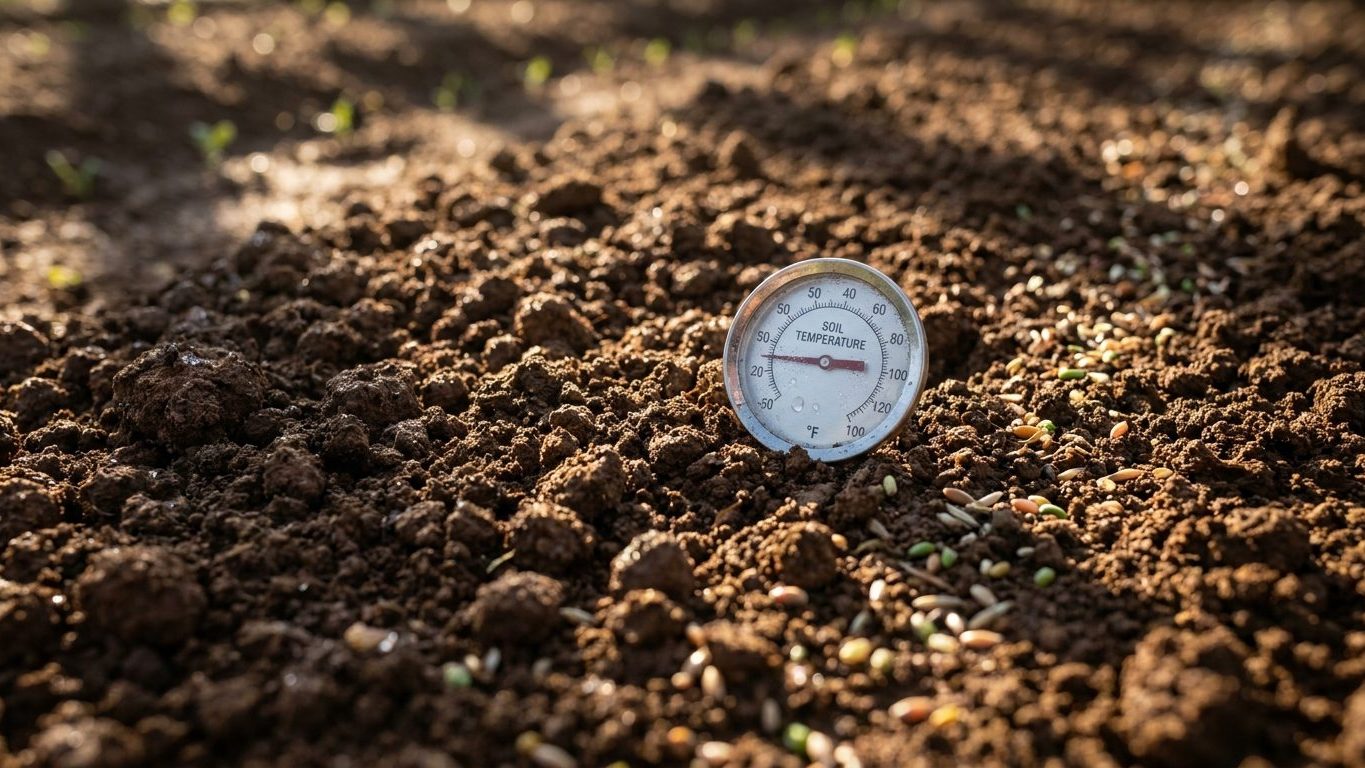

Cover crops in the Northwest Territories go in once the soil itself has warmed, which trails the average last spring frost of May 25 at Yellowknife by a couple of weeks. From there, the growing window runs only about 116 days to the average first fall frost on September 18, short enough that species choice, not timing tricks, decides success. Winter cold, not summer heat, is what actually shapes the list.
When the soil is warm enough in Northwest Territories
The average last spring frost at Yellowknife A, per Environment and Climate Change Canada’s 1981-2010 Climate Normals, falls on May 25. That number gets cited constantly, but it answers the wrong question for cover crops. Frost is a proxy for air temperature at a given moment. What a cover crop germinates into is soil temperature, and soil warms slower than air does, especially in a territory where the ground has spent five or six months frozen solid underneath a snowpack. In practice, gardeners in and around Yellowknife wait one to two weeks past that average frost date before they see soil conditions that support even cold-tolerant seed like oats or field peas.
That “average” also needs a warning label. An average frost date from Environment and Climate Change Canada is a midpoint, not a guarantee. In roughly half the years on record, the last frost at this station actually landed after May 25. Treat the date as the center of a window, not a green light, and hold seed in the bag if a cold snap is forecast even in early June.
A province is not one climate
Yellowknife A is a single weather station on the shore of Great Slave Lake. Communities to the north, at higher elevation, or further from the lake’s moderating effect run weeks behind this date, not days. If you’re gardening outside the immediate Yellowknife area, treat May 25 as an optimistic starting point and watch your own soil rather than the calendar. It’s also worth noting that these Canadian normals are drawn from the 1981-2010 period, while the American figures referenced elsewhere in this cover crop series use the more recent 1991-2020 US normals. The two aren’t measuring the same thirty years, so don’t stack a Northwest Territories date directly against a Montana or Minnesota one and expect a clean comparison.
Species selection matters more than date-chasing here. Cool-season cereal grains and brassica-family cover crops tolerate a marginal soil temperature far better than warm-season legumes do, and that tolerance buys a gardener real flexibility on either side of the average frost date. As for how much seed to put down, that number depends on the species, whether you’re broadcasting or drilling, and the source of the seed itself, a topic best settled with the Northwest Territories agriculture services rather than a generic rate pulled from a chart built for a different climate. This site’s approach to ending a cover crop stand is mechanical throughout: mowing, crimping, cutting, or simply letting a hard frost do the job, never a chemical termination.
How long the season lasts here
Subtract the average last spring frost (May 25) from the average first fall frost (September 18) at Yellowknife A and the growing window comes out to roughly 116 days, call it three and a half to four months. That’s a real number pulled from two real dates, both from the same Environment and Climate Change Canada station, and it’s short by almost any national comparison.
A window that length changes the whole strategy. In places with a six- or seven-month season, a gardener can run a spring cover crop, terminate it, grow a food crop, then sow a second cover crop in late summer before frost. In the Northwest Territories, 116 days generally covers exactly one useful planting. There usually isn’t enough runway left after a food crop matures to establish a second cover crop stand and let it build meaningful biomass before the ground freezes again. That doesn’t make cover cropping pointless here, it makes the single sowing decision more important, since there’s no second attempt to fix a mistimed one.
What the short window means for transplants
It also reshapes the transplant question. Where the season stretches long, gardeners can afford to start cover crop or vegetable transplants indoors and set them out after tearing back a mature cover crop stand, checking root development along the way without much time pressure. With roughly four months total, every week spent waiting on a transplant’s root system to catch up is a week subtracted from an already tight calendar. Direct-seeding cover crops as early as soil conditions allow, rather than starting them indoors, tends to make more sense in a season this short.
For gardeners weighing whether a second sowing is even worth attempting, or how to sequence a single cover crop stand around a short-season vegetable crop, the site’s succession sowing guide walks through how to judge that math for a given window length.
Heat and water in Northwest Territories
For most of the cover crop territories in this series, the conversation here turns to how many days a station logs above 90°F and how much rain falls over the summer, because those two numbers decide whether heat-loving species thrive or a wet summer breeds mildew. The Northwest Territories doesn’t give that conversation much to work with. Days above 90°F at Yellowknife are effectively a non-factor in the growing season, and this territory’s cover crop planning simply isn’t organized around summer heat stress the way a Kansas or Georgia garden’s would be.
The real variable here is winter, and it does almost all the work that heat and rainfall do further south. The average first fall frost, September 18 at Yellowknife A, sets the last realistic date to get a cover crop into the ground with enough time left to establish before hard freezes arrive. Miss that window and a fall-sown cover crop simply won’t put down enough root or top growth to be worth the seed.
The coldest month is the real filter
Then there’s the number that separates species that survive a Northwest Territories winter from species that don’t: a mean daily minimum of -21.1°F in the coldest month, per Environment and Climate Change Canada’s 1981-2010 normals. That’s not a record low or a one-night event, it’s the average low across the coldest stretch of the year, which is a far harsher test of winter survival. Paired with a Canadian plant hardiness rating of zone 1b for the Yellowknife area (a Canadian-system zone, built from seven climate variables and not convertible to the single-variable USDA zones used elsewhere on this site), the message is consistent: almost nothing planted in fall survives standing through this winter.
That’s not a drawback so much as a design constraint. In a mild territory, a species like oats can overwinter and turn into a weed problem the following spring because it never fully dies back. In a territory this cold, the same species winter-kills reliably, collapsing into a protective mulch by spring with no hand-pulling required. The cold that limits so much else in Northwest Territories gardening actually simplifies cover crop termination.
Which cover crops suit Northwest Territories
Given a roughly 116-day window and a winter cold enough to guarantee die-back on the right species, the logic here favors fast, cold-tolerant types over anything bred for a long season or a hot one.
| Crop type | Fit for a ~116-day window | Winter behavior at Zone 1b | Termination |
|---|---|---|---|
| Cereal grains (oats, spring rye) | Fast establishment, tolerates cool soil | Reliably winter-kills, leaving a flat mulch | Frost does the work; mow if regrowth appears |
| Brassicas (forage radish, mustard) | Quick top growth, good for short fall windows | Winter-kills; roots break down over winter | Frost; no cutting usually needed |
| Legumes (field peas, vetch) | Workable but slower to establish than cereals | Winter survival unlikely at this cold | Mow or crimp before frost if biomass is wanted first |
| Broadleaf broadcast (buckwheat, phacelia) | Very fast, good short-window filler | Killed by first light frost | Frost or hand-cutting |
Cereal grains and brassicas tend to be the more forgiving starting point in a territory this short and this cold, since both establish quickly in cool soil and both die back cleanly once the first hard frost arrives, saving the gardener a spring cleanup job. Legumes can still contribute, but they typically need more of the season to build the root mass and top growth that actually returns anything meaningful to the soil, and how much benefit that translates to depends on the species, how much biomass it built, and when it gets terminated, not on a fixed number.
None of this is a cue to reach for a specific variety by name. Seed companies trial cultivars against local disease pressure, local seed lots, and local soil conditions that a general guide like this one has no way to know. The Northwest Territories’ own agriculture services track what’s actually performed in territorial trials, and that’s the only recommendation worth following once you’re down to picking a named variety rather than a species type. The same office is the right place to settle on a seeding rate, since that number shifts with the species chosen, whether it’s broadcast or drilled, and the seed source itself.