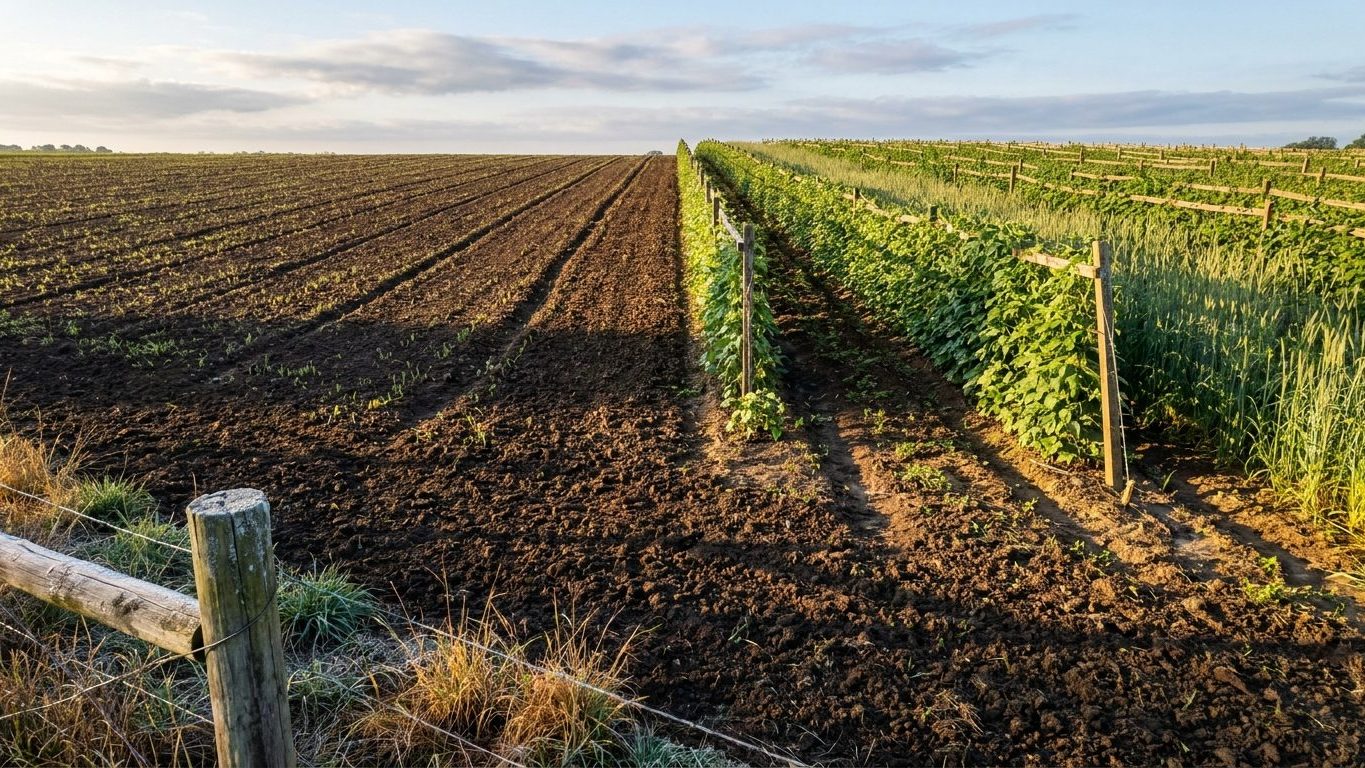

In the Northwest Territories, cover crops go into the ground only after the last spring frost, which lands around May 25 on average at Yellowknife. That date is a midpoint, not a promise, so most growers wait into early June before seeding. Fast-maturing species are the only realistic pick: the season closes with an average first fall frost on September 18, leaving roughly sixteen weeks of workable ground in a good year.
The short answer for Northwest Territories
Sow after the average last spring frost of May 25, and choose only cover crops that can finish their job before the average first fall frost of September 18. That gap, measured at the Yellowknife A station, runs about 116 days on the calendar. But an average frost date is exactly that: an average. Environment and Climate Change Canada builds these normals from three decades of record, and by definition half of those years saw frost arrive later than May 25 in spring, or earlier than September 18 in fall. Treat both dates as the center of a window, not the edge of a safe one, and push your seeding date a week or more later than the average if a hard freeze would wipe out a young stand.
The type of cover crop matters more here than almost anywhere south of the territorial border. With a frost-free window this short and this cool, slow legumes and warm-season grasses are off the table before you even open a seed catalog. What’s left are the quick covers built for cold, short summers: fast brassicas like forage radish or turnip, quick-germinating cereals like oats or spring-planted winter rye, and cold-tolerant peas sown as soon as the soil can be worked. These can establish, cover the ground, and be terminated or winter-killed inside the available window. Anything advertised as needing 90-plus frost-free days to reach full growth is being sold to a different climate.
The other number driving every decision here is the mean daily minimum of the coldest month: -21.1°F. That figure is not the record low for a bad winter, it’s the average low, night after night, through the coldest stretch. Any cover crop meant to overwinter in the ground has to survive that as a baseline, not an outlier, and very few can. This pushes most Northwest Territories growers toward covers that are seeded, grown, and terminated within the single short season rather than crops meant to carry through to spring.
What will not work here
Warm-season cover crops fail here almost by definition. Sudangrass, sorghum-sudangrass hybrids, and cowpeas are bred for long, hot summers and typically need 60 to 90 warm days just to bulk up before they’re any use as ground cover or biomass. The Northwest Territories doesn’t offer that combination of warmth and duration even in its best years. These species may germinate in a warm June, then stall the moment nights cool, leaving a thin, weedy stand instead of the dense mat a cover crop is supposed to provide.
Slow-establishing clovers run into the same wall from a different direction. Species that need a full growing season to build root reserves before facing a hard freeze are gambling against a fall frost that, in half the years on record, shows up before September 18. A clover seeded in June might barely reach flowering before the first freeze cuts it down, with none of the nitrogen-fixing payoff a longer season would deliver further south.
The overwintering trap
The instinct to let a cover crop stand through winter and resume growth in spring runs into the -21.1°F average minimum of the coldest month. That’s not a cold snap, it’s the typical low for weeks at a stretch. Species marketed as winter-hardy in milder zones, including some winter rye and hairy vetch varieties, are rated against far gentler minimums than this. Without reliable, deep snow cover acting as insulation, a stand that looks solid in October can be dead by March, and the grower finds out only when nothing greens up in May. Anyone planning to overwinter a cover crop here needs to confirm the specific variety’s cold tolerance against this exact figure, not against a general reputation for hardiness.
Dense, tightly spaced plantings also struggle, though for a different reason than in humid regions. The issue isn’t fungal disease from trapped moisture, it’s the short window for roots to spread and canopy to close before growth simply stops for the year. A cover crop that needs weeks of thickening after emergence to shade out weeds may run out of season before it ever gets there.
What changes across Northwest Territories
The 1b hardiness rating cited for this page comes from Natural Resources Canada’s Plant Hardiness Site and applies to Yellowknife, the reference city for these normals. It is a Canadian zone, built from seven climate variables rather than the single minimum-temperature measure the USDA uses, and NRCan is explicit that the two systems don’t convert cleanly: a single Canadian zone can overlap several USDA zones at once. Don’t try to translate 1b into a US zone number, and don’t assume it describes anywhere in the territory except the immediate area it was measured in.
That last point matters more in the Northwest Territories than almost anywhere else in this series. The territory stretches from roughly the 60th parallel up through the Arctic Archipelago, spanning tundra, boreal forest, and everything transitional between them. A hardiness rating taken at Yellowknife describes conditions well south of the territory’s northern communities, where growing seasons run shorter still and permafrost sits closer to the surface. There is no single sowing answer for “the Northwest Territories” as a whole, only a range that gets tighter and later the further north or the higher in elevation a garden sits.
A grower near the southern boundary, closer to the boreal forest zone, may see a spring frost-free date closer to the territorial average and can lean on the numbers in this article with reasonable confidence. A grower near the Arctic coast should assume a shorter, cooler, later-starting season than anything quoted here, and should treat every date on this page as an optimistic starting point rather than a target. Rather than guess at where a given garden falls on that spectrum, check the community’s position on NRCan’s plant hardiness map directly before picking a sowing date.
Where to check this for your own county
The Northwest Territories’ Department of Industry, Tourism and Investment maintains an agriculture service page at iti.gov.nt.ca/en/services/agriculture, and that’s the right next stop before finalizing any sowing plan. This page gives territory-wide figures pulled from a single reference station near Yellowknife. A community-level or regional recommendation from the territorial agriculture service will reflect local frost patterns, soil conditions, and the varieties that have actually been trialled nearby, all of which can shift the picture meaningfully from what’s written here.
Two things are worth hunting for on that site specifically. First, any planting or sowing calendar published for your region or community, since it will be built on more localized frost data than the single Yellowknife station referenced throughout this article. Second, any list of cover crop or forage varieties that extension staff or agronomists have actually grown and evaluated in the territory. A variety that performs well in trial plots near Yellowknife or Hay River carries far more weight than a seed packet’s generic hardiness claim, because it’s already been tested against this exact climate rather than a lab estimate of it.
This page exists to answer the territory-wide question: when does the season generally open and close, and what kind of cover crop fits inside it. A community-specific answer will always beat that. If the territorial agriculture service points to a different sowing window for your area, prioritize what they say over the averages presented here. This article is the starting point for a Northwest Territories garden, not the final word on any one plot of ground.
Checking this against your own garden
No calendar date beats what the ground is actually doing under your boots, and that’s especially true somewhere as variable as the Northwest Territories. Three simple checks tell you more than any average frost date ever will.
Push a finger a few inches into open soil before seeding. If it still feels cold and stiff, or if there’s resistance from ground that hasn’t fully thawed, the season hasn’t caught up to the calendar yet regardless of what the average date says. In parts of the territory sitting over permafrost, subsurface soil can stay cold and hard well after the surface looks ready, and seeding into it wastes seed on a stand that won’t establish.
Watch how fast weeds already growing nearby are moving. If native grasses and volunteer weeds nearby are still barely emerging, the soil temperature and daylight combination hasn’t reached the point where a fast cover crop like oats or forage radish will take off either. Vigorous weed growth around the plot is usually a better real-time signal than a calendar date pulled from decades of averages.
Finally, track how quickly a test patch of your chosen cover crop reaches its first true leaves after germination. A quick jump to true leaves within a week or so signals a warm enough microclimate to keep going on schedule. A stall at the seedling stage, with true leaves slow to appear, is the ground telling you this particular spot runs cooler than the territorial average, and that later sowings or a different variety might suit it better next year.