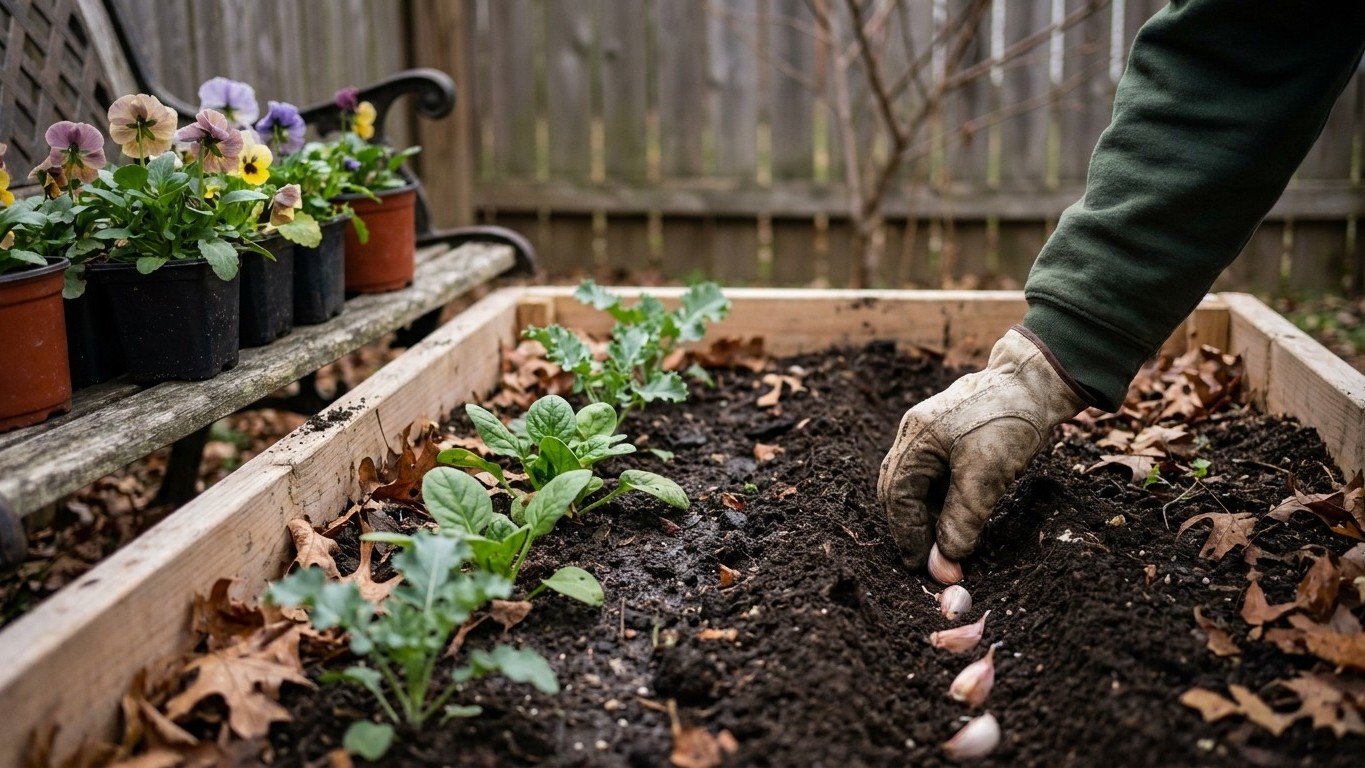

By October, the Northwest Territories has already passed its average first fall frost of September 18, so the open-ground planting window is closed for the season. The honest answer for most of the territory is that nothing new goes into unprotected soil this month. What still works: garlic and shallots pressed into ground that hasn’t frozen solid, bare-root and dormant plantings, cold frames, and forcing rhubarb or chicory indoors.
What goes in the ground in October

The calendar says October, but the ground doesn’t care about calendars. What decides whether anything can go into open soil is soil Temperature and where you sit relative to the average first fall frost, which at Yellowknife A runs to September 18. That date is a mean, not a guarantee, so in roughly half of all years frost arrives later, and in the other half it has already come and gone well before October opens. Either way, by the time this month starts, the territory’s brief outdoor growing window has closed for direct-sown or transplanted vegetables.
Say it plainly: this is not the month to be tucking lettuce starts or brassica transplants into a garden bed anywhere in the Northwest Territories. The soil is cooling fast, daylight is dropping, and anything tender put out now will not recover.
What still goes in
A short list of exceptions still makes sense while the ground remains workable, meaning not yet frozen solid at digging depth:
- Garlic cloves and shallot sets, pressed in for next season’s harvest, mulched heavily once planted
- Bare-root fruit trees, shrubs, and canes, if the nursery stock is dormant and the planting hole isn’t fighting frozen ground
- Cold frames or low tunnels holding over hardy greens like kale, spinach, or mâche that were already established before the frost arrived
- Forced rhubarb or chicory roots, lifted and brought indoors into darkness for a winter crop
The Canadian hardiness zone for the reference city is 1b under Natural Resources Canada’s system, a rating built on seven climate variables rather than the single minimum-temperature figure the USDA uses. It doesn’t convert cleanly to a USDA zone, so treat it only as a marker of how short and cold the growing season runs here, not as a number to compare against zones cited elsewhere.
What to start under cover
Counting backward from the average last spring frost of May 25, most transplants for outdoor beds should not be started until roughly six to eight weeks beforehand, which lands in late March or April, not October. Starting seed trays now for next spring’s tomatoes or peppers would leave them rootbound and leggy on a windowsill for five or six months before there’s anywhere outdoors to put them. That’s the first failure mode this month invites: starting too early because the calendar feels like it’s time to be doing something.
The second failure mode is the opposite mistake, waiting so long that a short-season crop never has time to size up once it finally goes outside after the May frost window closes. October doesn’t create that risk directly, but skipping seed planning now, when catalogs and stock are still full, is how gardeners end up starting six weeks behind next spring.
What legitimately belongs under cover this month is different from spring transplants. Microgreens and sprouts on a kitchen counter, a pot of chives or parsley pulled indoors before the cold locks in, or a tray of pea shoots for salads all make sense as October under-cover sowings, because they’re grown for harvest indoors, not for eventual transplant outside. Treat any seed packet dated for outdoor transplant as a spring job, and use this month for the crops that finish their whole life cycle under a grow light.
What is ready to pick
Outdoors, October offers little to nothing across most of the territory. Anything left unprotected in the garden by this point has almost certainly already been touched by frost, and root vegetables or hardy greens still standing should be lifted or covered before the ground locks up for good.
Cold frames and low tunnels are where the real harvest activity happens now. Kale, spinach, and other frost-tolerant greens tucked under cover before the September frost can keep producing leaves for cutting well into the month, especially on clear days when a frame traps enough heat to keep growth ticking over. Leeks left in the ground under a thick mulch layer can also be dug as needed, since they tolerate freezing soil better than almost any other vegetable.
Indoors, microgreens and sprouts fill the gap for households wanting fresh greens without relying on the garden at all, ready to cut within a week or two of sowing.
Stored crops need checking now too. Squash should feel firm with no soft spots near the stem, potatoes should be dry and free of green sprouting, and onions should have papery, tight necks. Pull anything showing soft rot or mold immediately, since one turning squash or onion in a bin will spread decay to its neighbors faster than most gardeners expect.
The jobs that matter this month
October in the Northwest Territories is a working month, even without much happening in open soil. The tasks done now, or skipped now, shape how next season starts.
Pruning, planning, and protection
Dormant pruning of fruit trees and cane fruit is best done once leaves have dropped and the plant has gone fully dormant, which for most of the territory means this month or shortly after. Cutting now, rather than waiting for a rushed job in spring, reduces stress on the plant and gives wounds time to callus before the coldest stretch sets in.
Seed ordering belongs here too. Suppliers selling into short-season, cold-hardy markets tend to sell out of the varieties bred for northern day lengths well before spring, so placing an order this month, while selection is still full, avoids settling for whatever’s left in March.
- Testing and amending soil pH and organic matter while beds are accessible
- Turning compost piles a final time before they freeze solid
- Cleaning and sharpening pruners, shears, and spades before they’re stored for winter
- Repairing raised bed frames, fencing, and cold frame glazing while the ground is still workable
- Planning next season’s crop rotation on paper, while this year’s layout is still fresh
None of these are filler jobs. A cracked cold frame panel or a fence gap left unrepaired now becomes a spring problem discovered too late, once seedlings are already inside and vulnerable.
What not to do in October
The most common mistake this month is misreading a mild stretch of weather as a second chance to plant. A few warm afternoons don’t change the fact that the average first fall frost has already passed and soil temperatures are trending one direction. Treat any tender crop still in open ground as living on borrowed time, not as evidence the season has more room left in it.
A related error is uncovering cold frames or pulling mulch off garlic beds after a warm spell, on the assumption the worst of the cold has passed. It hasn’t. Removing protection early exposes plants and cloves to the next hard freeze with no buffer, undoing weeks of protective work in a single cold night.
Feeding nitrogen this late is another misstep. Nitrogen pushes soft, leafy growth, and soft growth is exactly what winter cold damages fastest. Any fertilizing done now should favor phosphorus and potassium, which support root development and hardiness, not new top growth that has no chance to mature before freezing.
Finally, delaying garlic planting until the ground is fully frozen is a mistake that can’t be corrected once it happens. Get cloves in while a spade still goes into the soil, and mulch heavily immediately after.
Checking this against your own county
The frost averages and hardiness figures here describe conditions at one reference station, not the whole territory. Elevation, distance from large lakes, and the difference between southern and far northern communities can shift these windows by weeks in either direction. A community north of Great Slave Lake will not track the same as one closer to it.
Check local conditions against the Government of the Northwest Territories’ own agriculture resources through the Department of Industry, Tourism and Investment’s agriculture services for guidance tailored closer to your specific community.
Gardeners who plant by the Moon can check the October 2026 moon planting calendar, a tradition rather than a proven method.
Common questions
Can I still plant garlic in October in the Northwest Territories?
Yes, as long as the ground hasn’t frozen solid. Garlic and shallots are among the few crops that still go into open soil this month, and a heavy mulch layer after planting helps protect cloves through the winter ahead.
Is it too late to start seeds indoors in October?
For crops meant to transplant outdoors next spring, yes, that’s far too early given the average last spring frost of May 25. October is better suited to microgreens, sprouts, or herbs grown entirely indoors for kitchen use.
What can I still harvest outdoors this late in the season?
Very little without protection. Leeks mulched heavily and greens held in cold frames or low tunnels are the main exceptions still producing once the average frost date has passed.
Does the Canadian hardiness zone 1b mean the same thing as a USDA zone?
No. The Canadian system factors in seven climate variables, while the USDA system uses one. Natural Resources Canada is explicit that the two scales don’t convert directly, so this zone number shouldn’t be compared against USDA figures used elsewhere.
Elsewhere? See what to plant in October in every state and province.