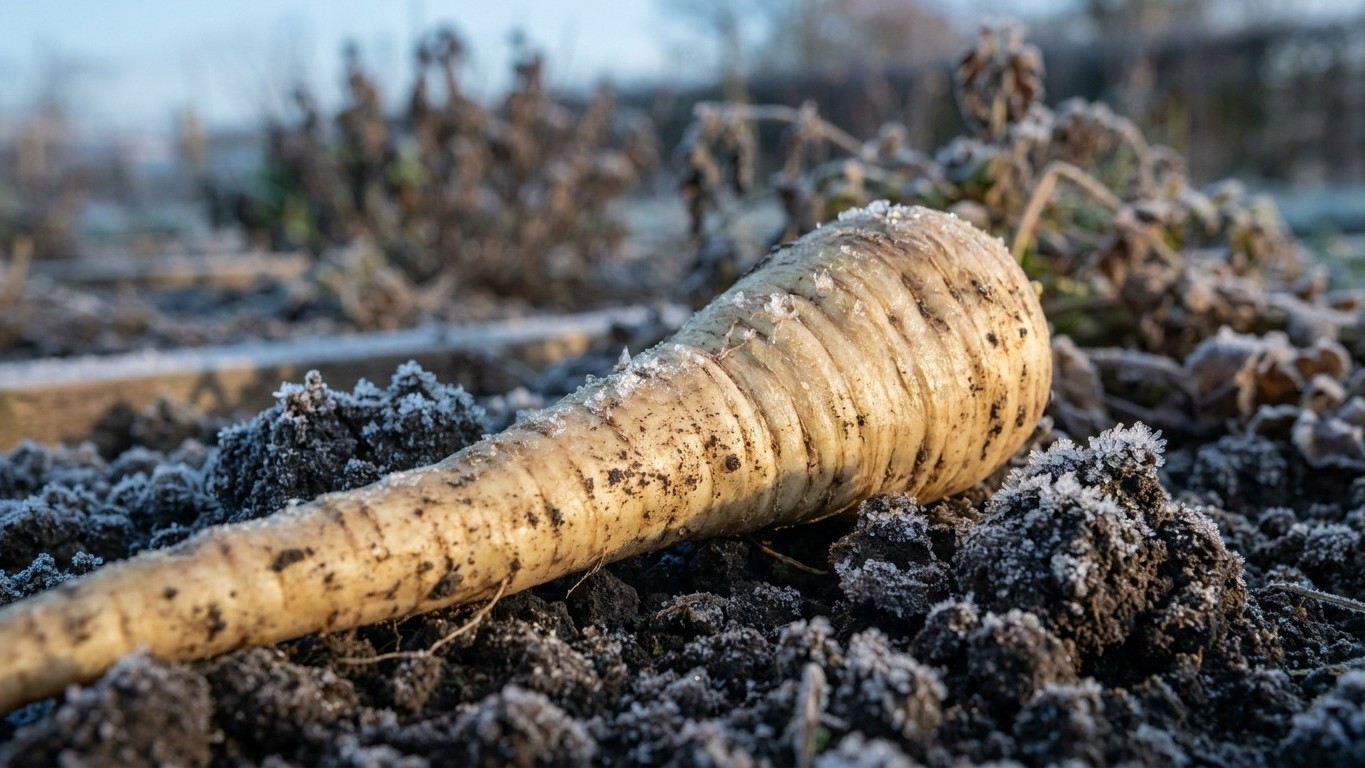

UAF Cooperative Extension documents four pests that actually reach parsnip roots and foliage in this region: aphids, cutworms, root maggots, and slugs. Cutworms hit first, right at germination. Root maggots do the damage nobody sees until harvest. Aphids build slowly through the short summer, and slugs show up whenever the soil stays wet. None of that changes with the calendar month, it changes with how close a garden sits to the region’s average frost dates.
Which pests attack parsnip in Northwest Territories
UAF Cooperative Extension, the University of Alaska Fairbanks Cooperative Extension Service, lists five pests for gardens across this northern region: aphids, cutworms, root maggots, slugs, and spruce beetle. That last one needs to come off the list right away. Spruce beetle attacks live spruce trees, boring into the bark, and it has no reason to touch a root vegetable bed. Anyone who spots bark-boring damage on a nearby tree and pins it on a struggling parsnip patch is chasing the wrong pest entirely.
The remaining four all have a plausible reason to be in a parsnip row, since parsnip is a root crop in the carrot family with soft foliage and a fleshy taproot, exactly the kind of plant these species already target elsewhere.
Aphids cluster on the undersides of leaves and feed on sap, which weakens foliage and can slow root growth if the infestation runs heavy through the growing season. Cutworms live in the top inch or two of soil and chew through stems at ground level, usually killing a seedling outright rather than just damaging it. Slugs graze on leaf tissue and prefer cool, damp conditions, which this region supplies for a good part of the season. Root maggot larvae tunnel straight into the taproot itself, the part of the plant anyone growing parsnip is actually trying to harvest, and that makes them the pest with the most direct impact on yield even though they’re rarely seen until the root comes out of the ground.
None of this is a long list, and that’s worth saying plainly. UAF Cooperative Extension documents these four as pests of concern for this kind of northern garden, not a dozen more. A short list is still the accurate list, and padding it with pests from warmer climates would only send someone looking for the wrong thing.
When each one shows up, and what it does first
Parsnip in this region gets sown as seed directly in the garden, and germination takes 14 to 21 days, according to Utah State University Extension. That stretch, right after sowing near the average last frost of May 25, is when cutworms do their damage. A seedling that emerges only to topple over or vanish overnight, cleanly severed at the soil line, points to cutworms feeding in that first vulnerable window before the stem toughens up.
Slugs tend to show up in that same early stretch and again whenever a stretch of damp, cool weather rolls through, which in this region can happen close to either frost date. The first sign is usually ragged holes chewed into young leaves, sometimes with a faint slime trail across the soil surface nearby, rather than any damage to the stem itself.
Aphids build up more gradually. They tend to become noticeable several weeks after seedlings are established, once there’s enough leaf surface to support a colony. Curled or yellowing leaf tips, a sticky residue on the foliage, or small clusters of soft-bodied insects on the underside of leaves are the first signs, and they tend to get worse the longer the colony goes unnoticed.
Root maggots are the trickiest of the four because there’s often no visible sign above ground at all. Adult flies lay eggs near the base of young plants not long after emergence, and the larvae feed inside the root as it thickens through the rest of the season. The first real evidence usually doesn’t appear until the root is pulled, close to the average first fall frost of September 18, when tunnels or scarring show up on a root that looked perfectly healthy from the top.
Telling the damage apart from everything else
Parsnip roots misbehave for reasons that have nothing to do with insects, and mixing those up wastes a season of guessing. A forked root has two separate possible causes here, heavy or stony ground and overwatering, and they are not the same problem, even though the result looks similar once the root is out of the soil.
| What you see | Could be a pest | Could also be | What settles it |
|---|---|---|---|
| Root splits into two or three forks | Not a pest sign | Heavy, stony soil, or too much water | Check soil texture and recent watering, not the plant |
| Seedling toppled, stem severed at soil line | Cutworm | Damage from hoeing or thinning too close to the stem | A clean chewed cut at the base points to cutworm |
| Ragged holes in leaves, slime trail | Slug | Hail or wind-whipped leaves | Slime trail present only with slugs |
| Curled, yellowing leaves | Aphid colony | Nitrogen shortage or drought stress | Check leaf undersides for insects before assuming a soil issue |
| Tunnels or scarring found at harvest | Root maggot | Cracking from rapid growth after rain | Tunnels run through the flesh; growth cracks stay on the surface |
| Bland or woody root at harvest | Not a pest sign | Pulled before enough frosty weeks passed | Sweetness comes from cold exposure, not from insect activity |
That last row trips people up more than any pest does. Parsnip sweetness comes from starch converting to sugar after several weeks of frosty weather, a trait of the crop itself and not something a hardiness zone rating can substitute for. A root that’s bland at harvest usually just needed more time in cold soil, not a pest inspection.
What actually works here, and what is a waste of time
On a season bounded by frost dates this early and this late, timing beats almost anything applied after the fact. Set a floating row cover over the bed the day the seed goes in the ground, not after seedlings appear, since cutworm and root maggot pressure both start right at emergence, before there’s any visible damage to react to. Covers also block adult flies from laying eggs near the stem base, which is the only real window to stop root maggot before the larvae are already inside the root.
Clearing garden debris and old mulch in fall removes shelter that both slugs and overwintering cutworm larvae rely on, and rotating root crops out of the same bed for a season or two reduces the number of root maggot flies that emerge nearby the following spring. Deep, loose soil, sandy where possible and double dug if it’s heavy, also reduces forking, which keeps roots straighter and less inviting to maggots working near the soil surface.
What doesn’t work is waiting until damage shows up to do anything. By the time root maggot tunnels are visible, the season is over for that root. Reactive treatments applied mid-season also run into the same problem as everything else in this region: there simply isn’t enough frost-free time left to recover a damaged crop and still reach the 100 to 120 days parsnip needs from seeding to harvest. Since no pesticide is named or recommended here, anyone dealing with a heavy infestation should check with a local extension contact about what’s actually registered for use in the territory before applying anything.
Where to check this for your own county
The pest list above comes from UAF Cooperative Extension, the nearest publicly documented source covering this kind of far-north garden pressure, since Northwest Territories doesn’t have its own territory-wide extension service publishing county-level pest data the way many U.S. states do. That matters because a pest list built for an entire territory or a neighboring state doesn’t describe what’s actually living in one yard. Soil, drainage, nearby vegetation, and even how close a garden sits to standing water all shift which of these four pests actually shows up and how badly.
Northwest Territories doesn’t divide into counties, so the closest equivalent is a local agricultural or horticultural contact tied to a specific community or region. Community greenhouses, territorial agriculture offices, and gardening groups tied to a specific settlement are usually the ones with a sense of what’s actually turning up in gardens nearby this season, rather than what’s documented at the scale of an entire territory or a neighboring jurisdiction.
Before assuming a pest is the cause of any damage, the next useful step is a call or visit to whichever local office covers gardening or agriculture in the area, with a sample or a clear photo of the damage in hand. That’s a faster path to an answer than working through a list built for a much larger area.
Common questions
Does the cold winter here kill off these pests over the year?
The coldest month’s mean daily minimum runs around -29.5°C at the Yellowknife reference station, which is severe enough to limit which pests can survive a winter buried in garden soil. That doesn’t rule out species that overwinter as eggs tucked into plant debris or that arrive fresh each year, so a hard winter reduces pressure without eliminating it.
Why do my parsnips taste bland even though nothing damaged them?
That’s almost never a pest problem. Parsnip needs several weeks of frosty weather after the root reaches size for starch to convert to sugar, so a root pulled right after the average first fall frost of September 18 may simply need more time in cold soil rather than any pest inspection.
Can parsnip seed go in the ground before the average last frost?
Utah State University Extension’s guidance covers sowing roughly 2 to 3 weeks before the last frost, and since germination itself takes 14 to 21 days, an early sowing timed against the average last frost of May 25 gives the crop more of its needed 100 to 120 days before the average first fall frost arrives.
How would I know root maggots are in the bed before I pull the roots?
There usually isn’t a reliable above-ground sign. Watching for small flies active near the soil surface early in the season and rotating root crops out of a bed that had maggot damage the previous year are the more practical steps, alongside checking with a local agricultural contact about what’s been seen nearby that season.