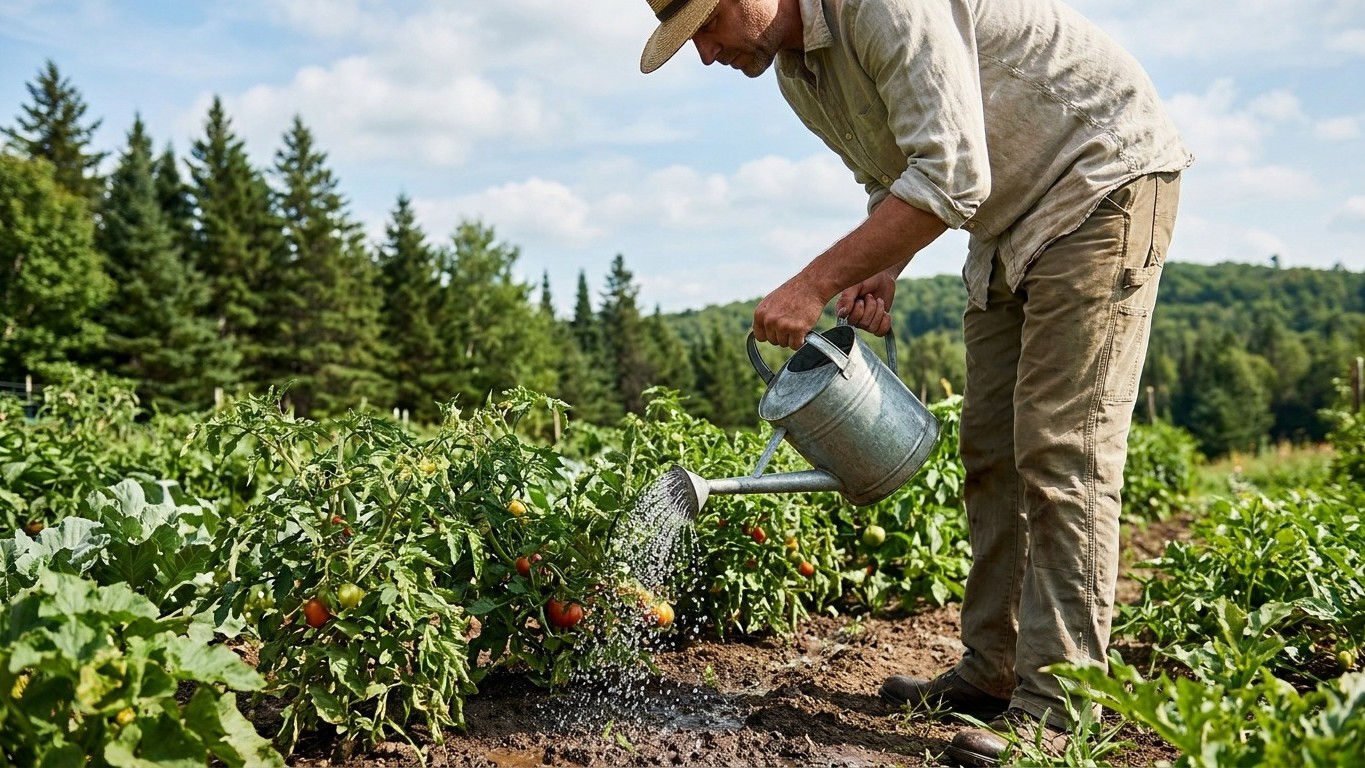

Northwest Territories gardeners face a paradox: summers rarely turn scorching, but the driest month still delivers barely more than an inch of rain. That gap is exactly why a watering can matters here. The trick isn’t fighting extreme heat, it’s compensating for a sky that simply doesn’t deliver enough, on a schedule that fits a growing season measured in weeks, not months.
What changes here

Two numbers set the whole picture for a Northwest Territories garden bed. The driest summer month, June, averages just 1.14 inches of rain. And the number of days a year that reach 90F sits at 0.0. Put those together and you get a climate that almost never punishes a plant with heat, but also almost never gives it enough water from the sky alone during its driest stretch.
Do the arithmetic and the gap becomes concrete. A vegetable bed or a perennial border generally wants around an inch of water a week to keep growing without stress. June has roughly four and a third weeks in it, so spreading that 1.14 inches evenly works out to about a quarter inch of rain arriving per week during the driest month, not the full inch a bed is asking for. That leaves close to three quarters of an inch a week that has to come from a hose or a watering can, not from the clouds.
The 0.0 days-above-90F figure changes how that gap plays out rather than closing it. In places where afternoons regularly clear 90F, that same shortfall gets worse fast, because heat pulls moisture out of soil and out of leaves at a much higher rate. Here, without that heat load, water that does go into the ground tends to stay put longer once it’s there. The deficit is real, but it’s a slow leak rather than a flash flood of evaporation. That distinction matters for how often a gardener needs to show up with a hose, and it’s the reason a rigid rule borrowed from a hotter state doesn’t transfer cleanly to a Northwest Territories yard.
None of this is a forecast for any single backyard. A slope, a windbreak of spruce, or a spot shaded most of the afternoon will all shift the real number up or down. A rain gauge staked into the actual bed, checked weekly through June, July and August, tells a gardener more than any regional average ever will.
How to water when it matters
The method that works in this territory rests on three habits: water deeply, water infrequently, and water at the base rather than overhead. Each one exists for a reason tied to what’s happening underground and in the leaf, not just tradition.
Deep watering pushes moisture down several inches, which trains roots to follow it downward. Shallow, frequent watering does the opposite: it keeps roots parked near the surface, right where the top layer of soil dries out fastest between waterings. Morning watering matters because it gives foliage the whole day to dry off before nightfall, and because less of the water is lost to evaporation compared with the heat of midafternoon. Watering at the base rather than spraying leaves keeps foliage dry, which matters more in a cool, often damp climate where fungal problems already have an easier time getting started.
Before turning on a hose, check the soil rather than the calendar. A finger pushed two inches down, or a trowel lifted at the edge of the bed, tells the truth that a dry-looking surface can hide. If that spot two inches down feels cool and damp, skip watering that day even if the top crust looks parched.
Soil texture changes the rhythm of all this. Sandy ground drains fast and holds little, so it needs shorter, more frequent soakings to keep roots from drying between waterings. Heavy clay holds a week’s worth of water in reserve, but watering it again before it has had the chance to dry invites root rot rather than growth. A gardener working clay should lean toward the infrequent side of the method; one working sand should lean toward frequent.
- Check soil moisture two inches down with a finger or trowel before watering, not by looking at the surface.
- Water at the base of the plant, early in the morning, rather than overhead in the evening.
- Apply enough to soak the top six to eight inches of soil in one session, roughly one inch of water, as a starting point to adjust from.
- Space sessions two to four days apart on sandy soil, and stretch to once a week or slightly beyond on heavy clay, depending on how quickly that two-inch check comes up dry.
- Treat that one-inch, twice-weekly starting point as a baseline to be corrected against your own soil and weather, not a fixed rule.
What goes wrong
“I water a little every day to keep it looking fresh”
A daily light sprinkle wets only the top inch or so of soil. Roots follow the water they can reach, so they stay shallow, right in the zone that dries out fastest once the sun comes back out. The plant ends up more fragile, not less, because it never develops the deeper root system that would let it coast through a few dry days without stress.
“I water in the evening so it doesn’t evaporate”
Evening watering does save some water from evaporation, but it leaves leaves wet through the cool overnight hours, exactly the conditions fungal diseases favor. In a climate that already runs cool and damp for long stretches, that’s an added risk this territory doesn’t need. Morning watering trades a small evaporation loss for a much lower disease risk.
“It rained yesterday, so I skipped watering”
A summer shower can look generous while wetting only the top half inch of soil, especially if it fell fast and mostly ran off rather than soaking in. The fix is the same finger check described above: two inches down, not a glance at wet pavement, decides whether that rain actually reached the roots.
“I watered heavily, so I don’t need to check again for a while”
Because this territory logs 0.0 days a year at or above 90F, evaporation demand stays low most of the summer. That makes overwatering the costlier mistake here, more than the scorched, bone-dry bed a hotter state might worry about. A bed that’s watered again before it has had a chance to dry, especially on clay, drowns roots quietly, and the damage often shows up as wilting that looks like thirst, tricking a gardener into watering even more.
“I never bothered with mulch”
Bare soil left exposed loses moisture straight back to the air, undoing part of whatever was just applied. A two-to-three-inch layer of mulch slows that loss and evens out the swings between a soaking and the next check of the soil.
Local help
For planting advice suited to Northwest Territories growing conditions, the NWT agriculture services page is the starting point. Watering restrictions, where they exist, are set locally and can change through the season, so check with your own municipal water provider or district office for current rules before planning a watering schedule around them.
Common questions
How often should I water during a Northwest Territories dry spell?
Start with roughly one inch of water every two to four days on sandy soil, stretching toward once a week on heavy clay, then adjust based on a finger check two inches down rather than a fixed calendar.
Does the lack of 90-degree days mean watering matters less here?
No. It means the risk shifts from heat stress toward overwatering, since low evaporation lets excess moisture sit in the soil longer than in hotter regions.
Is June really the driest month to plan around?
Yes, at 1.14 inches of average rainfall, June comes in lower than both July (1.61 inches) and August (1.55 inches), based on the Yellowknife reference station’s 1981-2010 normals.
Should I trust a rain gauge over these regional averages?
Yes. Regional normals describe what a reference station usually sees over decades, not a specific yard’s slope, shade, or soil. A gauge on your own bed, checked weekly, gives the number that actually matters for your watering decisions.