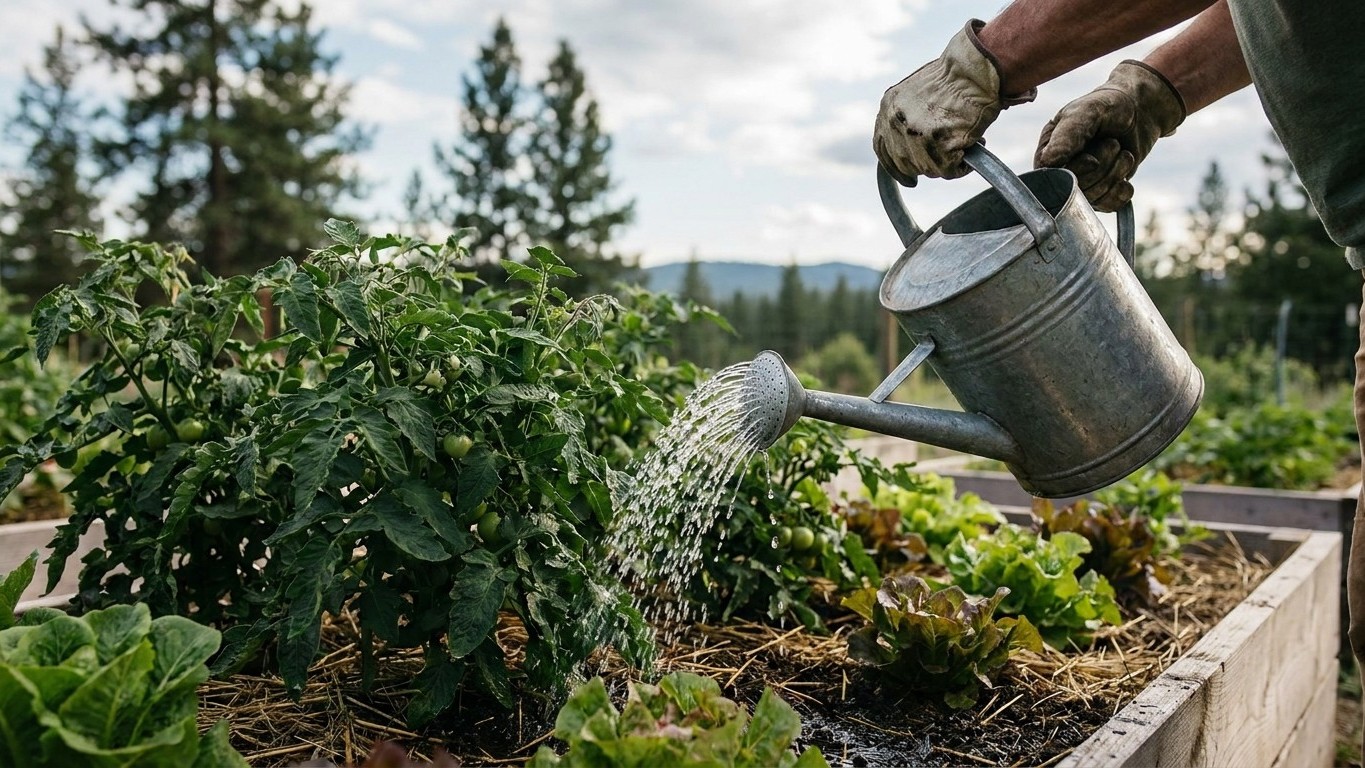

In the Northwest Territories, a vegetable bed needs about three-quarters of an inch of hand-watering a week during June, the driest stretch of summer, because the sky itself delivers only a small fraction of what a growing plant asks for. That gap has to be filled with a can or a hose, not left to chance, even though this is a region that almost never turns dangerously hot.
What changes here

June, the driest summer month at the Yellowknife reference station, brings 1.14 inches of rain. The same station logs 0.0 days a year at or above 90F. Put those two numbers side by side and you get a clear picture: the ground is short on water, but the air is almost never hot enough to pull that water back out in a hurry. That’s a different problem than the one gardeners face in a hot, dry state further south, where low rainfall and high heat compound each other. Here, the deficit is real, but it isn’t racing against evaporation the way it does elsewhere.
The arithmetic makes the deficit concrete. A bed wants roughly an inch of water a week to keep roots supplied. June has 30 days, so 1.14 inches of rain spread evenly works out to about 0.038 inch a day, or 0.266 inch across a seven-day week. That leaves about 0.734 inch, call it seven-tenths of an inch, that has to come from a watering can or a hose if the bed is going to get its full inch. July (1.61 inches) and August (1.55 inches) narrow that gap slightly, but June is the month where the shortfall bites hardest.
The FACTS available for this territory don’t include a measured sand-and-clay reading, so no specific soil percentage should be assumed here. But the general rule still applies: the same 0.734 inch behaves differently depending on what’s underfoot. On loose, fast-draining ground it soaks through and disappears within a day, which means more frequent, lighter refills. On heavier, slow-draining ground the same water sits near the surface for days, which means fewer visits with the can but a real risk of drowning roots if the gardener doesn’t check first. Since no territory-specific soil figure is on record, the safest move is to test your own bed with a trowel before settling on a schedule.
How to water when it matters
The method that fits the Northwest Territories climate is deep, infrequent watering at the base of the plant, done in the morning, and each piece of that method exists for a reason tied to how a plant actually uses water. Deep watering pushes moisture down to where roots can follow it, training them to grow downward instead of staying shallow. Infrequent watering gives the surface time to dry between soakings, which is what pushes roots deeper in the first place. Watering at the base, rather than overhead, means the leaves stay dry, which matters because wet foliage sitting overnight is what fungal disease needs to take hold. Morning watering lets any splash on the leaves dry off in daylight hours before evening humidity sets in, and it also means the plant has moisture on hand before the day’s growth begins.
Checking soil moisture at the surface tells a gardener almost nothing useful. A bed can look dry on top and still be damp two inches down, or look fine on top while the root zone underneath is bone dry. The reliable test is a finger or a small trowel pushed down about two inches: if it comes out dry at that depth, it’s time to water; if it’s still cool and damp, wait.
Where soil is loose and fast-draining, that two-inch depth dries out sooner, so the rhythm should lean toward shorter, more frequent soakings rather than one big weekly dose. Where soil is heavy and slow to drain, the same water can sit for the better part of a week, and watering again before it has dried invites root rot rather than growth.
A practical starting sequence for a June bed in this territory looks like this:
- Check soil moisture two inches down with a finger or trowel before deciding to water at all.
- If dry at that depth, apply water at the base of the plant until roughly 0.734 inch has been delivered for the week, split across one or two sessions rather than a daily trickle.
- Water in the early morning, before the day warms up, so any incidental splash on foliage has hours to dry.
- Recheck at the two-inch depth two to three days later and adjust the next session’s timing based on how fast that spot dried.
Treat that 0.734-inch figure as a starting point tied to the June rainfall normal, not a fixed rule. Your own soil, your own container mix if you’re growing in pots, and your own microclimate will shift it in one direction or the other.
What goes wrong
Watering a little every day
A light daily sprinkle wets only the top inch or so of soil, which is exactly where it does the least good. Roots follow the water, so if water never goes deeper than an inch, roots stay shallow, brittle, and quick to stress the moment a watering gets skipped. Deep, less frequent watering is the fix, not more frequent light ones.
Watering the leaves in the evening
Wetting foliage as the sun goes down leaves it damp all night, and damp foliage overnight is close to an invitation for fungal disease. Morning watering at the base avoids this entirely.
Trusting a summer shower
A passing rain shower can look like it solved the problem while wetting only the top half-inch of soil, which evaporates again within a day. The only way to know is the same finger test at two inches deep, checked after the rain has passed, not before.
Skipping mulch because the air feels cool
With 0.0 days a year above 90F here, it’s tempting to assume evaporation isn’t a real concern and skip mulch altogether. But wind and low humidity still pull moisture out of bare soil even without extreme heat, and skipping mulch means giving back some of the water just carried out by hand. A couple of inches of mulch over the root zone slows that loss regardless of the thermometer.
Local help
The Government of the Northwest Territories agriculture services offer region-specific growing guidance for gardeners in the territory. Watering restrictions, where they exist, are set at the community or district level and change from year to year, so check with your local water provider before setting a fixed watering schedule.
Common questions
How often should I water a garden bed in the Northwest Territories during summer?
Check soil moisture two inches down every two to three days during June, the driest month, and water deeply at the base whenever that spot is dry, rather than watering on a fixed daily calendar.
Do I need to worry about heat stress on plants here?
The reference station records 0.0 days a year at or above 90F, so extreme heat stress is not the main risk in this territory. The bigger issue is a genuine rainfall shortfall in June that heat alone doesn’t create.
What’s the best time of day to water in the Northwest Territories?
Morning, at the base of the plant. It gives any incidental moisture on the leaves time to dry before evening, which lowers the risk of fungal disease overnight.
Is a rain barrel worth setting up given the summer rainfall here?
With only 4.3 inches of rain across June, July and August combined, a rain barrel fills slowly, but it still captures water that would otherwise run off, and every inch collected reduces what has to be carried by hand during the driest weeks.