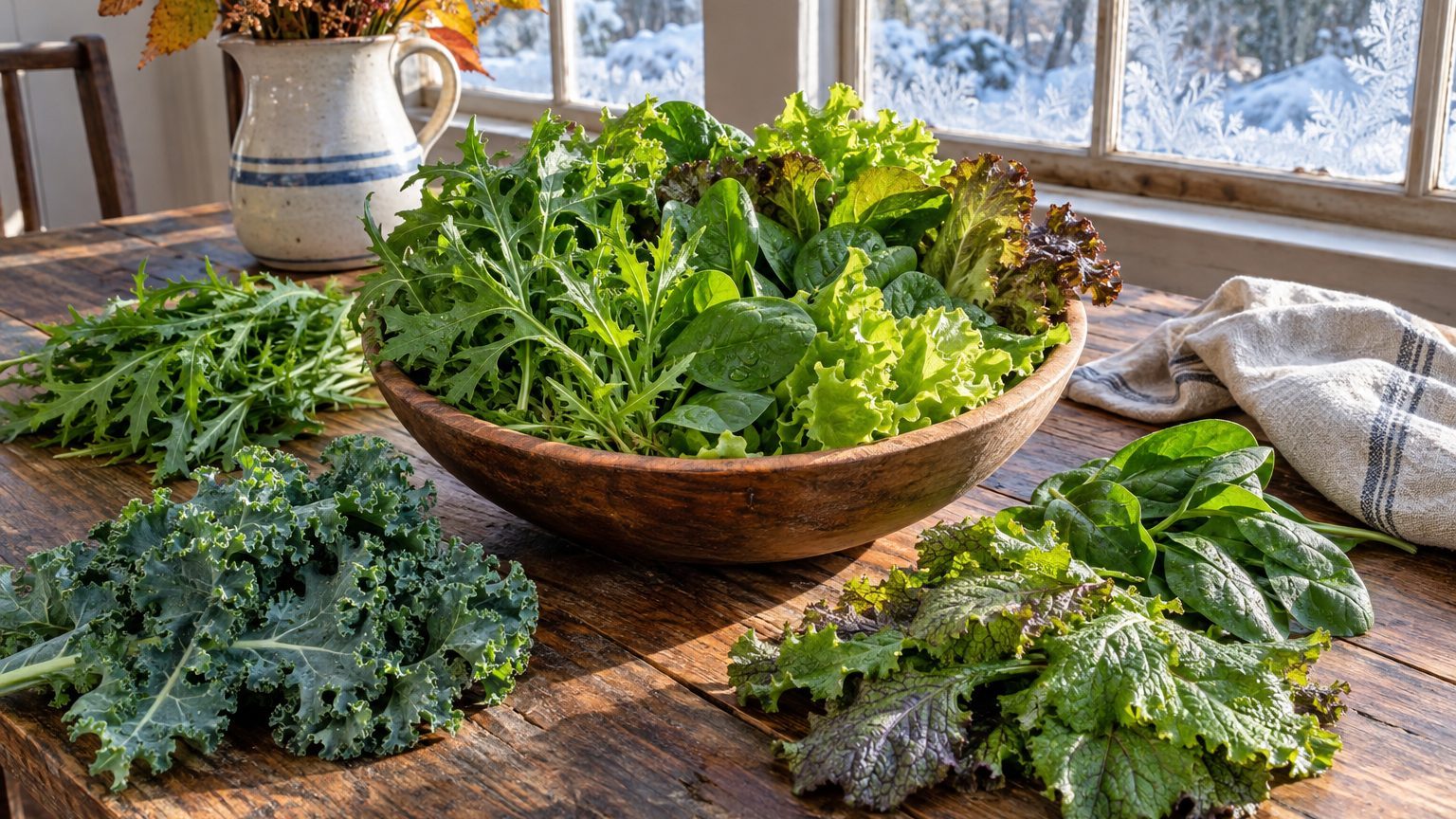

In the Northwest Territories, the best winter salads are fast, cold-tolerant leaf greens such as spinach, arugula, mizuna, tatsoi, mâche, and claytonia, cut young. Slow heading types lose the race with the frost. Nothing grows outdoors through the deepest part of winter here, so a winter salad means one of two things. Either it is a late fall harvest of hardy greens, or it is a crop raised under cover with heat and light.
The short answer for Northwest Territories
Pick quick leaf greens and harvest them as baby leaf. The reference station at Yellowknife has about 116 frost-free days between the mean last spring frost on May 25 and the mean first fall frost on September 18. That is enough for a spring sowing and a late-summer sowing of fast greens, but not for anything that needs months to form a head.
Both dates are midpoints. In one year out of two, the last spring frost falls later than May 25, and in one year out of two, the first fall frost arrives earlier than September 18. Plan around the edges of the window. The dates also come from the Yellowknife A station and from 1981-2010 normals, which are older than the 1991-2020 normals used for most US stations. Northern and upland districts run weeks behind them.
Cold decides the rest. The mean daily minimum of the coldest month at Yellowknife is -29.5 °C (-21.1 °F). Hardy salad greens will not carry through weeks of that outdoors, so winter harvests come from protected space.
| Type | Examples | Verdict for the Northwest Territories |
|---|---|---|
| Quick baby-leaf greens | Arugula, mizuna, tatsoi, leaf lettuce | Best bet. Sow in spring and again in late summer. |
| Hardy spinach and kale | Spinach, baby kale | Good. They shrug off light fall frosts and stretch the harvest. |
| Cold-season specialties | Mâche, claytonia | Good, especially under cover. Slow to start but happy in cool soil. |
| Heading chicories | Radicchio, escarole, endive | Poor outdoors. They need a longer season than the territory gives. |
Where do winter salads actually grow in the territory?
Three places work. The first is the open garden in September and early October, where spinach, kale, and arugula keep producing after the first light frosts. The second is a cold frame or low tunnel, which adds a few weeks at each end of the season but cannot hold greens through midwinter. The third is a heated greenhouse or an indoor shelf under grow lights, which is the only route to fresh salad in December and January, when daylight is short and the sun stays low.
For the full picture of how these options fit together, see Winter Salads for Northwest Territories Gardens. Exact sowing windows are laid out in When to Sow Winter Salads in Northwest Territories.
What will not work here

Heading chicories fail first. Radicchio, escarole, and Belgian endive are the classic winter salad crops in milder places, and they need a long stretch of growth to form a dense head or a usable root. With about 116 frost-free days at the reference station, and a frost that can come early in half the years, they stall before they size up. Leave them to growers with a heated greenhouse.
Overwintering in the open ground fails too. In much of the US, gardeners sow mâche or spinach in fall and pick through winter under a row cover. That works where the coldest month averages a few degrees below freezing. Here the coldest month averages a nightly low of -29.5 °C, which means many nights run colder. A layer of fabric or a plain cold frame cannot buffer that, and the plants die or sit frozen until spring.
Late sowings fail quietly. A row of greens seeded in August has to reach picking size before the mean first fall frost on September 18, while the light is still strong. Frost arrives earlier than that date in half of all years. Light fades quickly through September, so growth slows long before the ground freezes. Sow in midsummer instead, or move the late crop under cover.
Spring sowings have a different problem. Around the June solstice the days are very long, and that pushes spinach, arugula, and lettuce to bolt, meaning they send up a flower stalk and turn bitter. A spring row that is not cut young often goes to seed within weeks. Heat is not the trigger here. Day length is. Cut baby leaf early and often, and favor varieties sold as slow to bolt.
Finally, an unheated hoop house will not give December salad. Inside, it drops close to the outdoor temperature on long winter nights, and the low winter sun gives plants too little light to grow. Greens hold on, if they survive at all, but they do not produce.
What changes across Northwest Territories
There is no single answer for the territory. The reference city sits in Canadian hardiness zone 1b, according to Natural Resources Canada’s 1991-2020 normals. That is the Canadian system, built on seven climate variables, and it does not convert to a USDA zone. It describes one city, not the whole territory.
The Northwest Territories stretches from the Alberta border near the 60th parallel to the Arctic coast beyond the Arctic Circle. Season length, frost dates, and winter cold all shift along that run. Southern communities near the border have more room for a second sowing. Gardeners farther north work with a shorter window, an earlier first frost, and ground that may sit on permafrost, so raised beds and greenhouses carry more of the load.
A reader in the north should shift three things. Start spring sowings later, since the soil thaws late. Finish fall sowings earlier, since frost comes sooner. Lean harder on fast types such as arugula, mizuna, and spinach and drop anything slow. A reader in the south can try mâche and claytonia in a cold frame and stretch the fall harvest a little further.
Local ground matters as well. A south-facing wall, a sheltered yard, or a raised bed of imported soil can run warmer than open land a few hundred yards away. To see where your community falls, check the Natural Resources Canada plant hardiness map rather than borrowing a number from a neighbor or from a US chart.
Where to check this for your own county
The Northwest Territories has no counties, so the nearest equivalent is your community or region. The place to start is the agriculture section of the Government of the Northwest Territories Department of Industry, Tourism and Investment. It is the territory’s agriculture office, and it is the closest thing to an extension service for northern growers.
Look there for two things. The first is a planting calendar written for your community or the nearest one, with local frost dates rather than the Yellowknife midpoints. The second is the list of varieties that have grown well in gardens and greenhouses near you. If your community is not listed, call or email the office and ask what growers nearby have had success with.
A recommendation for your own community beats a territory-wide one every time. A statement that covers the whole territory has to average a southern river valley and a coastal tundra town, and no garden sits at that average. Treat the guidance here as the territory-level starting point, then adjust to what local growers and the agriculture office report.
Checking this against your own garden
Your own observations outrank every date above. Three are worth watching, and none needs an instrument.
The first is soil warmth by feel. In spring, push your fingers a few inches into the bed. If the soil still feels cold and damp after several seconds, seeds will sit and may rot, so wait. A bed that feels workable a week before your neighbor’s is in a warmer microclimate, and you can sow earlier there.
The second is the first true leaves. A seedling first shows two rounded seed leaves, then the first leaves that look like the adult plant. If seedlings stall at the seed-leaf stage for weeks, the soil or light is too cold, and your sowing date was early. If true leaves appear within days, the spot suits the crop.
The third is the first flower stalk on spinach or arugula. When the stalk appears, day length has beaten the variety. Note the date and sow earlier or cut younger next year. A spot that bolts weeks later than the rest of your yard has more shade or cooler soil.
Common questions
Can you grow salad greens outdoors all winter in the Northwest Territories?
No. The coldest month at Yellowknife averages a nightly low of -29.5 °C, which is too cold for salad greens in open ground, even under a cover. Winter salads come from a heated greenhouse or an indoor setup with grow lights. Outdoors, the harvest runs into early fall.
Which greens are fastest for a fall harvest?
Arugula, mizuna, tatsoi, and baby leaf lettuce reach cutting size quickest. Spinach and baby kale take a little longer but tolerate more frost, so they keep producing after the first cold nights.
Is the Canadian hardiness zone the same as a USDA zone?
No. Zone 1b is a Canadian zone, based on seven climate variables, while USDA zones rest on one. Natural Resources Canada states that the two systems have no simple conversion. Use the Canadian map for Canadian gardens.
Are the Yellowknife frost dates good for the whole territory?
They describe one station. The mean last spring frost of May 25 and mean first fall frost of September 18 are midpoints from 1981-2010. Northern and upland areas run weeks behind them, and in any one year the frost can fall on either side of those dates. Keep a notebook of your own first and last frosts, since a few years of them will beat any published number.