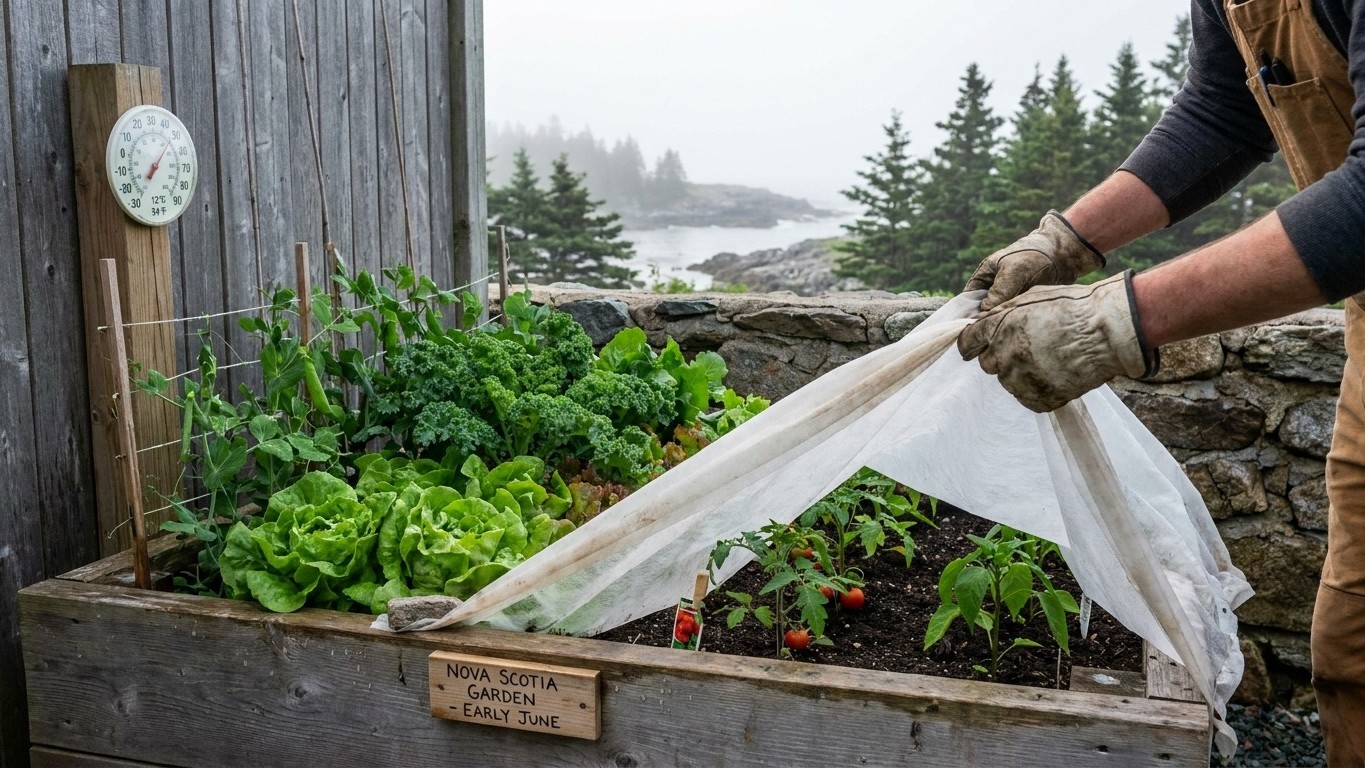

Nova Scotia gardeners work with a frost-free window of roughly five months, cool summers that rarely stress plants with real heat, and winters mild enough by Canadian standards to keep hardiness zone 6b workable near the coast. That’s the frame. Everything else, what you plant and when, follows from those three numbers.
How long your season really is

Three figures decide what you can grow here, and they belong together before anything else gets said:
| Measure | Value |
|---|---|
| Canadian hardiness zone (reference: Halifax) | 6b |
| Average last spring frost | May 7 |
| Average first fall frost | October 18 |
Do the subtraction and you get about 164 days between the average last spring frost and the average first fall frost. That’s the frost-free window, and it’s the single number that governs a Nova Scotia garden more than any other. It’s long enough for the full run of cool-season crops, and for warm-season crops with a fast finish. It’s tight, sometimes too tight, for the slow ones. A 100-day watermelon or a long-season dry corn variety asks for a season this territory doesn’t reliably hand out, though quicker-maturing varieties can still work, and Growing Sweet Corn in Nova Scotia covers the varieties and timing that make it possible. That’s not a reason to skip them, but it is a reason to treat them as a gamble rather than a plan, and to lean on transplants, row cover, or a warm microclimate against a south-facing wall if you try anyway. Peppers sit in that same gray zone between doable and demanding, and Growing Peppers in Nova Scotia covers the transplant timing and heat tricks that make them work here. Pumpkins fall into a similar timing puzzle, and Growing Pumpkins in Nova Scotia covers the varieties and spacing that suit this window, while knowing When to Carve a Pumpkin in Nova Scotia can help you plan backward from Halloween to a realistic planting date. Potatoes, by contrast, sit comfortably within this window with room to spare, and Growing Potatoes in Nova Scotia lays out the planting and hilling schedule that fits the local frost dates. Beets are another crop that fit easily into this frost-free stretch, and Growing Beets in Nova Scotia walks through the succession sowing that makes the most of it. Carrots are just as forgiving of this timeline, and Growing Carrots in Nova Scotia covers the sowing dates and soil prep that suit the local season. Asparagus takes a different approach entirely, asking for patience over a couple of seasons before the first real harvest, and Growing Asparagus in Nova Scotia explains how to establish a bed that will keep producing for years within this climate. Spinach thrives in this same cool window and can even be sown before the last frost, and Growing Spinach in Nova Scotia covers the timing that keeps it from bolting once the days lengthen. Parsnips share that same tolerance for the local frost dates, and Growing Parsnips in Nova Scotia explains the long, slow growing period and sweetening frost that make them a natural fit for this window.
The zone number needs a word of its own. 6b here is a Canadian hardiness zone, built from seven climate variables measured at the Halifax reference station, not the single-variable USDA zone used everywhere else on this site. Natural Resources Canada is explicit that the two systems don’t convert cleanly: a Canadian zone can span nine different USDA zones depending on which variable is driving the number. So treat 6b as a description of what survives winter near Halifax, not as a stand-in for a US zone map, and don’t assume a plant tag written for the American system tells you anything precise about this one.
The frost dates deserve the same caution. May 7 and October 18 are averages pulled from 1981-2010 Canadian Climate Normals at Halifax Stanfield, which means by definition that in roughly half of all years, frost arrives later in spring or earlier in fall than these dates suggest. An average is not a guarantee and it’s certainly not a safe date to plant by. It’s a midpoint. Gardeners who plant tender starts on May 7 every year without checking a forecast are gambling on the coin flip going their way, and inland or upland parts of the province, away from the moderating coast, typically lag those dates by more.
What the summer does to a garden here
Zero. That’s the average number of days per year that reach 90°F at the Halifax reference station. For a gardener, that single fact reshapes the whole growing season, because heat isn’t just a comfort issue for plants, it’s a hard mechanical limit. Tomatoes stop setting fruit and drop their flowers once temperatures push past roughly 90°F for stretches of time. Lettuce, spinach, and other cool-season greens bolt to seed and turn bitter under sustained heat. Nova Scotia’s summers essentially never cross that threshold, which cuts both ways.
On one side, this means the province mostly avoids the brutal midsummer stall that gardeners farther south deal with every July and August, that dead stretch where cool-season crops are simply impossible to grow and even heat-lovers need daily watering just to hold on. Here, there’s no real need to split the year into two shoulder seasons around a scorching middle. Lettuce, spinach, peas, and brassicas can often run later into summer than a US gardener further inland would expect, and a second sowing of quick greens in August is a reasonable bet rather than a lost cause.
On the other side, that same absence of heat means the warm-season crops that depend on real warmth to ripen, peppers, eggplant, melons, long-season tomatoes, are working against a ceiling as much as a calendar. A frost-free window of roughly 164 days sounds generous until you realize much of it passes without the heat units these plants actually want. That’s the honest trade of a maritime climate: reliably mild instead of anything hot, one continuous season rather than two, but a season that rewards cool-tolerant crops more than it rewards anything craving a real summer swelter.
Winter sits at the other extreme. The coldest month’s average daily minimum runs 13.3°F, mild enough by Canadian standards to keep zone 6b viable near the coast, but still cold enough that anything not rated hardy to that threshold, or left unprotected over winter, is not a safe bet without mulch, a cold frame, or a spot against a heat-holding wall.
What tends to go wrong in Nova Scotia
No Canadian provincial extension service publishes its own home-garden pest list for Nova Scotia, so the pests below come from the University of Maine Cooperative Extension, just across the border, where the same climate and the same insects show up on the same kind of vegetable and ornamental beds. The biology crosses the border freely; the calendar and the official guidance don’t always. Treat this as a heads-up, not a diagnosis, and confirm anything you find with Nova Scotia’s own agriculture office.
- Colorado potato beetle, appears as adults right after plants emerge in late spring and keeps producing generations through midsummer, stripping potato and related foliage down to the stems.
- Cabbage maggot, the early-season threat, laying eggs at the base of young brassica transplants in spring when soil is still cool and wet, with larvae tunneling into roots.
- Squash vine borer, shows up as moths in early summer and the larvae bore into stems by midsummer, causing sudden wilting of an otherwise healthy-looking squash plant.
- Spotted wing drosophila, a late-summer and early-fall problem, attacking ripening soft fruit like raspberries and blueberries just as they’re ready to pick.
None of these call for a fixed spray calendar, and nothing here should be read as one. Timing and treatment depend on the crop, the pressure in a given year, and often the specific variety planted, which is exactly the kind of detail worth checking against a current, local source before acting.
Where to check before you plant
Everything above is a provincial average built from one reference station near Halifax, and Nova Scotia runs from the Fundy shore to Cape Breton highlands, several degrees of latitude and more than one microclimate along the way. A planting calendar written for Halifax’s frost dates can run two or three weeks off for a garden in the Annapolis Valley or up on the Cape Breton plateau, in either direction depending on elevation and distance from the coast.
The Nova Scotia Department of Agriculture is the right first stop for provincial guidance, and from there, a county or regional office can narrow the picture down to conditions closer to your own soil and elevation. Local frost records, local pest reports, and local soil test recommendations will always beat a province-wide average once you’re deciding what to put in the ground this particular spring.
What to Plant Once You Know Your Season
Once the frost dates and cold averages make sense, the next question is what actually grows well under them. If you’re after alliums that need a real winter to split into cloves, growing garlic in Nova Scotia covers planting dates and varieties suited to the fall frost timing at Halifax Stanfield. For the lawn itself, Nova Scotia lawn care works from the same cool-season reality — a place with zero days a year above 90°F and winters that stay well below freezing overnight, so the grass and the feeding schedule have to match that. And if tomatoes are the goal, growing tomatoes in Nova Scotia starts from the frost-free window itself, the roughly 163-day stretch at Halifax that decides when transplants go in and how much ripening time they’ll get before the season closes.