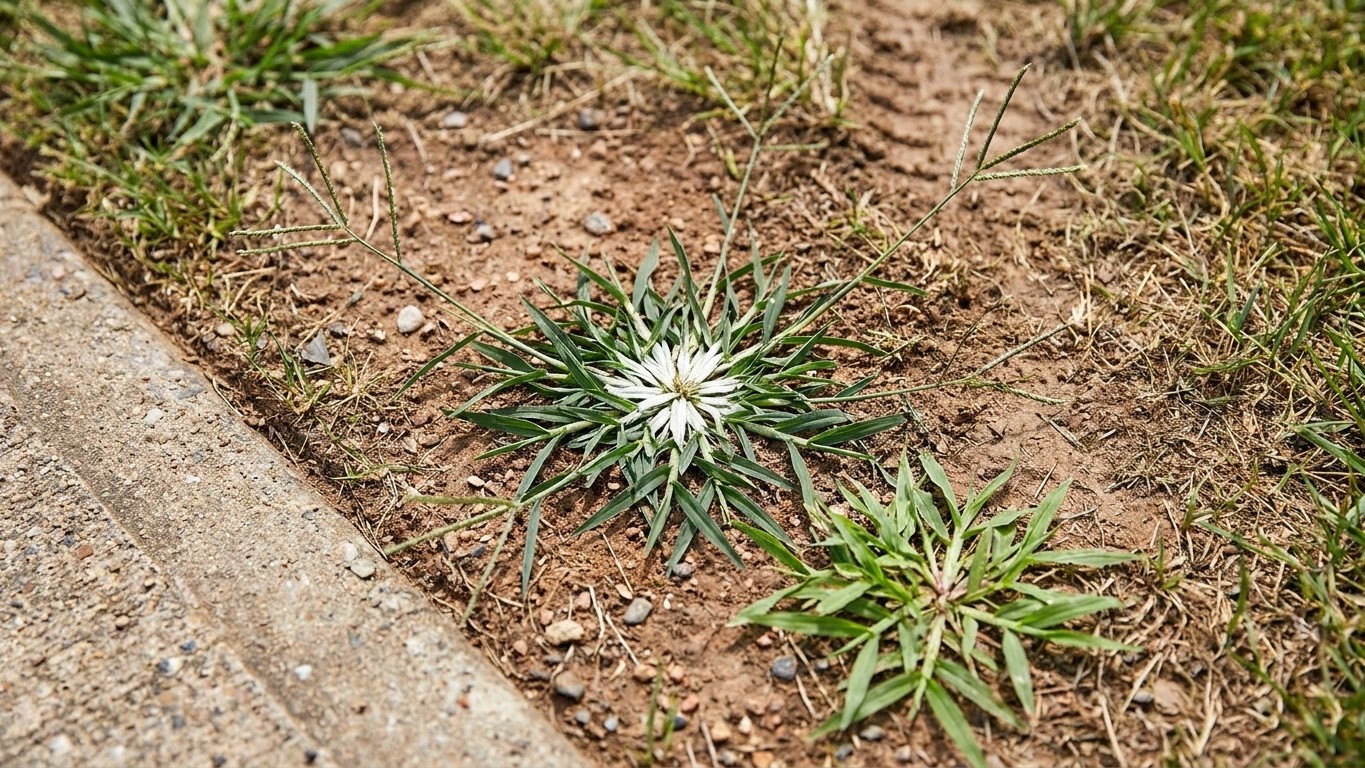

Most Nova Scotia lawns do not need dethatching, so measure before you rent anything. If the thatch layer is thicker than 0.75 inch, the best window is early fall, several weeks ahead of the first frost, which averages October 18 at Halifax Stanfield. Spring, once the grass is growing and past the average last frost of May 7, is the backup. Both dates are midpoints, not guarantees.
Do you need to dethatch at all?
Thatch is the brown, spongy layer between the green blades and the soil. It is made of dead stems and roots that pile up faster than they rot. A thin layer is a good thing: it cushions the lawn and holds some moisture. The trouble starts when it gets thick enough that water and fertilizer run off it instead of reaching the roots.
The spade test
Cut a small wedge out of the lawn with a spade, lift it, and look at the side. Measure the brown, spongy band between the green growth and the soil. Under 0.5 inch is healthy. Above 0.75 inch, act. Between those two numbers, you are in a gray zone where the right move is usually to check again next season and fix whatever is feeding the buildup.
Test three or four spots, not one. Thatch is rarely even. A sunny, well-fertilized slope can carry twice the layer of a shaded corner, and a single lucky (or unlucky) wedge will mislead you.
What builds it up
Species matter. Kentucky bluegrass and the fine fescues spread by creeping stems and tend to build more thatch than the bunch-type tall fescue and perennial ryegrass. Heavy nitrogen feeding, frequent shallow watering, and compacted soil all push the balance toward accumulation, because they favor top growth over the soil life that breaks it down.
Grass clippings, by the way, are not the culprit. They are mostly water and decay quickly. People who bag every cut to avoid thatch are working hard to solve a problem they did not have.
A lawn that feels bouncy underfoot but passes the spade test probably has a different problem, such as compaction, drought stress, or a grub infestation. Dethatching a healthy lawn tears out living turf and gives weeds a clean seedbed. For the general method, see Dethatching a Lawn.
The season to do it in Nova Scotia
The grasses that hold up here are all cool-season species: fine fescues, Kentucky bluegrass, perennial ryegrass, rough bluegrass, and tall fescue. Warm-season grasses are the wrong tool for this province. They grow in summer heat and go dormant once it cools, and a Nova Scotia winter is more than they can take. Cool-season turf does the opposite, growing hardest in fall and spring, which is exactly when it can recover from being raked up.
Early fall is the first choice
Dethatching wounds the lawn, and the repair needs time, warm soil left over from summer, and moisture. Fall delivers all three, with fewer weeds competing than in spring. The timing logic is to finish while the grass still has several weeks of growth left.
The anchor date comes from Environment and Climate Change Canada, which puts the average first fall frost at October 18 for the Halifax Stanfield station. Treat that as the middle of a window. It is a mean, so in one year out of two the first frost arrives later, and in the other half it comes earlier. It is not a safe date, and planning to seed on October 17 is a gamble.
As of today, October 2, anyone near Halifax is already inside the shrinking part of that window. If your spade test says thatch is only slightly over the line, skipping this fall and doing the work in spring is a reasonable call. Seed that goes down too close to a hard freeze often sits there and fails to establish before winter.
Spring as the backup
The average last spring frost at the same station is May 7, and the same caveat applies: half of all years see frost later than that. Wait until the lawn is visibly growing, not just green at the tips. Dethatching a lawn that is still sluggish from winter slows its recovery, and spring seedlings face crabgrass and summer heat soon after.
One more limit on the numbers: they describe a single airport station, not the province. Northern and upland districts run weeks behind Halifax, so a homeowner in the Cape Breton highlands should not copy these dates. The Canadian normals cover 1981-2010, while the US figures cover 1991-2020, so the two sets are not measured over the same years. If you want to see how the same job is timed in other cold climates, compare When to Dethatch a Lawn in Minnesota and When to Dethatch a Lawn in Connecticut. For district-level advice, the Nova Scotia Department of Agriculture is the right place to start.
Rake, power rake, or core aeration
The tool should match the thickness of the layer. Reaching for the biggest machine is the most common mistake, and it is also the most expensive one in turf lost.
| Method | Best for | Damage to turf | Main drawback |
|---|---|---|---|
| Dethatching rake | Thatch just over 0.75 inch, small lawns | Low to moderate | Hard work on a large yard |
| Power rake (vertical mower) | Thatch well above 0.75 inch, larger lawns | High | Leaves a ragged, torn surface that needs reseeding |
| Core aeration | Thatch near the threshold, plus compacted soil | Low | Slower, gradual effect on the layer |
A manual dethatching rake has curved tines that pull out the dead layer. On a small lawn with a layer only a little past the line, it is enough, and it gives you control. Expect a pile of brown debris, more than you would guess, and plan to compost or bag it.
A power rake, sometimes called a vertical mower, uses spinning blades that cut into the thatch and the soil surface. It is the right answer for a truly thick layer on a bigger lawn, but it is aggressive. The lawn will look worse for a few weeks before it looks better, which is one more reason to run it early enough in fall for the grass to fill in. Run it in two passes at right angles only if the first pass leaves a lot behind.
Core aeration pulls small plugs of soil out of the lawn. It does not remove thatch directly, but it breaks up the layer, opens the soil, and lets microbes get at the dead material. It is the gentlest option and the best choice when the lawn is both thatchy and compacted, which often go together on heavily trafficked turf. Many lawns that sit right at the threshold do better with aeration than with any raking.
Whatever you choose, mow the lawn a bit shorter than usual first, and do the work when the soil is moist but not soggy. Dry, hard ground makes every tool more destructive.
What the lawn needs afterwards
A freshly dethatched lawn is thin, and thin lawns invite weeds. Rake up the loosened debris, then overseed the bare patches with a cool-season mix suited to your site. Fine fescues are the usual pick for shade, tall fescue for toughness, and Kentucky bluegrass for a dense, self-repairing sward. Use the same species as the existing turf where you can.
The seed rate trips people up. The figures below are for building a new lawn, in pounds per 1,000 square feet. Overseeding an existing lawn uses half of these rates.
| Grass | New lawn (lb per 1,000 sq ft) |
|---|---|
| Tall Fescue | 6 to 8 lb |
| Fine Fescues | 4 to 6 lb |
| Rough Bluegrass | 2 to 3 lb |
| Kentucky Bluegrass | 1 to 3 lb |
| Perennial Ryegrass | 4 to 10 lb |
More seed is not insurance. Seedlings that come up too thick compete with each other and thin themselves out, so you pay for seed that dies. Press the seed into good contact with the soil and keep the top inch moist until it sprouts, which may mean light watering once or twice a day for a stretch rather than one deep soak.
Go easy on fertilizer. A modest starter feeding helps seedlings, but heavy nitrogen is one of the things that built the thatch in the first place. Hold off on herbicides that would stop the new seed, and keep foot traffic off until the new grass has been mowed a few times.
Common questions
Is October 18 a safe date to plan around?
No. It is the average first fall frost at Halifax Stanfield, a midpoint. In one year out of two the frost comes later, and in the other half it comes earlier. Finish dethatching and seeding well before it, not on it.
Do these dates work for the whole province?
They do not. The figures come from a single station, and northern and upland districts run weeks behind it. For other Nova Scotia locations, check with the Nova Scotia Department of Agriculture or watch your own lawn and first frost.
Can I dethatch in summer?
It is a poor idea for the cool-season grasses that grow here. Summer heat and dry spells stress them, and a lawn torn up by a rake or power rake struggles to recover. Wait for fall, or for active growth in spring.
How much seed do I need after dethatching?
Half the new-lawn rate for your species, since you are overseeding existing turf. For tall fescue, for example, a new lawn takes 6 to 8 lb per 1,000 square feet, so overseeding takes half of that. Spreading more rarely helps, because crowded seedlings thin each other out.