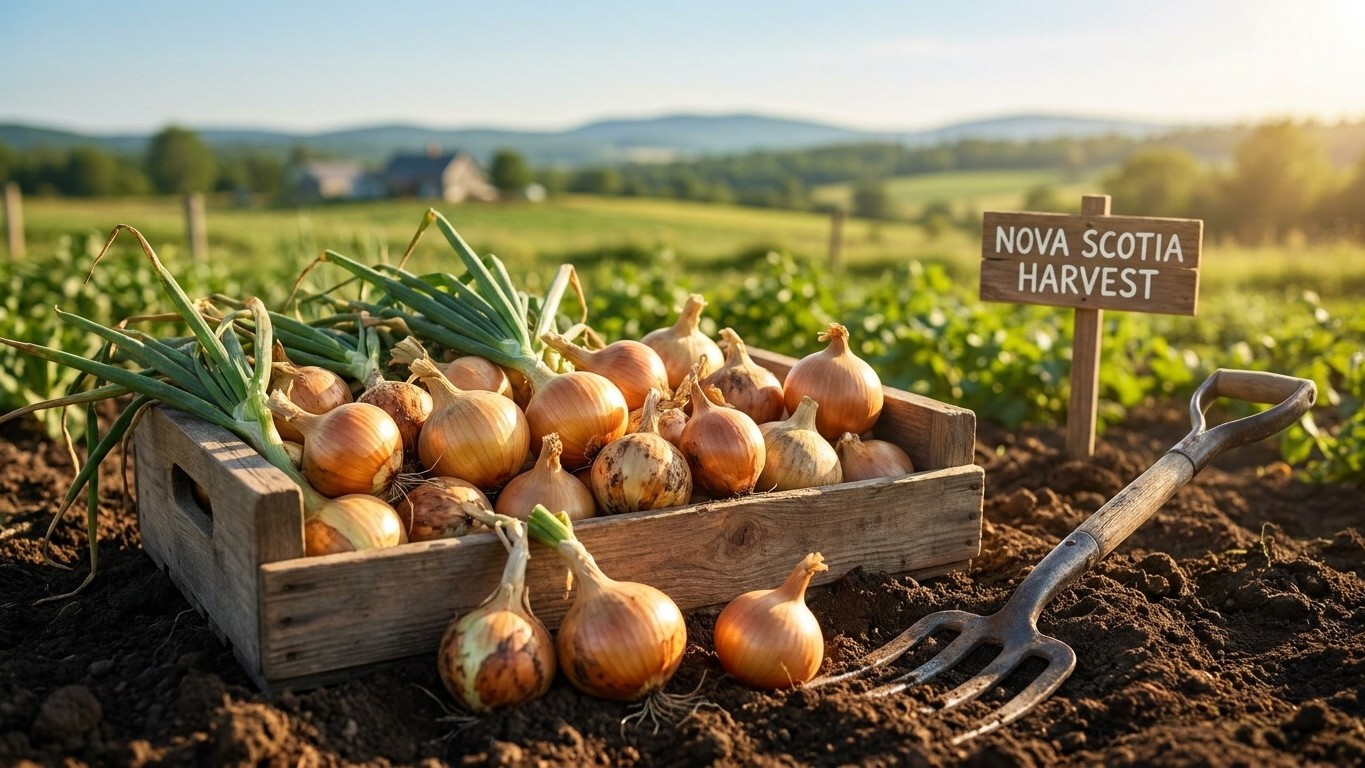

At 44.88 degrees north, the latitude of Halifax Stanfield International Airport, Nova Scotia gets 15 hours and 25 minutes of daylight on its longest day. That number, not the calendar or the thermometer, is what tells an onion when to stop making leaves and start making a bulb. It puts the province squarely in long-day onion territory, with intermediate-day varieties also getting enough light to trigger bulbing. Anything bred as a short-day onion is the wrong choice here, no matter how well it performs farther south.
The short answer for Nova Scotia

Onions don’t respond to warmth the way tomatoes or peppers do. They respond to day length, and once the hours of daylight climb past a variety’s trigger point, the plant switches from building leaves to building a bulb, whatever size it happens to be at that moment. At 15h25 on the solstice, Nova Scotia clears the 14-to-16-hour window that long-day onions need, and it clears the 12-to-14-hour window that intermediate-day onions need too. Short-day onions, which trigger around 12 hours, are a different story, covered in the next section.
Of the 31 onion varieties documented on this site, 23 have a published latitude range that covers 44.88N. Fourteen are long-day types, nine are intermediate-day. At this latitude, that split matters less than it sounds, since both groups get enough daylight to bulb properly. The real choice comes down to flavor, storage life, and how much head start the plant gets in spring, not whether it will bulb at all.
Long-day and intermediate-day varieties that fit
| Variety | Day-length group | Published range |
|---|---|---|
| Ailsa Craig | Long-day | 38-60N |
| Barolo | Long-day | 38-55N |
| Blush | Long-day | 38-55N |
| Bridger | Long-day | 35-50N |
| Frontier | Long-day | 40-50N |
| New York Early | Long-day | 38-50N |
| Patterson | Long-day | 38-55N |
| Powell | Long-day | 43-47N |
| Red Carpet | Long-day | 40-45N |
| Redwing | Long-day | 43-65N |
| Rossa di Milano | Long-day | 38-50N |
| Safrane | Long-day | 42-50N |
| Talon | Long-day | 42-50N |
| Walla Walla Sweet | Long-day | 35-55N |
| Cabernet | Intermediate-day | 35-45N |
| Calibra | Intermediate-day | 35-45N |
| Elsye | Intermediate-day | 32-45N |
| Expression | Intermediate-day | 32-45N |
| Monastrell | Intermediate-day | 35-46N |
| Red Long of Florence | Intermediate-day | 38-50N |
| Red Long of Tropea | Intermediate-day | 35-48N |
| Scout | Intermediate-day | 32-46N |
| Sierra Blanca | Intermediate-day | 32-45N |
Powell and Redwing, both rated with a lower edge at 43N, sit closest to the northern limit of what this table shows, and Redwing’s range stretching up to 65N gives it the widest margin of any variety here.
What will not work here
Eight varieties documented on this site are rated for latitudes that end below 44.88N, and none of them belong in a Nova Scotia garden. Seven are short-day onions, bred to trigger bulbing at around 12 hours of daylight; one, Candy, is an intermediate-day type whose northern edge stops at 40N, four degrees south of Halifax. Plant any of them here and the failure runs backward from what most northern gardeners expect. The onion doesn’t sulk and refuse to bulb. It bulbs too soon.
A short-day onion set out in a Nova Scotia garden hits its 12-hour trigger by late spring, while the plant is still a few thin leaves tall. The bulb that forms is whatever size the plant managed to reach by that point, which usually means something closer to a golf ball than a proper cooking onion. There’s no recovering from it once daylight passes the trigger. The plant has already switched from making leaves to making bulb, and it doesn’t switch back.
- Candy (intermediate-day, 33-40N): its range stops four degrees south of Halifax, and day length here triggers bulbing before the plant has built real leaf mass.
- Gabriella (short-day, 20-35N): hits its 12-hour trigger in early summer, well before Nova Scotia’s growing season has done any real work.
- Madalyn (short-day, 20-35N): the same short-day mismatch, bulbing starts before the plant is ready.
- Red Rock (short-day, 30-36N): bred for a growing season roughly a thousand miles south of Halifax.
- Red Sensation (short-day, 25-35N): bulbs early and small this far north.
- Texas Grano 1015Y (short-day, 25-35N): a classic Southern short-day onion, out of place at this latitude.
- Vidora (short-day, 25-35N): same trigger problem as the other short-day types on this list.
- White Castle (short-day, 30-38N): the closest of the eight to Halifax’s latitude, but still nearly seven degrees south.
What changes across Nova Scotia
Halifax anchors the numbers above, but Nova Scotia isn’t a single point on a map. The province runs from the southern tip of the mainland near Yarmouth, on the open Atlantic, up through Cape Breton Island in the northeast, a spread of roughly three and a half degrees of latitude. That’s enough to shift the length of the solstice day by several minutes from one end of the province to the other. It doesn’t move Nova Scotia out of long-day territory anywhere, but it does change how much cushion a given variety has.
A garden near Sydney, in northern Cape Breton, sits several degrees north of Halifax and gets a slightly longer solstice day as a result, which is comfortable ground for long-day varieties with a wide range, including Redwing, whose published range runs as far north as 65N. A garden near Yarmouth, at the southern end of the mainland, sits closer to the intermediate-day zone, and while it still clears the long-day threshold, the margin is thinner. Growers there may find intermediate-day varieties such as Cabernet or Scout bulb more reliably in a cool, late spring.
| Region | Approximate latitude | What changes |
|---|---|---|
| Halifax (reference) | 44.88N | 15h25 on the longest day; both long-day and intermediate-day varieties bulb with room to spare |
| Northern Cape Breton (Sydney area) | roughly 46N | slightly longer solstice day; long-day varieties get extra margin |
| Southern mainland (Yarmouth area) | roughly 43.7N | slightly shorter solstice day; still enough for long-day, but the margin over intermediate-day types narrows |
None of this pushes any part of Nova Scotia into short-day country. It just means the far north and far south of the province aren’t identical gardens, and a variety that’s marginal at one end may be an easy grower at the other.
Checking this against your own garden
The 15h25 figure above belongs to Halifax specifically, not to every backyard in the province. Gardeners near the province’s edges, in northern Cape Breton or along the southwestern shore, will see a slightly different daylight total on the solstice, and that’s worth confirming before committing a whole bed to one variety. Frost dates matter just as much: Nova Scotia’s Atlantic coast moderates temperatures compared with inland valleys like the Annapolis Valley, and coastal fog can push planting and harvest windows back by a week or more in a given year.
A few things worth checking before seed or sets go into the ground:
- Look up your own latitude if you garden well north or south of Halifax; a few degrees changes the length of the solstice day enough to matter for borderline intermediate-day varieties.
- Contact Perennia Food and Agriculture or the Nova Scotia Department of Agriculture for average last and first frost dates specific to your area, rather than relying on a provincial average.
- Note whether your site is coastal or inland; fog and moderated coastal temperatures shift onion transplant timing even when the daylight math stays the same.
- Check the day-length rating printed on your seed packet or catalogue listing before buying, rather than assuming a variety that worked for a neighbor two towns over will behave the same in your soil and microclimate.