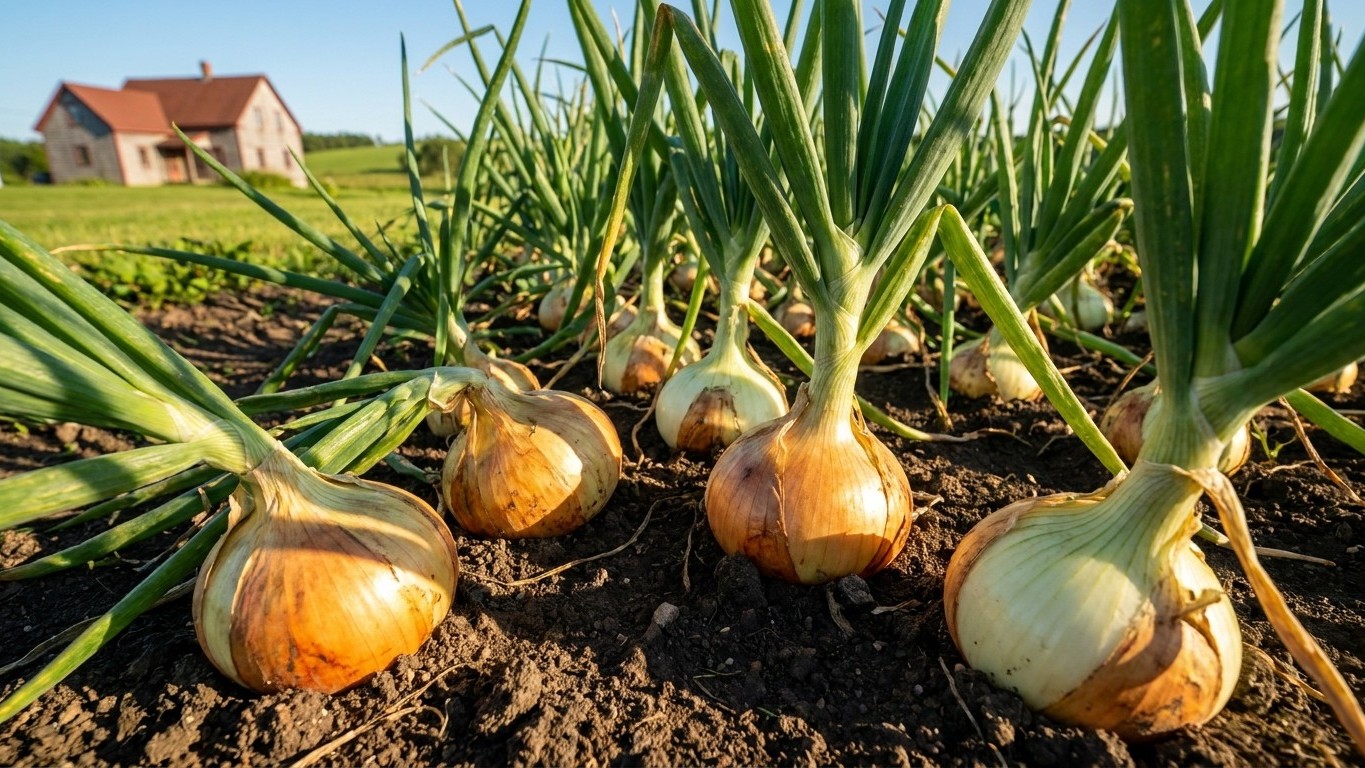

Nova Scotia’s summers give onions roughly 15 hours and 25 minutes of daylight at their longest, measured from the Halifax Stanfield station at 44.88 degrees north. That single number decides almost everything: which onion varieties will actually form a bulb here, and which ones will just sit in the ground making leaves. The short answer is that long-day and intermediate-day onions work in Nova Scotia, and knowing When to Plant Onions in Nova Scotia is just as important as choosing the right variety. Short-day types, the kind sold in generic “onion sets” bags at big-box stores across North America, do not.
How long your longest day is

Halifax sits at 44.88 degrees north, and on the summer solstice its gardens get about 15 hours and 25 minutes of daylight. That figure is the whole story. Onions don’t bulb because the soil warms up or because the calendar hits July. They bulb because of day length, a signal called photoperiod that tells the plant to stop putting energy into leaves and start putting it into the bulb below ground. Every onion variety carries a threshold, a number of daylight hours it needs before it will flip that switch.
Short-day varieties trigger at around 12 hours of daylight. Intermediate-day types wait for something closer to 12 to 14 hours. Long-day varieties hold out for 14 to 16 hours before they’ll bulb at all. Nova Scotia’s 15 hours and 25 minutes on the longest day falls comfortably inside the long-day range and well past the intermediate-day threshold, which means both groups can complete the process here. Short-day onions are a different story. Their trigger point sits so far below what this province offers that the bulbing signal fires too early in the season, while the plant is still small.
This is worth pausing on, because it explains why a bag of onion sets bought at a hardware store sometimes works in Nova Scotia and sometimes produces onions the size of a golf ball with no obvious cause. The sets themselves aren’t labeled by day-length type nearly often enough, and a bag grown for a mild-winter market further south can end up on a shelf in Halifax or Truro without anyone flagging the mismatch.
One more thing before moving to specific varieties: 44.88 degrees north is Halifax’s latitude, not Nova Scotia’s. The province runs from the tip of Cape Breton down to the shores of the Bay of Fundy, and while Nova Scotia is small enough that the daylight variation across it is modest compared to a state like California or Texas, a gardener near Yarmouth or up toward Sydney should still treat the Halifax figure as a close approximation rather than an exact reading for their own backyard.
Which varieties bulb in Nova Scotia
Of the onion varieties documented on this site, 23 have a published latitude range that covers Nova Scotia’s 44.88 degrees north. These are almost entirely long-day and intermediate-day types, which lines up exactly with what the daylight math predicts. For a closer look at these picks, see The Best Onion Varieties for Nova Scotia.
Varieties that will bulb here
- Long-day: Ailsa Craig, Barolo, Blush, Bridger, Frontier, New York Early, Patterson, Powell, Red Carpet, Redwing, Rossa di Milano, Safrane, Talon, Walla Walla Sweet
- Intermediate-day: Cabernet, Calibra, Elsye, Expression, Monastrell, Red Long of Florence, Red Long of Tropea, Scout, Sierra Blanca
Some of these run their range right up to the edge of what’s practical for a Nova Scotia garden. Powell, for instance, is listed for 43 to 47 degrees north, which puts most of the province near the middle of its comfort zone rather than at the margin. Redwing sits at the opposite end, rated from 43 all the way to 65 degrees north, which tells you it’s bred for places with even longer summer days than Halifax gets, and it will still perform fine here, just without needing every hour of that extra daylight.
Varieties that will not bulb here
Five varieties documented on this site have a published range that tops out below Nova Scotia’s latitude, which means the province gets more daylight than these onions are built to handle:
- Candy (intermediate-day, 33-40N)
- Gabriella (short-day, 20-35N)
- Madalyn (short-day, 20-35N)
- Red Rock (short-day, 30-36N)
- White Castle (short-day, 30-38N)
Plant one of these short-day types in a Nova Scotia garden and the bulbing signal arrives too soon. The plant hasn’t had time to build up much leaf growth, so it responds to the daylight trigger anyway and starts forming a bulb on a small frame, which caps how big that bulb can ever get. The onion isn’t sick and the soil isn’t at fault. It’s a variety mistake, not a feeding mistake, and it’s exactly the kind of disappointment that follows planting a generic bag of sets without checking what day-length type is inside it.
When to plant onions in Nova Scotia
Because Nova Scotia needs long-day or intermediate-day varieties, its planting calendar looks nothing like the calendar for a mild-winter state where growers tuck onion sets into the ground in autumn and let them overwinter. That approach depends on winters gentle enough that a small onion plant survives outdoors, which isn’t a bet worth making in a Nova Scotia winter. Here, the planting window sits in spring instead.
Environment and Climate Change Canada’s normals, drawn from the Halifax Stanfield station and covering 1981 to 2010, put the average last spring frost at May 7 and the average first fall frost at October 18. Those two dates frame the frost-free stretch that onions need to grow through before winter shuts things down, and it’s a workable window for long-day varieties that need those long June and July days to finish bulbing.
Treat both dates as averages, not guarantees. An average means frost arrives later than May 7 in roughly half of all years, sometimes by a week or two, and the same holds in reverse for the October date in fall. A gardener who transplants onions outdoors the day after May 7 every year will get caught by a late frost about as often as not. The safer approach is to watch the extended forecast in early May and treat that date as the midpoint of a window, not the edge of one.
In practice, most Nova Scotia gardeners start onion seed indoors in late winter, generally eight to ten weeks before they intend to transplant, then move seedlings or purchased transplants outside once the worst frost risk has passed. That gives the plants a long run of cool spring weather to build leaf mass before the June solstice pushes daylight toward its 15-hour-25-minute peak and triggers bulbing in earnest. Onions started too late miss out on that leaf-building stage and tend to bulb small, the same outcome as planting the wrong day-length variety, just caused by timing instead of genetics. Harvest typically finishes well before the average October 18 frost date, since bulbing and curing wrap up over the summer months, not in fall.
Gardeners near the province’s coastal edges, where the growing season can run slightly longer or shorter than the Halifax averages suggest, are better off keeping a simple frost log of their own over a season or two rather than relying solely on the regional figures.