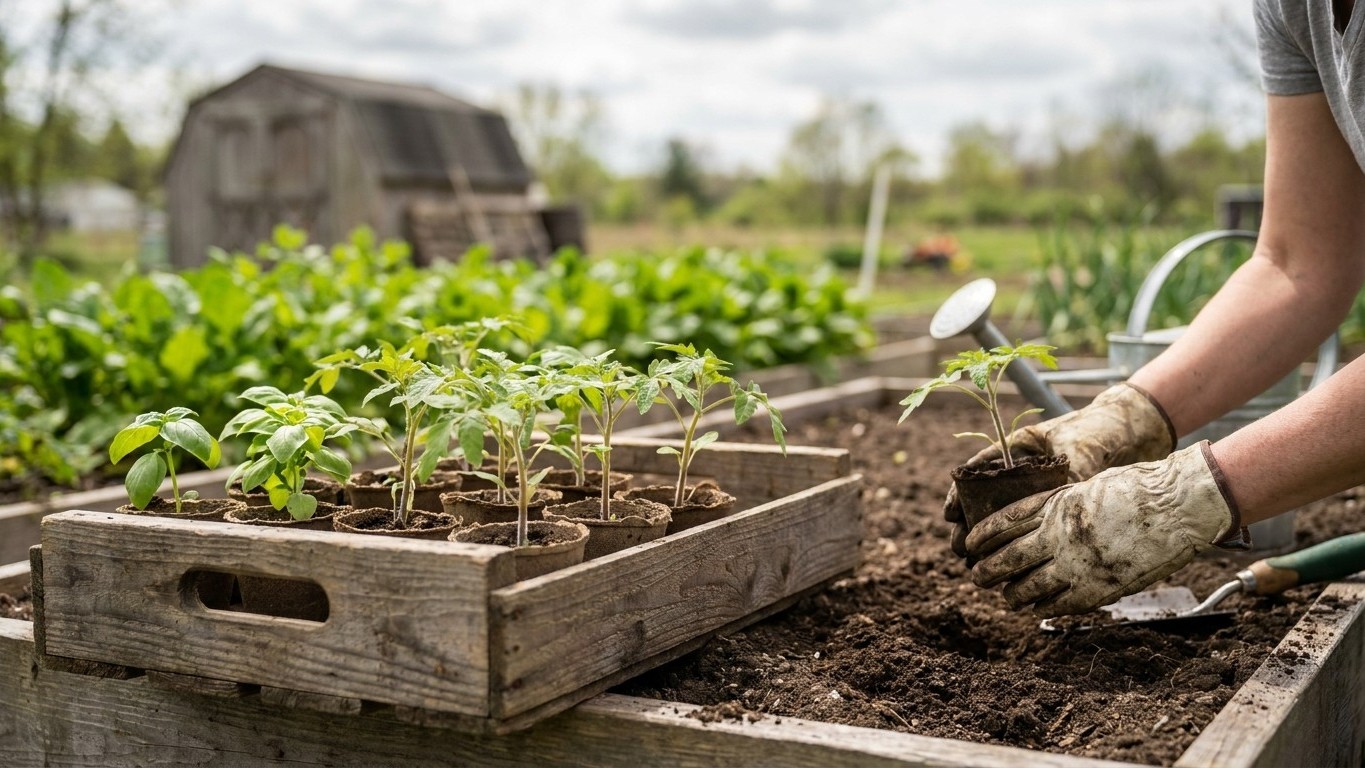

May in Nova Scotia sits right on the edge of the frost window, so the safe list is short but real: cold-hardy greens, alliums, peas, and seedlings hardening off under cover. The average last spring frost falls May 7, and that date is a midpoint, not a guarantee. Tender crops wait. Here’s what actually goes in the ground, what needs a head start indoors, what’s ready to harvest, and the jobs worth finishing before the growing season opens in earnest.
What goes in the ground in May

The calendar says spring, but soil temperature is what actually decides whether a seed germinates or rots. Cool soil that’s still waking up after winter runs well behind air temperature, which is why a warm afternoon can feel like planting weather while the ground four inches down is still in the 40s. That gap is the whole story of May gardening in this province.
The average last spring frost at Halifax Stanfield sits at May 7, but that figure is drawn from decades of Environment and Climate Change Canada data, which means in roughly half of all years the frost lands later than that. Treat it as a rough middle point, not a green light. A frost-free date that early in May is a coin flip at best, and inland or elevated districts run behind the Halifax average by a stretch that can matter more than the calendar does.
Given that, the crops worth trusting to open ground this month are the ones that shrug off a light frost. Peas go in as soon as the soil can be worked, since cold, damp ground is exactly what pea seed tolerates. Onion sets, shallots, and seed potatoes go in through the month once the soil has dried enough not to clump in the hand. Spinach, lettuce, and other salad greens can be direct-sown early, and hardened-off transplants of cabbage, broccoli, and kale can go out under a light cover toward the back half of the month.
| Crop | Method | Frost tolerance |
|---|---|---|
| Peas | Direct sow | High, sow in cold soil |
| Onion sets, shallots | Direct plant | High |
| Spinach, lettuce | Direct sow | Moderate to high |
| Cabbage, broccoli, kale transplants | Transplant, hardened off | Moderate, protect from hard frost |
| Tomatoes, peppers, squash | Wait | None, killed by frost |
What doesn’t belong outdoors yet is anything from the tomato, pepper, cucumber, or squash family. Those crops are killed outright by frost and slowed by any soil under roughly 60°F, so setting them out on the strength of one warm weekend is the single most common way May turns into a replanting month instead of a growing one.
What to start under cover
Seed packets give a start date relative to the last frost, and that means the real math starts from the frost window, not from a fixed day on the wall. With an average last frost of May 7, and remembering that half of all years run later, counting backward from that midpoint is the only way to get the timing right for this province.
Tomatoes and peppers typically need six to eight weeks under cover before they’re ready to go outside, which puts their indoor start well before May even opens, so if that window has already passed, the fallback is buying started plants rather than sowing from seed now. What still makes sense to start under cover through May is a second wave: more lettuce and brassica seedlings for succession planting, plus squash and cucumber starts that only need three to four weeks indoors before they’re ready to transplant once the soil has genuinely warmed, not just the air.
There are two ways this goes wrong. Start too early and the plants outgrow their pots weeks before it’s safe to set them out, ending up rootbound, leggy, and stressed by the time they finally reach the garden. Start too late, especially with anything that needs a long run like tomatoes or peppers, and the plant never catches up to a growing season that runs from a mean last frost of May 7 to a mean first fall frost of October 18, a stretch of about 164 days on average. Cold frames and unheated tunnels buy a couple of extra weeks on both ends of that window, which is often the difference between a squash plant that fruits and one that just gets going as the season closes.
What is ready to pick
May is a lean harvest month, but it isn’t an empty one. Rhubarb is usually the first real crop of the season, with stalks thick enough to pull once they’ve reached decent length, generally avoiding the thin, pale early growth. Established asparagus beds start throwing spears through the month, and the rule there is simple: cut while the spears are firm and the tips are still tight, before they loosen and start to fern out.
Anything that overwintered in the ground under cover, garlic tops, leeks, and hardy kale that made it through the cold months, is worth checking now, since these plants often resume growth fast once the ground softens and can bolt if left too long. Cold frame greens sown in earlier weeks should be filling in enough for a first thinning, which doubles as an early salad.
Indoors, this is also a good stretch to lean on sprouts and microgreens, since they close the gap between the last of the stored crops and the first real garden harvest. Speaking of storage: this is the month to go through the root cellar or pantry shelf one more time. Squash with any soft spot, potatoes that have started sprouting eyes, and onions gone soft at the neck should come out now, both to use them before they turn and to stop rot from spreading to the crops stored around them.
The jobs that matter this month
Soil preparation is the job that pays off longest and shows up latest. Working compost or aged manure into beds now, while the ground is workable but before the bulk of transplanting starts, gives it weeks to integrate rather than sitting as a raw amendment around young roots.
Mulching comes right behind it. Laying mulch too early traps cold, damp soil exactly when crops need it to warm up, so the better order is to let the soil warm through May, then mulch once seedlings and direct-sown crops are established, locking in moisture before the season’s dry stretches arrive.
Staking and support structures belong in the ground before the plants that need them, not after. Peas, and any vining crop started this month, grow fast enough that a stake or trellis installed after the fact means damaged stems and roots disturbed at the worst possible time.
Watering rhythm shifts this month too. Spring rain can mask how dry the topsoil actually gets under a windy afternoon, so it’s worth checking soil moisture by hand rather than trusting the sky, especially around new transplants that haven’t rooted deep enough to find their own water yet.
Succession sowing of quick crops like lettuce, radish, and spinach keeps the harvest coming rather than arriving all at once, and a small sowing every couple of weeks through May sets that rhythm for the rest of the season. Pest scouting matters here too: slugs and early aphids move fast on tender new growth, and catching them on a handful of plants is a five-minute job that a full infestation later on is not.
What not to do in May
The classic mistake is planting by the feel of the air instead of the state of the soil. A run of 65°F afternoons doesn’t mean the ground has caught up, and tomatoes, peppers, or squash set out on the strength of one warm week routinely sit and sulk, or die outright, when a cool night follows.
Uncovering too early after a mild stretch is the second trap. Pulling row cover or cold frame lids off because a few days felt like real spring, only to have a frost roll back through, sets tender growth back further than leaving the cover on an extra week ever would. The average last frost of May 7 is exactly that, an average, and the years where frost lands two or three weeks later than that are not rare.
Nitrogen timing is the third one gardeners get backwards. Heavy nitrogen feeding early on pushes soft, leafy growth on crops like tomatoes and peppers before they’ve even gone outside, and that soft growth is more vulnerable to cold and pests than a plant fed more moderately and allowed to build sturdier tissue first. The better approach is a light feed at transplant time, with heavier nitrogen held back until the plant is established and actively growing in the ground, not still hardening off in a tray by a window.
Checking this against your own county
A province-wide month is a starting point, not an instruction. Nova Scotia’s frost dates, drawn here from the Halifax Stanfield station, shift by weeks depending on elevation, distance from the coast, and whether a county sits in a valley that traps cold air or on a slope that drains it away. The Annapolis Valley, the South Shore, and the northern mainland do not share a single planting week, even though they share a province.
The hardiness zone figure for this reference city, 6b under the Canadian system, is not a USDA zone and should never be read as one; it’s built from seven climate variables rather than one. For a planting window matched to your own county, the Nova Scotia Department of Agriculture is the place to check before trusting a provincial average over local conditions.
Common questions
Is it safe to plant tomatoes outdoors in Nova Scotia in May?
Not reliably. The average last frost is May 7, but that’s a midpoint from historical data, meaning frost arrives later than that in about half of all years. Tomatoes are killed outright by frost, so waiting until soil has genuinely warmed, not just the air, is the safer call.
What vegetables can be direct-sown in May in Nova Scotia?
Peas, onion sets, shallots, seed potatoes, spinach, and lettuce all tolerate the cool, unsettled soil typical of this month and are the most reliable direct-sow choices.
When does the growing season actually start and end in Nova Scotia?
Using the Halifax Stanfield averages, the frost-free stretch runs roughly from May 7 to October 18, about 164 days, though both dates are averages and can shift later or earlier depending on the year and the county.
Does a Canadian hardiness zone rating tell me what USDA zone I’m in?
No. The Canadian system uses seven climate variables while the USDA system uses one, and Natural Resources Canada is explicit that there’s no simple conversion between them. A Canadian zone rating should never be treated as equivalent to a USDA number found on US seed packets.