
Nunavut’s climate makes open-ground cucumber growing impractical across the territory. The best approach is a fast-maturing, compact, parthenocarpic (self-pollinating) bush type started indoors and grown its entire life under some form of protection, cold frame, hoop house, or heated greenhouse, rather than any variety planted straight into open soil. No cucumber type overcomes a Canadian hardiness zone of 0a on its own.
The short answer for Nunavut
Start with the type, not the name on a seed packet. Nunavut’s growing-season numbers rule out anything but the fastest, most compact cucumber types, and even those need help to finish.
The frost-free window here averages 86 days, running from a mean last spring frost of June 19 to a mean first fall frost of September 13, both measured at the Rankin Inlet reference station. That’s already tight for a warm-season vine that typically wants 55 to 70 frost-free days to set fruit outdoors in a favorable climate. The bigger problem sits in the fine print: these are mean dates, not guaranteed ones. In one year out of two, frost lands later in spring or earlier in fall than the average, so the real safe window can run shorter than 86 days more often than it doesn’t.
Then there’s heat. Rankin Inlet averages 0.0 days a year above 90°F. Cucumbers want warm soil, generally above 70°F at the root zone, to germinate reliably and grow fast. Without any real heat buildup, that soil temperature is unlikely to arrive outdoors on its own, at any point in the season. That single fact shapes the outcome more than any variety choice ever could.
Given that, the types worth considering are:
- Bush or compact parthenocarpic cucumbers, self-fruitful, so not dependent on scarce northern pollinators, and bred to mature fast in a container or small bed under cover
- Short-vine pickling types, which tend to finish faster than long slicing types and tolerate close spacing inside a cold frame or hoop house
- Dwarf, container-friendly types, useful because they can be shifted indoors on the coldest nights of an already brief summer
Territorial cultivar trial data for Nunavut is not available. For actual variety names proven to perform in a specific community, the next step is Agriculture and Agri-Food Canada, not a guess borrowed from a warmer province.
What will not work here

Long-maturing slicing cucumbers are the first thing to cross off. Varieties bred for a long run of days to maturity assume a full stretch of warm days after germination; with a mean frost-free window of 86 days that can shrink further in a below-average year, and with essentially no real heat to push growth along, a long-season type runs out of season before it produces a usable fruit.
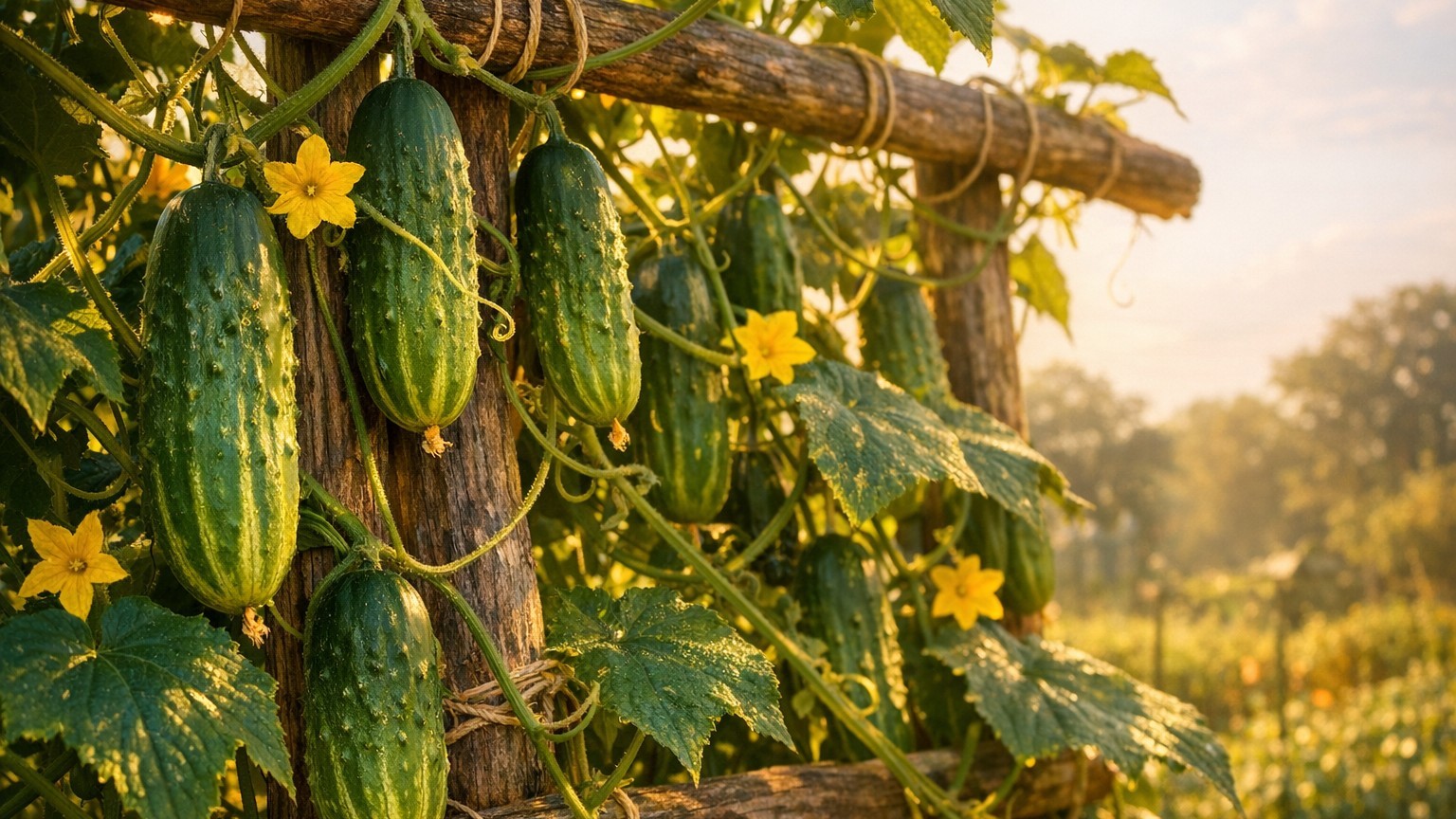
Traditional vining types trained up an open trellis fail for a related reason. Vines exposed to open Arctic air lose whatever marginal warmth they’ve built up overnight, and a site that suits an outdoor trellis rarely offers the wind shelter a heat-loving vine needs this far north. Any vining type grown here needs to live inside a structure, trellised within a hoop house or greenhouse, not out in the open.
Direct-seeding outdoors is the next failure point, full stop. With zero days above 90°F to warm the soil, seed sown straight into open ground has no reliable trigger to germinate promptly; it either rots in cold, damp soil or germinates so late that half the short season is gone before the first true leaves show. Starting seed indoors, then transplanting only after the soil under cover has warmed, isn’t a refinement here, it’s the difference between a harvest and none.
Cucumber types that depend on insect pollination are a quieter failure. Nunavut’s short, cool season supports far fewer pollinating insects than a temperate province, and a monoecious variety needing bees to move pollen between separate male and female flowers can flower reliably and still set no fruit. That’s the specific reason parthenocarpic, self-fruitful types matter more here than almost anywhere else in this series.
One thing that will not be the limiting factor: drought. Summer rainfall averages about 5.0 inches across June, July and August, with June the driest month at 1.05 inches. That’s modest, but in a cool climate with no heat load pulling moisture from the soil, watering demand stays low. Treating a Nunavut garden like a hot, dry province and rationing water on that assumption solves the wrong problem. The limiting factor here is cold and short days, not thirst.
What changes across Nunavut
A hardiness zone of 0a, in the Canadian system, isn’t a single fact spread evenly across a territory the size of Nunavut. It’s the rating for the Rankin Inlet reference station alone, and Nunavut stretches from sub-Arctic mainland communities to islands well inside the Arctic Circle.
Zone 0a is already the coldest classification the Canadian system assigns to an inhabited area, calculated from seven climate variables rather than the single minimum-temperature figure the USDA system uses. That distinction matters here specifically: a Canadian zone number never converts cleanly to a USDA zone, and Natural Resources Canada is explicit that one Canadian zone can span nine different USDA zones depending on which variable is driving the score in a given place. Calling zone 0a “about the same as” any particular USDA rating is a mistake, not a shortcut.
A reader in a more southerly mainland community, closer to the tree line, is likely working with a longer, slightly milder season than the reference station used here. A reader on a high Arctic island, or at real elevation, should expect a season shorter and colder than these figures describe, not the same one.
The one takeaway that holds across the territory: whatever the local variation, it pushes the numbers further toward difficulty, not away from it. Nowhere in Nunavut approaches the season length or heat load a fast cucumber type wants outdoors. What shifts is how much artificial season-extension a grower needs, not whether they need it. For an exact local rating, the Plant Hardiness Zones of Canada map is the tool built for that, not a guess based on the territorial average.
Where to check this for your own county
This heading uses “county” because it sits inside a broader series on cucumbers by territory, but Nunavut, like the rest of Canada, doesn’t organize agricultural advice at the county level. The equivalent step is checking with Agriculture and Agri-Food Canada, and any hamlet or territorial gardening program, rather than relying on averages alone.
The federal address to use is Agriculture and Agri-Food Canada. It’s used here because Nunavut’s own provincial-level department page didn’t return a working automated check at the time this page was verified, while the federal site did. That’s worth knowing on its own: a source that loads reliably beats one that might carry more locally specific advice but can’t be confirmed.
Once there, look for any planting guide built around northern or Arctic conditions rather than a generic Canada-wide calendar assuming the longer seasons of southern provinces. It’s also worth searching for lists of vegetable varieties actually trialled in Nunavut’s community greenhouses, since school and community greenhouse projects across the territory have grown cucumbers under cover for years, and that lived experience beats any average.
A reference-station average, however carefully sourced, describes Rankin Inlet, not a specific greenhouse, cold frame, or backyard container somewhere else in the territory. A recommendation built around one community’s own recorded frost dates and one grower’s own setup will always outrank it, and that’s simply what a territorial average can and can’t tell a reader.
Checking this against your own garden
None of the dates or averages above replace what the plant itself shows, especially somewhere as variable as Nunavut. Three things to watch, all checkable without equipment:
- Soil warmth by feel: press a bare hand a couple of inches into the growing medium, whether that’s a raised bed, container, or greenhouse soil. Cucumber seed wants soil that feels genuinely warm before it’s worth sowing or transplanting into. If it still feels cold this late in the calendar, the local microclimate is running behind the reference-station average, not ahead of it.
- The first flush of male flowers: cucumbers typically produce male flowers before the female ones, which carry a small swelling behind the petals, appear. Seeing male flowers only, week after week, signals the plant is stalled by low light or low heat, whatever the calendar says about the season being underway.
- The first true leaves: a seedling’s first leaves are rounded seed leaves; the true leaves that follow, larger and more deeply veined, mark the shift from surviving to actually growing. How long that takes, under whatever cover is being used, is a faster and more local read on the season than any territorial mean.
A grower whose seedlings are slow to produce true leaves, or whose flowers stay male-only well into what should be productive weeks, is looking at real information about their own greenhouse, cold frame, or windowsill setup. In a territory with a mean frost-free window this short, that kind of direct observation is worth more than any date on a calendar.