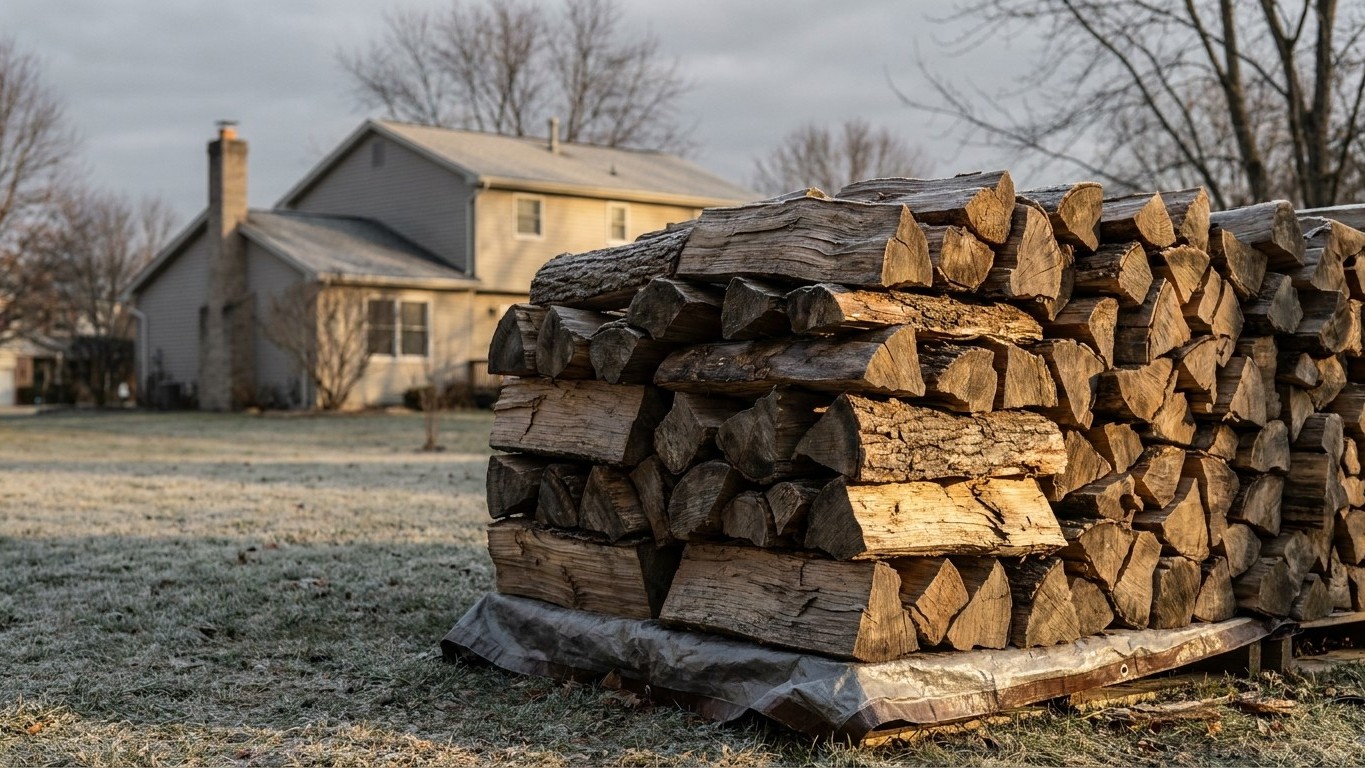

The average low during Ohio’s coldest month sits at 22°F, measured at the Columbus reference station (NOAA NCEI Climate Normals, 1991-2020). That single number tells you almost everything about how to burn wood here: not brutal enough to demand the densest hardwoods on every load, but cold enough that a supply of well-seasoned wood is a real heating strategy, not a nice-to-have.
How cold it actually gets here

Twenty-two degrees is the average nightly low for the worst month, based on the Columbus climate record. That’s not the record low, and it’s not some rare cold snap. It’s the typical bottom of the thermometer, night after night, for weeks at a stretch during January. Anyone burning wood in central Ohio should plan around that number, not around the occasional deep freeze that makes the news.
A 22°F overnight low means a house is losing heat steadily for eight or more hours at a stretch, every single night, for a solid chunk of winter. That’s the kind of cold where a fire that dies out at midnight leaves a cold house by 4 a.m., and where a stove loaded with the wrong wood burns down to coals before sunrise. This isn’t the kind of climate where firewood is pure atmosphere, the crackling fire while the furnace does the real work in the next room. In much of Ohio, wood heat is asked to actually carry a room, sometimes a whole house, through a genuine cold season.
At the same time, 22°F isn’t the kind of extreme that shows up in the northern Great Lakes or the high country out west, where overnight lows regularly drop into the single digits or below zero. Ohio’s winter sits in a middle band: cold enough to matter, temperate enough that a mixed woodpile, some dense, some lighter, covers most situations without needing to chase the single hardest-to-find species on the market.
That middle-of-the-road cold figure is exactly why the species choice below matters as much as it does. In a genuinely brutal climate, you’d load only the densest wood you could find and accept the smoke and spark tradeoffs. In Ohio’s climate, you have room to be smarter about matching wood to the job, saving the dense stuff for when 22°F actually shows up on the forecast, and using lighter wood where it makes more sense.
Which woods are worth the effort here
A cord is a fixed volume: a stack 4 feet high, 4 feet wide, and 8 feet long, or 128 cubic feet total. That fixed size is exactly why density matters so much. Two cords of different wood can look identical stacked in the yard and hold wildly different amounts of usable heat, because a denser species simply packs more wood fiber, and less air, into the same box shape.
Michigan State University Extension puts the benchmark at about 20 million BTU per cord for well-seasoned hardwood, which works out to roughly the heat of 145 gallons of #2 fuel oil or 215 gallons of LP gas in a single cord. That’s the number to hold in your head when a seller tells you a price per cord: you’re buying heat energy, and the density of the species inside that cord is what decides how much of it you’re actually getting.
Matching density to the job
For the coldest nights, when that 22°F average low is doing its worst, denser hardwoods carry more heat per load and burn down slower, which matters most for an overnight burn you want still glowing at sunrise. Lighter, less dense woods have their place too: they light faster, work well for shoulder-season evenings when you don’t need a house-carrying fire, and make sense for getting a stove up to temperature before switching to something heavier.
Availability matters as much as density on paper. A species you can’t find seasoned and dry is worse than a more modest wood you can actually get split, stacked, and ready. Ohio’s local firewood sellers and co-ops vary by county, and a species that’s abundant and cheap two counties over may be scarce and pricey where you live. Ask what’s actually seasoned and ready before asking what’s theoretically the densest option.
| Wood category | Heat output (per cord) | Smoke | Sparks |
|---|---|---|---|
| Dense hardwoods | At or above the ~20 million BTU seasoned average | Low once fully seasoned | Fewer, more controlled |
| Lighter, softer woods | Below the seasoned hardwood average | Higher, especially if not fully dry | More frequent, larger |
Use that table as a starting point for conversations with local sellers, not a final answer. Ask specifically what species is in the load, and ask how long it’s been split and stacked, because the answer to that second question changes the real BTU output more than the species name on the invoice does.
How much wood a winter takes
There’s no honest single number for “cords per winter” in Ohio, and anyone who gives you one without asking follow-up questions is guessing. The estimate depends on three things working together, and skipping any one of them makes the number meaningless for your specific house.
- Local cold: a winter that bottoms out near that 22°F average low demands steady, reliable heat output for weeks at a time, not just the odd cold snap.
- How well the house holds heat: insulation, air sealing, window quality, and even how exposed the house is to wind all change how fast heat escapes once you’ve made it.
- Wood’s role in the heating plan: burning wood as the sole heat source through a full winter takes a very different volume than burning it as a supplement on cold evenings while a furnace handles the rest.
The mechanism that makes those variables move so much is simple: a poorly insulated house in a hard winter can burn through double what a tight, well-sealed house uses in that same climate. Same outdoor temperature, same species of wood, twice the consumption, purely because one house is losing heat through gaps, thin walls, and old windows while the other is holding onto what the fire produces.
Run your own estimate down that list rather than trusting a published average. Start with how the house performed last winter (more wood burned than expected, or less), adjust for whether this year’s plan leans more heavily on wood or less, and then pad the estimate rather than cutting it close, because running out mid-January with green wood as the only backup is a worse problem than having half a cord left over in March.
Drying wood in this climate
Seasoning matters more than species selection almost everywhere, and Ohio is no exception. The target, according to Michigan State University Extension, is 20 percent moisture or less before burning. Green wood can sit well above 60 percent moisture, and every bit of that water has to boil off before the wood gives up any usable heat, which is exactly why a green log hisses, smokes, and refuses to catch while a properly seasoned split lights and holds a steady flame.
What actually dries wood is air movement and time, not direct sun exposure. Split wood stacked loosely, with gaps for air to move through the pile and some airflow underneath, off bare ground, will typically reach that 20 percent target after one full summer of seasoning. The key word is split: rounds left whole, bark still wrapped tight around the wood, dry far slower because the moisture has almost no path out.
The most common local mistake
Wood cut and split in spring for the winter that follows it is, in most cases, not actually ready by the time that cold weather arrives. One summer of stacked, split seasoning is often the bare minimum, and that assumes decent air movement and a species that dries at a normal rate. Red oak is the named exception worth remembering: MSU notes it dries slowly because of its cell structure, so it typically needs longer than a single season to reach burnable moisture content, regardless of how well it’s stacked.
Given Ohio’s cold figure sitting at that steady 22°F average low, arriving at winter with wood that’s still 35 or 40 percent moisture means smoky, inefficient fires exactly when you need reliable heat the most. The fix isn’t complicated: buy or cut wood a full year ahead when possible, split it promptly, stack it off the ground with airflow on multiple sides, and treat “cut this spring” wood as next year’s supply, not this one’s.