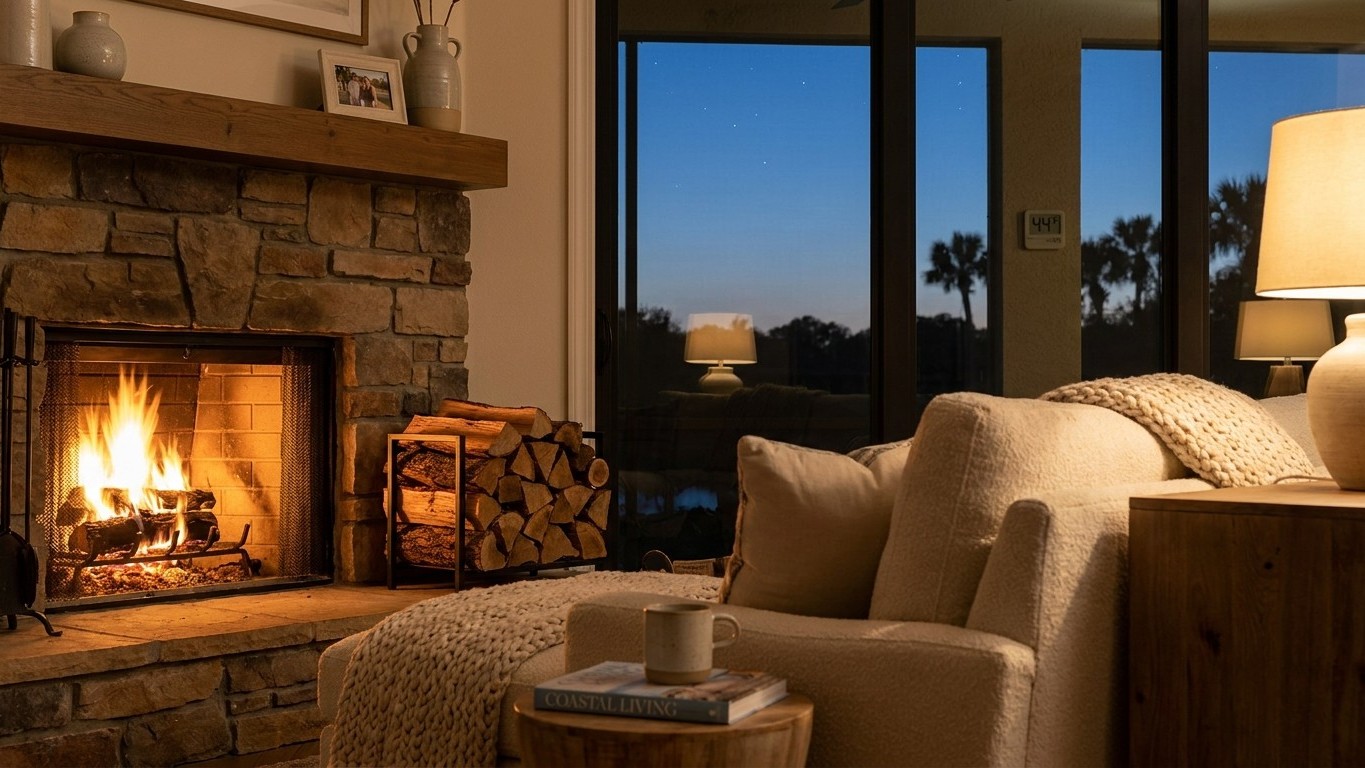

If you’re wondering whether you actually need a cord of oak this winter or just a bundle from the gas station, the answer starts with one number: 42.9°F. That’s the average low for the coldest month in Jacksonville, and it tells you almost everything you need to know about heating with wood in Florida. This isn’t survival territory. It’s comfort, ambiance, and the occasional real cold snap that catches people off guard.
How cold it actually gets here

NOAA’s Climate Normals for 1991-2020 put the average daily minimum for Jacksonville’s coldest month at 42.9°F. That’s not the record low, and it’s not some abstract monthly average that gets skewed by warm afternoons. It’s the number that answers the question homeowners in colder states ask constantly: will the pipes freeze, will the wood stove need to run all night, will a fire matter for actual warmth. In north Florida, the honest answer is: rarely, and not for long.
Compare that 42.9°F to what someone in Minnesota or even Tennessee deals with, and the gap is enormous. A winter that bottoms out in the low 40s on an average night means most days never require supplemental heat at all. The furnace or heat pump handles the rare chilly stretch, and a wood fire becomes something you choose to build, not something standing between you and a cold house. That distinction matters because it changes every other decision, from how much wood to buy to how urgently you need it seasoned.
Florida isn’t uniform, of course. Jacksonville sits in the northern part of the state, and it’s meaningfully cooler in January than Tampa or Miami. If you’re further south, treat 42.9°F as a ceiling on how cold it gets in the reference climate, not a floor. Panhandle and north-central counties see actual frost and the occasional freeze warning; south of Orlando, a “cold night” often just means throwing on a sweater. Wherever you are, the mild baseline holds: this state doesn’t ask firewood to carry a household through winter the way Wisconsin or Vermont does.
What that means practically: heating through a Florida winter with a bottom around 42.9°F is not a fuel-security problem. Nobody here needs three cords stacked against the shed for insurance. The real use case is a fireplace lit on the handful of nights it actually drops into the 30s, or a fire pit running most weekends from November through February because it’s pleasant, not because the alternative is hypothermia. That’s a different set of priorities than a cold-climate guide would give you, and it’s worth being upfront about it rather than pretending Florida winters demand the same stockpile a northern household needs.
If your only goal is comfort and atmosphere, the rest of this guide is written for that reader. You’re not choosing wood to survive January. You’re choosing wood that lights easily, smells good, and burns long enough to enjoy an evening outside or by an open hearth.
Which woods are worth the effort here
Because a winter this mild rarely tests a wood’s endurance, the usual advice to “always buy the densest hardwood available” doesn’t apply with much force. Density still matters, it’s just a different kind of decision. A cord is a fixed volume, a stack measuring 4 feet by 4 feet by 8 feet, or 128 cubic feet total, according to Michigan State University Extension. A denser species packs more actual wood mass into that same volume, which is why a cord of a heavy hardwood delivers meaningfully more heat than a cord of a light one, even though both take up the identical footprint in your yard.
MSU’s figure for well-seasoned hardwood averages around 20 million BTU per cord, comparable to roughly 145 gallons of #2 fuel oil or 215 gallons of LP gas. That’s the number worth anchoring to when you’re deciding whether a load is worth the price. But it’s an average across species and moisture levels, not a guarantee for any specific delivery, and a load that’s still damp inside will fall well short of it no matter what tree it came from.
In a climate like Florida’s, where a fire is often lit for a handful of genuinely cold nights and a lot of pleasant-but-not-cold evenings, it makes sense to think in two categories rather than chasing the single “best” wood. For the rare hard freeze or the night you actually want serious, sustained heat, a dense hardwood is worth seeking out, because it holds a bed of coals overnight and won’t need feeding every hour. For everything else, a lighter, easier-to-split wood does the job fine: quick to light, good for shoulder-season evenings, and not something you need to babysit. Check the species comparison guide on this site for the density and BTU rankings before you buy, since matching the wood to the actual use matters more here than defaulting to whatever’s marketed as “premium.”
Local availability ends up mattering as much as any chart. A species with excellent numbers on paper is worthless to you if the only supplier within driving distance can’t deliver it seasoned. Red oak, for instance, is a wood MSU singles out as slow to dry because of its cell structure, so a red oak load sold as “seasoned” deserves extra scrutiny, not automatic trust. A modest, readily available species that’s actually dry will outperform an impressive one that’s still half-green every time. Ask what’s seasoned and available before you ask what’s theoretically best.
How much wood a winter takes
There’s no honest single number for “how many cords does a Florida winter take,” and anyone who gives you one without asking follow-up questions is guessing. The real estimate depends on three things: how cold your specific winter actually gets, how well your house holds onto heat, and whether wood is your main source of warmth or just a supplement to a working furnace or heat pump.
Start with the cold figure. A winter that bottoms out around 42.9°F on average, like Jacksonville’s, simply doesn’t demand many hours of fire-burning to stay comfortable. That’s the baseline multiplier, and it’s small compared to what a northern climate guide would use. From there, insulation quality swings the estimate hard. A drafty older house with single-pane windows and a leaky attic can burn through twice the wood of a tightly sealed, well-insulated home experiencing the exact same outdoor temperatures, because so much of that heat is escaping before it does any good. In Florida, where many homes are built for cooling rather than retaining warmth, that insulation gap can be significant even in a mild winter.
The third variable is intent. If wood heat is purely supplemental, an evening fire while the HVAC handles the baseline temperature, you might use a fraction of a cord across an entire season. If you’re actually trying to heat a room or a whole house with a wood stove during the handful of cold snaps, the math changes, and you’d size your purchase around the coldest week you realistically expect, not the mild average across the whole winter.
The mechanism to remember: cold figure sets the floor, insulation decides the multiplier, and intent decides whether you’re buying for ambiance or for actual heat load. Skip any of those three, and a published “buy two cords” recommendation is just noise. For most Florida households, the honest starting point is a partial cord bought for the season, with room to buy more only if a hard freeze actually settles in and the fire starts working overtime.
Drying wood in this climate
Seasoning matters more than species anywhere in the country, and Florida is no exception, it just runs on a different clock. MSU’s benchmark is clear: firewood should burn at 20 percent moisture or less, while green, freshly cut wood can run over 60 percent. That difference isn’t cosmetic. Water sitting inside the wood has to boil off before the fire produces usable heat, and that boiling process eats the exact energy you were counting on, which is why a green log hisses, smokes, and refuses to really catch while a seasoned one lights clean and burns hot.
Florida’s long, humid summers complicate the timeline. Humidity slows the release of moisture from split wood compared to a drier climate out west, so the same “one summer stacked” rule of thumb that works elsewhere can take longer here to actually hit that 20 percent target. What dries wood isn’t sunlight, it’s airflow and time. A pile shoved against a fence in full shade with no gaps for air movement will dry slower than an open, elevated stack sitting in partial shade with wind able to pass through it. Split wood dries faster than wood left in rounds, because splitting exposes far more surface area to the air.
Red oak deserves a specific mention, since MSU flags it as unusually slow to season because of its cell structure. If red oak is part of your supply, don’t assume it’s ready on the same schedule as a faster-drying species. Give it more time, and check it rather than trust a calendar.
The most common mistake in a climate like Florida’s is cutting or buying wood in spring and expecting it to be ready for that same winter. Between the humidity slowing evaporation and a mild season arriving faster than a cold-climate winter would, wood split in April or May frequently isn’t down to 20 percent moisture by November or December. If you want reliably dry wood for this winter, it needed to be split and stacked the summer before, sometimes earlier for slower species like red oak. Buying “seasoned” wood from a supplier close to the season doesn’t guarantee it actually reached that threshold, so a quick moisture check, or simply listening for the hiss of trapped water when a log hits the fire, tells you more than the label does.