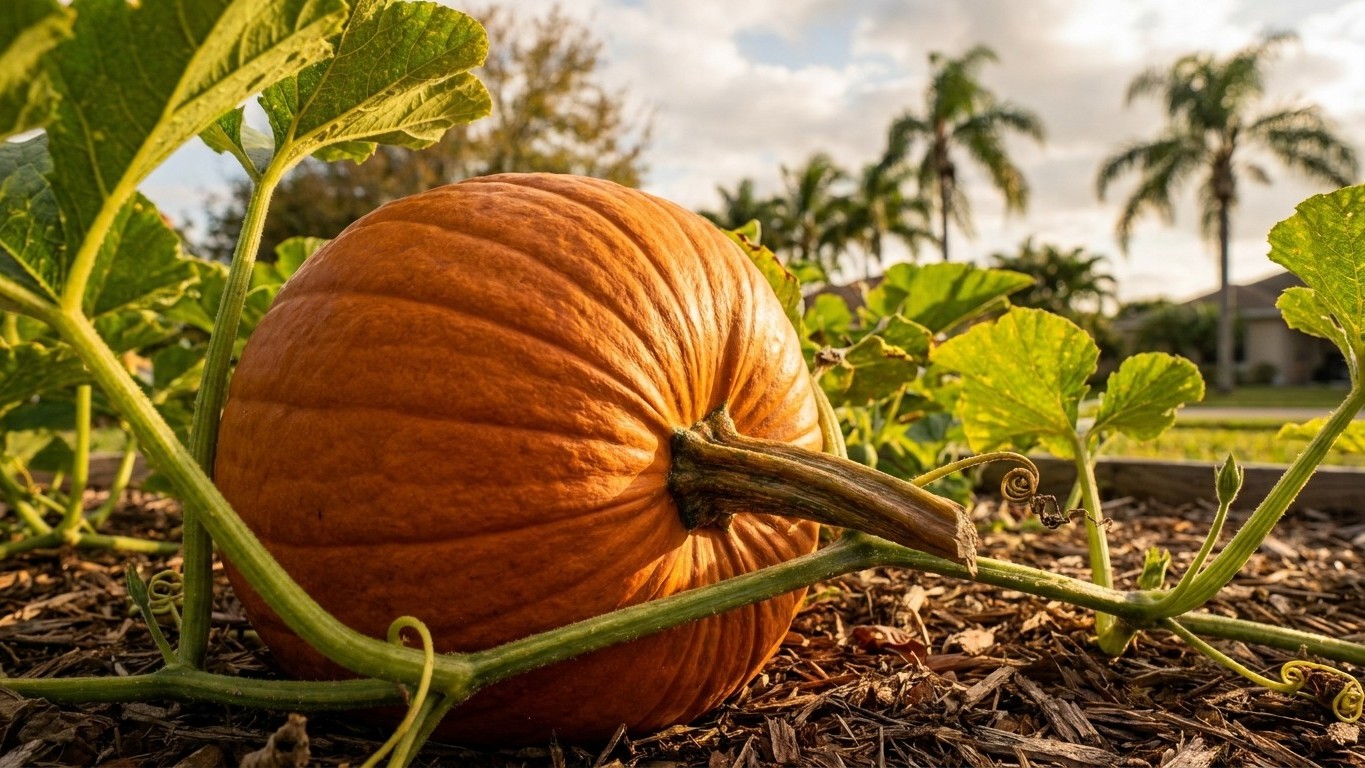

North Florida gardeners can grow a ripe Halloween pumpkin, but the flowering date is what decides it, not the sowing date. Around Jacksonville, the first fall frost lands somewhere between November 26 and December 13, and a pumpkin needs 45 to 55 days from the moment its flower opens to reach a hardened, colored rind. Work back from frost and the flowering deadline falls in October, with little room to spare.
The short answer
Start with the frost, because that’s the fixed end of the calendar. NOAA’s 1991-2020 climate normals for the Jacksonville station put the first fall freeze in a window running from November 26 to December 13. That’s not a guess dressed up as a date, it’s a thirty-year record showing the freeze risk climbing from 30 percent to 70 percent across those days. Some years it slips later. Three of the thirty falls in that record had no freeze at all by the usual cutoff, which tells you this window is a planning tool, not a guarantee either way.
Utah State University Extension’s pumpkin guide gives the other half of the equation: 45 to 55 days from flowering to a mature fruit, and harvest happens with the stem attached, before frost touches the rind. Run the subtraction against both ends of the frost window and both ends of the maturation window, and you get a range rather than a single cutoff.
Using the earliest frost date (November 26) and the slower end of maturation (55 days), a flower needs to open by around October 2 to be safe. Using the same early frost but the faster end of maturation (45 days), that pushes to around October 12. If frost holds off until the latest end of the window (December 13), the deadline for flowering stretches further out, to somewhere between October 19 (55 days) and October 29 (45 days).
So the honest answer is a window, not a date: aim for flowers open by early October if you want a comfortable margin, and treat anything after the last week of October as a gamble on a late frost. Nobody can tell you which end of the frost range this particular fall will land on until it happens, which is really the heart of the question Will Pumpkins Ripen Before Frost in Florida? That uncertainty is baked into the record, and it’s the reason this whole exercise starts from the frost date and works backward rather than starting from a seed packet and hoping.
One more thing worth saying plainly: this window belongs to north Florida, specifically the Jacksonville area where the weather station sits. Central and south Florida don’t get a meaningful fall frost most years, and their pumpkin calendar runs almost the opposite direction, through the cooler months, with summer heat as the real obstacle. None of the fall-frost math above applies south of roughly Ocala.
When to sow here
Sowing date isn’t set by the last frost. It’s set by soil temperature, and the two don’t move together, which is the whole subject of When to Sow Pumpkins in Floridar the way people assume.
- Locate the last spring frost window. For the Jacksonville station, NOAA’s climate normals put it between February 16 and March 7. That’s the point after which the air is unlikely to freeze, based on the same thirty-year record used for the fall window.
- Wait for the soil, not the air, to catch up. Pumpkin seed needs soil at 65 F to germinate reliably, and soil warms weeks behind the air after a frost window closes. A calendar that says frost season is over doesn’t mean the ground is ready. Treat the last-frost date as the earliest the clock could conceivably start, not the day to grab a trowel.
- Use a soil thermometer instead of a calendar. Push it a couple of inches into the bed on a few mornings once the frost window has passed, and sow when the readings hold at 65 F rather than spike there for one warm afternoon.
- Consider row covers if the season feels tight. They trap enough daytime heat to warm the soil faster, and gardeners generally count on them buying about two weeks over bare, uncovered ground. That’s the difference between sowing in a cool stretch and waiting it out.
- Check the resulting date against the flowering deadline from the section above. If soil hits 65 F, covers included, only shortly before your county’s average frost recedes, the vine still has to reach flowering by early-to-late October. Count the weeks between your sowing date and October before committing to a variety, since a slower-growing vine eats into a calendar that isn’t generous to begin with.
What goes wrong here
The gap between “the plant grew fine” and “the pumpkin is actually ready” is where north Florida’s season length causes trouble. Three failures show up more than any others.
- A late flower that never colors up. If the first female flowers don’t open until November, the fruit is still green and hard when frost arrives, no matter how healthy the vine looked all summer. The remedy is upstream: track your sowing date against the arithmetic in the section above, and if the math is tight, choose a variety on the shorter end rather than hoping frost arrives late.
- A fruit caught by frost before the rind hardens. A pumpkin can look orange and still have a soft, unhardened shell if it hasn’t had the full 45 to 55 days. Harvest with the stem attached as soon as a hard frost is forecast, even a few days early, rather than leaving it on the vine gambling for extra color.
- A vine that dies back before the skin hardens. Foliage can collapse from disease pressure or from the season’s own humidity and heat stress well before the fruit has finished maturing, leaving a pumpkin stranded mid-ripening with no leaves left to feed it. Watching vine health through the final weeks matters as much as watching the calendar, since a dying vine cuts the maturation clock short regardless of how many days are technically left.
- Insect pressure that stalls a vine right when it needs to be racing the calendar. Squash bugs and cucumber beetles both weaken vines enough to slow fruit development, and a slowed vine in a short season is a vine that misses the October flowering deadline. Both pests have their own dedicated pages on this site covering identification and control specific to Florida growing conditions, worth checking before symptoms cost you weeks you don’t have.
Checking this against your own county
Everything above is anchored to one weather station near Jacksonville, and Florida’s frost patterns shift fast moving south or even a short distance inland. Your own county’s UF/IFAS Extension office keeps localized frost and planting guidance that reflects your actual microclimate rather than a single airport’s thirty-year average. The UF/IFAS Extension directory lets you find your county office directly, and a quick call or visit there will tell you whether your local frost dates run earlier, later, or roughly in line with the Jacksonville window used in this guide.
Common questions
Can I still get a ripe pumpkin if my flowers open in November?
It’s unlikely in north Florida. With frost arriving as early as November 26 in some years, a flower opening in November leaves less than the 45 days a pumpkin needs at minimum, and the fruit typically stays green and soft.
Does a light frost kill the vine outright?
The facts behind this guide don’t publish a separate threshold for light versus hard frost, only the freeze-probability window itself. Treat any frost in that window as the point past which fruit still on the vine is at risk, and harvest ahead of it rather than waiting to see how severe it turns out to be.
Why does soil temperature matter more than the frost date for sowing?
Pumpkin seed simply won’t germinate reliably in cold soil, and soil warms up weeks slower than the surrounding air. A frost-free morning tells you the air is safe, but it says nothing about whether the ground a few inches down has caught up.
Does this frost window apply to Orlando or Miami?
No. The window in this guide comes from a Jacksonville station and reflects north Florida’s climate. Central and south Florida rarely see a meaningful fall frost, and their pumpkin-growing calendar runs on a different logic entirely, built around avoiding summer heat rather than racing an autumn freeze.