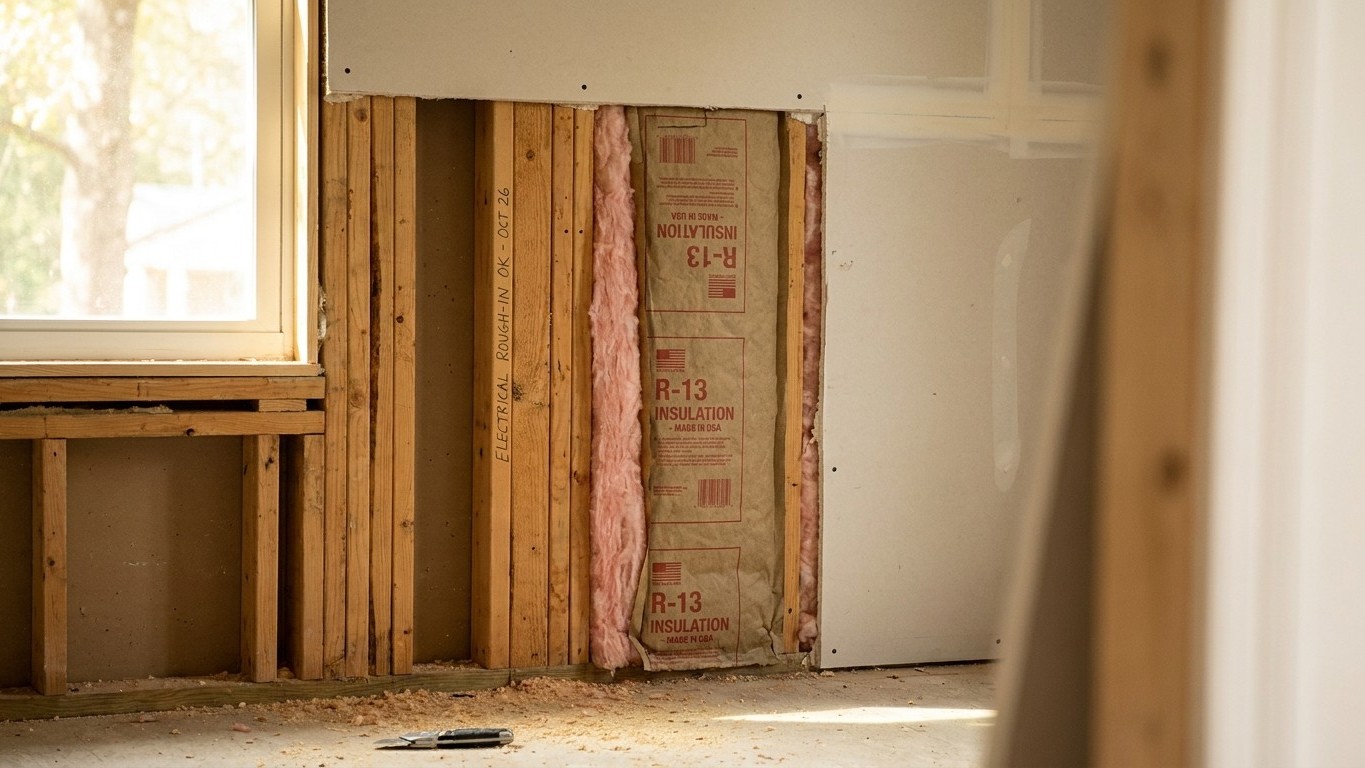

The answer splits three ways across Oklahoma’s 77 counties. In the 59 counties mapped to Climate Zone 3A, the 2021 International Residential Code does not require an interior vapor retarder on frame walls. In the 15 counties in Zone 4A and the 3 counties in Zone 4B, the general rule does apply, and a Class I, II or III retarder is expected on the interior side of the wall assembly.
What the code asks for in Oklahoma

Section R702.7 of the 2021 International Residential Code states it plainly: a vapor retarder of the class listed in Table R702.7(2) “shall be provided on the interior side of frame walls.” That is the baseline rule for the whole country. The code then carves out four exceptions, and the one that changes everything for a state like Oklahoma reads: “A vapor retarder shall not be required in Climate Zones 1, 2 and 3.”
Oklahoma’s 77 counties don’t sit in one zone. Fifty-nine of them fall in Zone 3A, which means the interior vapor retarder requirement is lifted there under the code exception. Fifteen counties sit in Zone 4A, and three more in Zone 4B. Zone 4 is not named in that exception list, so the general requirement stands in those 18 counties: a Class I, II or III retarder belongs on the interior face of the wall, per the table.
That is not a rounding error. A homeowner in a Zone 3A county and a homeowner in a Zone 4A county, sometimes two counties apart, are working under different obligations for the exact same wall assembly. Dropping the retarder in a 3A county is not doing something forbidden. It removes an obligation, and it happens to line up with what the wall physically wants in that climate, which the next section explains. Skipping it in a 4A or 4B county, on the other hand, means building against the code’s default row in that table.
Why this matters more than it looks
A wall built with the wrong vapor control doesn’t announce the problem at closing, or even in the first winter. The framing takes on moisture slowly, Insulation loses R-value quietly, and the rot shows up years later when someone opens the wall for a renovation or a leak investigation. Nobody has ever failed a home inspection over vapor retarder class on the day of the sale. That is exactly why the rule matters, and exactly why it is worth checking rather than guessing.
None of this tells an individual reader which county they’re in or what to install in their own wall. The county-by-county zone assignment sits in the IECC’s official table, and the local building department is the authority that applies it, because the code in force is whatever edition and whatever amendments that jurisdiction has adopted, not necessarily the model code as written above.
Why the answer is the opposite in a warm climate
The zone exception isn’t an accident of drafting. It follows the direction water vapor actually travels, and that direction flips depending on the season and the climate.
In a cold-dominated climate, the moisture problem starts inside the house. Heated indoor air carries water vapor, that air pushes toward the colder wall cavity in winter, and if it reaches the cold sheathing on the exterior side it condenses there. A Class I or Class II retarder on the interior side blocks that vapor before it gets that far. This is the logic behind the base rule in R702.7, and it’s why colder zones keep the requirement.
In a warm-humid climate, the moisture arrives from the other direction. Outdoor air is loaded with water vapor for much of the year, and it pushes inward through the wall toward the cooler, air-conditioned interior. If that wall has an impermeable layer, like sheet polyethylene, sitting on the interior side of the insulation, the vapor coming from outside hits that layer and has nowhere to go. The U.S. Department of Energy’s Building America program describes the outcome directly: “If the wall contains a vapor retarder on the interior side of the insulation, the water vapor will condense on this cool, impermeable surface,” resulting in “ruined insulation, mold, and structural rot of framing members.”
That single sentence is why the code writes different rules for different zones. It isn’t paperwork for its own sake. It’s an acknowledgment that the same material, installed the same way, does opposite things depending on which side of the wall the water is trying to leave from. A wall in a Zone 3A Oklahoma county and a wall in a Minnesota Zone 6 county are not variations on the same problem. They’re facing the problem from opposite sides.
The three classes, and why the word matters
Code language separates vapor control materials into three classes by how much moisture they let through, measured in perms. The number, not the brand name, is what the code is actually regulating.
| Class | Example materials | Perm range |
|---|---|---|
| Class I | Sheet polyethylene, nonperforated aluminum foil | 0.1 perm or less |
| Class II | Kraft-faced fiberglass batts, vapor retarder paint | Above 0.1 up to 1.0 perm |
| Class III | Latex or enamel paint | Above 1.0 up to 10.0 perm |
Sheet polyethylene is Class I, but calling it “a vapor barrier” without that label skips the part that actually matters. The disagreement between a builder finishing a wall in a Zone 3A county near Oklahoma City and a builder finishing one in a Zone 4A county isn’t about whether to use vapor control at all. It’s about which class belongs on that wall, and an impermeable Class I sheet is the one most likely to cause trouble if it ends up on the wrong side of a warm-humid assembly.
Here’s the detail most homeowners miss: ordinary latex wall paint qualifies as a Class III vapor retarder. Anyone who has painted an interior wall with a standard latex finish already has a retarder in place, whether they intended one or not. That’s usually enough to satisfy a Class III requirement on its own, without adding a separate membrane.
One more distinction worth keeping straight: a vapor retarder and an air barrier do different jobs. A vapor retarder slows the diffusion of water vapor through a material. An air barrier stops bulk air movement, which can carry far more moisture, far faster, through gaps and cracks. Some products do both jobs at once, but the code addresses them separately, and satisfying one doesn’t automatically satisfy the other.
Where the rule stops
Beyond the climate-zone exception, R702.7 lists three other situations where the interior vapor retarder requirement doesn’t apply:
- Basement walls
- The below-grade portion of any wall
- Construction where accumulation, condensation, or freezing of moisture will not damage the materials
The basement exception is the one most readers actually run into. A poured concrete or block foundation wall sits in contact with soil that holds moisture year-round, and that wall absorbs and releases water for as long as it stands. That assembly needs to be able to dry toward the interior. Sealing it with an impermeable sheet on the inside face traps the moisture that’s already migrating through the concrete, with nowhere for it to go, which is the same condensation problem described above, just below grade instead of above it. The detail on how to handle vapor control in a basement wall specifically, including where the exception applies and where it doesn’t, is covered in this site’s basement wall vapor barrier guide.
The third exception, for construction where moisture won’t damage the materials, covers assemblies built from materials that simply don’t rot, corrode, or lose performance when damp, which removes the need for the protective layer in the first place.
Who actually decides, in Oklahoma
The 2021 International Residential Code is a model code. States and local jurisdictions adopt it, sometimes with amendments, sometimes on a delay of a code cycle or more, and the version actually enforced on a given project is whichever edition that jurisdiction has adopted at the time of permitting. That’s true everywhere, but it carries real weight in a state that spans three climate zones, because the zone assignment for a specific county is what determines whether the retarder exception applies at all.
Oklahoma’s winters give some sense of why this question has weight in the first place. Oklahoma City Will Rogers World Airport averages about 3,615 heating degree days a year against a 65 F base, alongside about 1,867 cooling degree days. Heating degree days measure demand, not temperature: each day’s shortfall below 65 F adds to the total, so a bigger number means more fuel burned to keep a house warm over the course of a year. That figure puts Oklahoma in a moderate range, a heating season real enough to matter but nowhere near the totals a northern state racks up, which lines up with a state where most counties fall in the milder Zone 3A rather than the colder end of the map.
None of that changes the fact that this page can’t tell an individual reader what belongs in their own wall. The local building department holds the answer for a specific address, because they know which code edition and which amendments apply there, and which zone that county has been assigned. A wall built with the wrong vapor control doesn’t fail an inspection on the spot. It fails quietly, over years, and the owner usually finds out only when the wall is already open.