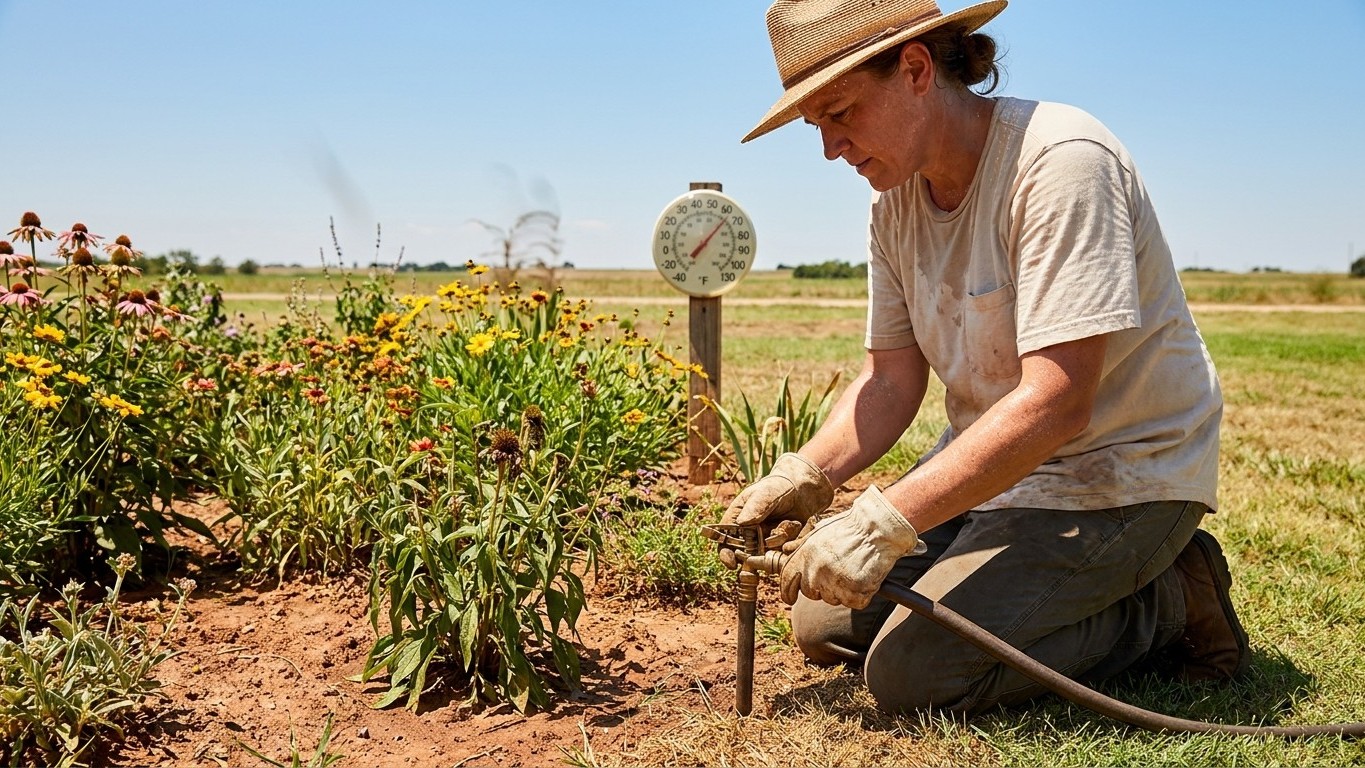

Oklahoma has no single statewide watering law. What decides your schedule is the climate at your address, the ground under your feet, and whatever your city or rural water district has posted this summer. Here’s how to read all three, using the numbers that actually apply to this state.
What the climate asks of you

Start with the number that rules out any illusion of an easy summer: at the Oklahoma City reference station, an average of 70.7 days a year reach 90F or higher, according to NOAA’s 1991-2020 Climate Normals. That’s not a heat wave. That’s ten weeks of the year where a garden bed is losing water to the air faster than most people assume, and it’s the figure that rules out treating a cool-season lawn or a shallow-rooted planting the way you would in a milder state.
What isn’t in the official normals data for this page is a single, defensible rainfall figure for June, July, and August at that same station, and this is a case where guessing does more harm than good. Oklahoma spans a real climate gradient, from the wetter southeast to the semi-arid panhandle, and a single “average summer rainfall” number for the whole state would flatten a difference that matters enormously to a gardener. If you want the number for your own yard, your local OSU Extension office or the nearest NOAA cooperative station can give you the actual monthly totals for your county, and that’s worth five minutes before you set a sprinkler timer for the season.
What you can plan around without guessing: a garden bed generally wants about an inch of water a week during the growing season, whatever the source. In a state with 70.7 days a year above 90F, that water leaves the soil fast, through evaporation off the surface and transpiration through leaves working overtime to stay cool. If your particular week happened to get less than an inch from the sky, and in an Oklahoma summer that’s the way to bet, you’re the one making up the difference with a hose, and knowing how to go about Watering Through a Dry Spell in Oklahoma can save both water and plants. The same logic applies to soil texture: sandy ground in the state’s western counties drains an inch of rain through in hours, while the heavier clay common in central and eastern Oklahoma can hold that same inch for a week. Two gardens getting identical rainfall can need completely different watering schedules once the ground itself is factored in, and that gap only widens once you move from open beds to pots, where the rules for Watering Pots and Containers in Oklahoma change again because the soil volume is so much smaller.
How much, how often
Deep and infrequent beats a daily sprinkle every time, and the reason is root behavior, not habit. A garden watered lightly every day trains roots to stay near the surface, where the top inch of soil dries out first and fastest, especially with 70.7 days a year pushing past 90F. A garden watered deeply once or twice a week pushes roots down into moisture that survives the afternoon heat. The test for whether it’s time to water isn’t the calendar, it’s the ground: push a finger, or a small trowel, about two inches into the soil near the base of the plant. If it comes out dry at that depth, water. If it’s still cool and damp, wait another day.
Soil texture changes the math here more than most gardeners expect. On sandy ground, water passes through quickly and doesn’t hold much, so shorter, more frequent soakings work better than trying to force a week’s worth into one session that mostly runs off or drains past the root zone. On heavy clay, which covers a lot of central and eastern Oklahoma, the soil holds a week’s worth of moisture, but watering it again before it’s actually dried out drowns roots in a soil type that already drains slowly. Clay that’s still wet also shouldn’t be dug, tilled, or walked on repeatedly. It compacts into something closer to concrete once it dries.
With 70.7 days a year above 90F and no dependable summer rainfall figure to lean on for this state, treat July and August as irrigation months rather than rain-fed ones, and adjust the frequency below based on what actually falls in your county that week.
A basic watering routine
- Check soil moisture at two inches down before you water at all, using a finger or trowel, not a fixed day of the week.
- Water at the base of the plant, not overhead, first thing in the morning, so leaves dry before the day’s heat and fungal disease has less of a window.
- Apply roughly one inch of water, adjusted for whatever rain actually fell, in a single deep session rather than splitting it into daily sips.
- On sandy soil, shorten the interval and water more often in smaller amounts; on clay, lengthen it and let the soil dry between waterings.
- Reduce frequency once fall approaches, when the reference-station data puts the first freeze between October 29 and November 8, and growth slows on its own.
Restrictions and rules
Watering restrictions in Oklahoma are set locally, by individual municipal water utilities and rural water districts, not by a single state law, and they change from year to year depending on reservoir levels and drought conditions. Some cities run odd-even day schedules by address during dry summers, others restrict watering hours to early morning and evening, and some have no formal restriction at all until a drought emergency is declared. There’s no way to state a single rule here that will still be accurate by the time you read it.
Given the state’s exposure to hot, dry summer stretches (again, 70.7 days a year above 90F at the reference station), restrictions are a real possibility almost every summer somewhere in Oklahoma, and they tend to arrive with little notice once a drought stage is declared. Before you set an automatic timer for the season, check with your specific water provider. Municipal customers can usually find current rules on their city’s water department page, and rural customers should contact their rural water district directly, since those districts often set their own separate policies. Fines for violating an active restriction are common enough that it’s worth the five-minute check rather than finding out the hard way.
Using less
Cutting water use in an Oklahoma garden isn’t about watering less carefully, it’s about losing less of what you put down. A few changes do most of the work, and they stack.
- Mulch, two to three inches deep: cuts surface evaporation dramatically on the days that matter most, the ones pushing past 90F, and keeps soil temperature more stable around the root zone.
- Drip irrigation or soaker hoses: deliver water at the base, where roots actually are, instead of losing a share to evaporation and wind drift the way overhead sprinklers do.
- Grouping plants by water need: keeps a thirsty vegetable bed from being watered on the same schedule as a drought-tolerant native planting next to it, so neither gets overwatered or underwatered to compensate for the other.
- Organic matter worked into the soil: improves how much water sandy soil can hold and how well heavy clay drains, closing the gap between the two extremes found across the state.
- Rain barrels, where local rules allow them: an inch of rain falling on a 1,000-square-foot roof works out to roughly 600 gallons of runoff, a standard rainwater-harvesting figure. In Oklahoma, that math cuts both ways: a barrel fills fast during a wet spring storm, but with 70.7 days a year above 90F and long dry stretches typical in mid-summer, that same barrel can sit empty for weeks right when the garden needs it most. It’s a supplement to a hose, not a replacement for one.
Common questions
What USDA hardiness zone is Oklahoma in?
Oklahoma spans USDA zones 6a to 8a, according to the 2023 Plant Hardiness Zone Map. That’s a wide range for one state, so treat the reference city, not the statewide range, as your planning point, and confirm your own zone using your county rather than assuming a state average applies to your yard.
When is the last frost in Oklahoma?
At the reference airport station used for NOAA’s 1991-2020 normals, the last spring frost typically falls between March 28 and April 10. Suburban and rural gardens tend to see frost linger later than that, often by one to two weeks, and more at higher elevation, so check your own county’s typical date before setting out tender transplants.
When does the first fall frost usually hit?
The same reference station puts the first fall frost between October 29 and November 8. As with the spring date, outlying areas away from the station often see frost arrive earlier, so use this as a starting estimate rather than a guarantee for your specific property.
Who do I contact about watering restrictions in my area?
There’s no statewide watering restriction in Oklahoma, so the answer depends entirely on your water provider. Municipal customers should check their city water department’s current rules, and rural customers should contact their rural water district directly. For general growing and irrigation guidance tailored to your county, Oklahoma State University Extension is the right first call.