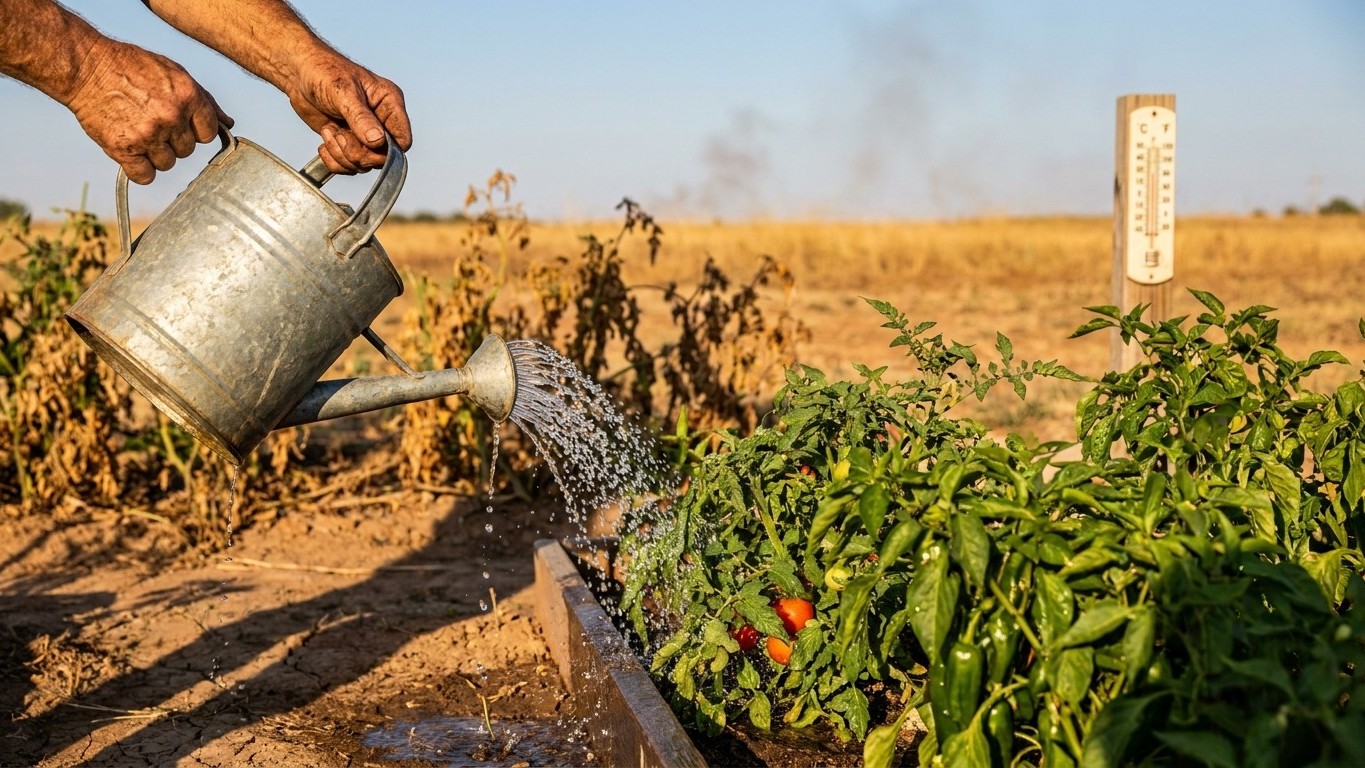

Oklahoma gardens face a rough combination: a dry midsummer month and more than ten weeks of 90-degree heat each year. That means the sky alone rarely covers what a vegetable bed or flower border needs from June through August, and the gap has to be filled by the hose, on a schedule that matches the ground, not the calendar.
What changes here

Two numbers set the terms for watering in Oklahoma. The driest summer month, July, brings just 3.59 inches of rain on average. At the same time, the reference station logs 70.7 days a year at or above 90F. Put those together and the message is blunt: the hottest stretch of the growing season is also the driest one, so evaporation and plant demand peak exactly when the sky is giving the least.
Run the arithmetic on a single week. A vegetable bed generally wants about an inch of water a week to keep roots hydrated and growth steady. July’s 3.59 inches, spread over roughly 4.3 weeks, works out to about 0.83 inches a week from rainfall alone. That leaves a shortfall of roughly 0.17 inches the gardener has to carry in themselves, most weeks. On a modest 10-square-foot bed, that gap alone is close to a gallon of water the sky simply didn’t deliver. And that’s an average month: Oklahoma’s summer rain often arrives as a single heavy thunderstorm rather than steady drizzle, so several weeks can pass with none of that 3.59 inches showing up at all, followed by a downpour that runs off more than it soaks in.
Soil texture decides how far that inch travels once it lands. On sandy ground, water drains through quickly and out of reach of roots within a day or two, so the same rainfall or hose session needs to be repeated sooner. On heavy clay, that inch can sit in the root zone for the better part of a week, but it also drains slowly enough that a second watering before the first has soaked in can leave roots sitting in water they can’t use. Neither soil type changes how much water a plant needs. Both change how often you have to show up with the hose to deliver it.
How to water when it matters
The method that works with Oklahoma’s climate is deep, infrequent watering at the base of the plant, done in the morning. Deep watering pushes moisture down to where roots actually live, six inches or more, instead of wetting only the surface. Infrequent watering forces roots to grow downward chasing that moisture, which builds a plant that can ride out a dry week instead of one that panics the day the hose breaks. Watering at the base, rather than overhead, means the water goes where it’s needed instead of evaporating off leaves in the afternoon heat. Morning watering gives the soil surface time to dry before evening, which matters more in a state logging over 70 days above 90F than almost anything else on this list.
Checking whether the ground actually needs water beats guessing. A finger pushed two inches into the soil, or a trowel pulled up for a quick look, tells you more than staring at the surface ever will. Topsoil can look bone dry an hour after a storm while the root zone underneath is still soaked, or look damp on top while the roots six inches down are parched.
Soil texture sets the rhythm from there. Sandy ground holds little water, so shorter, more frequent soakings suit it better than one big weekly dose. Heavy clay holds a week’s worth of water if it’s given the chance, but watering it again before it’s had time to dry invites root rot rather than drought stress. A reasonable starting point for a Oklahoma vegetable or flower bed is the sequence below, adjusted after checking your own soil with a finger test:
- Water deeply once or twice a week, aiming for about 1 inch total, delivered at the base of the plant rather than overhead.
- Check soil moisture two inches down before each session with a finger or trowel; skip the watering if it’s still damp.
- Water in the early morning, before the day’s heat sets in, so the soil surface dries out by evening.
- On sandy soil, split that inch into three shorter sessions a week instead of one or two long ones.
- On clay soil, water less often but let each session run longer, and always confirm dryness before repeating.
Treat that as a starting rhythm, not a rule. The only way to know it’s right for a specific yard is to check the soil itself, week after week, until the pattern becomes obvious.
What goes wrong
Watering a little every day
A quick daily sprinkle feels responsible, but it only wets the top inch of soil. Roots follow the water, staying shallow and close to the surface, right where 70.7 days of 90-degree heat can bake them. Deep, infrequent watering trains roots downward instead, into soil that stays cooler and holds moisture longer.
Wetting the leaves in the evening
Overhead watering at night leaves foliage damp for hours with no sun or breeze to dry it. That standing moisture is exactly what fungal disease needs to take hold, turning a healthy plant into a spotted, wilting one within days.
Trusting a passing shower
A summer thunderstorm can dump rain hard enough to run off the surface without ever reaching root depth, especially on compacted or clay soil. The bed looks watered. It isn’t. A finger pushed two inches down after the storm settles the question the sky won’t answer honestly.
Skipping the mulch
Bare soil in a state averaging over ten weeks of 90-degree days loses moisture to the sun almost as fast as it’s applied. A few inches of mulch around the base of plants slows that evaporation and stretches every gallon carried out to the garden considerably further.
Local help
The Oklahoma State University Extension offers guidance tailored to local soils and growing conditions across the state. Watering restrictions vary by city and water district, and they change with drought conditions, so check with your own municipal water provider for the rules that apply to your address before setting an outdoor watering schedule.
Common questions
Is 3.59 inches in July enough for a vegetable garden in Oklahoma? No. Spread over the month, that comes to roughly 0.83 inches a week, short of the roughly 1 inch most vegetable beds need, and often delivered in one storm rather than evenly.
How many days a year does Oklahoma hit 90F or above? The reference station averages 70.7 days a year at or above that mark, which is the main driver of summer watering demand.
Does clay soil mean I can water less often in Oklahoma? Less often, yes, but not less overall. Clay holds water longer than sand, so sessions can be spaced further apart, but each one should still deliver enough to reach root depth.
Where can I find Oklahoma-specific gardening advice? The Oklahoma State University Extension publishes guidance for the state’s soils and climate, and your local water utility can confirm any current watering restrictions.