
Sow winter squash seed outdoors in Oklahoma once soil has warmed past the last spring frost window, which runs March 28 to April 10 at the reference station. Count backward from the first fall frost, October 29 to November 8, to set your final sowing date. Everything else on this page explains why that window narrows fast once you factor in what actually grows here.
The short answer for Oklahoma
Winter squash is frost-tender at both ends of its life, so the sowing window sits entirely between the two frost bands recorded at the Oklahoma City reference station (USW00013967): last spring frost March 28 to April 10, first fall frost October 29 to November 8. Those dates mark a 30-70% freeze probability, not a guarantee, which means a grower who plants right at March 28 is betting against roughly a coin flip that a freeze still shows up.
Winter squash needs 80 to 115 days from seed to harvest depending on the type, and that maturity clock has to finish before the earliest end of the fall frost band, October 29, not the latest. Working backward from October 29, a squash needing 100 days should go in the ground by July 21 at the very latest, and a 110-day type needs to be seeded by July 11. Because the caution attached to these frost dates warns that county gardens away from the airport station often see fall frost arrive one to two weeks earlier, the safer practical cutoff is closer to the Fourth of July for anything slower than 90 days.
The other number that shapes the calendar is heat, not frost. Oklahoma City averages 70.7 days a year at 90F or above, and squash flowers stop setting fruit reliably once afternoon temperatures push past the mid-90s for days in a row. That makes early planting worth more than the frost math alone suggests: seed going in soon after April 10 puts flowering in late May or June, ahead of the worst of that 70.7-day heat load, rather than in the thick of it.
| Squash type | Typical days to maturity | Fits Oklahoma City window (Apr 10 to Oct 29)? |
|---|---|---|
| Acorn | 80-85 days | Yes, wide margin |
| Delicata | 80-100 days | Yes, with April-May sowing |
| Butternut | 90-100 days | Yes, sow by late June |
| Spaghetti | 90-100 days | Yes, sow by late June |
| Hubbard | 100-115 days | Only with April sowing; risky after early July |
What will not work here
A hubbard or other slow, large-vined type sown in mid-July is the most common way this fails. A 115-day squash sown July 15 needs to finish around November 7, which is already past the late end of the fall frost band, and past the early end by more than a week. Add the caution that county gardens outside Oklahoma City often see frost a week or two sooner than the station reads, and that planting has effectively no margin left.
Watering once a week fails for a different reason. Summer rainfall across June, July and August averages only about 11.7 inches, and July, the driest month, brings just 3.59 inches. Pair that with 70.7 days a year above 90F, which drives heavy evaporation from both soil and leaf surface, and a single weekly soaking cannot keep pace once fruit is sizing. Squash plants under that kind of heat load pull water fast, and a garden relying on rainfall alone through July will see blossom drop and stunted fruit before the plant ever runs out of season.
Dense spacing is another quiet failure. Rain here tends to arrive as bursts rather than steady drizzle, given that 11.7 inches falls across only three summer months, and squash foliage packed close together holds that moisture on the leaf surface longer after a downpour. Warm nights on top of wet leaves is the exact combination that lets powdery mildew take hold on winter squash, and a crowded planting loses the airflow that would otherwise dry leaves out between storms.
Seeding too early carries its own risk. Soil that is still cold from a late-arriving spring, which the March 28 end of the frost band suggests is entirely possible, rots squash seed before it germinates rather than saving time. The seed does not benefit from getting a jump on the calendar if the ground underneath it hasn’t caught up.
What changes across Oklahoma
Oklahoma spans hardiness zones 6a to 8a under the USDA system, a range built on one measure, average annual extreme minimum temperature, and that spread alone tells you this state has no single planting date. A garden at the cold end of that range, generally the Panhandle and parts of the northwest, sits in a shorter, later-starting season than one at the warm end, generally the south-central and southeast parts of the state.
A zone 6a garden should expect its own last spring frost to land later than the March 28 to April 10 window recorded at the Oklahoma City station, and its first fall frost to arrive earlier than October 29. That compresses the safe sowing period on both ends, which matters most for anything in the hubbard range of 100 to 115 days: a type that barely fits the Oklahoma City window may not fit at all farther north or at higher elevation.
A zone 8a garden, by contrast, likely sees frost dates loosen in the other direction, spring frost ending sooner and fall frost holding off longer, which stretches the safe window and gives more room for slower-maturing types or for a later second sowing.
None of that tells an individual reader which zone applies to their own yard. The right move is checking the current USDA Plant Hardiness Zone Map against a specific address rather than assuming based on the region of the state.
Where to check this for your own county
This page reads frost and heat data from one reference station near Oklahoma City. That is a state-level starting point, not a county forecast, and the gap between the two is exactly what decides whether a hubbard squash sown in early July survives to harvest or not.
Oklahoma State University Extension, at extension.okstate.edu, is the source built to close that gap. Two things on that site are worth the visit specifically for winter squash: the local planting calendar for the reader’s own county, which adjusts sowing windows for frost dates measured closer to home rather than at the Oklahoma City airport, and the list of squash varieties the extension service has actually trialled under local conditions, which factors in things this page can’t, like a county’s typical humidity pattern or its record with squash bugs and vine borers.
A county recommendation from OSU Extension will always beat a state-wide one. This page works from a single reference station’s frost and heat normals; a county extension office works from local trial data and, often, decades of grower reports specific to that soil and that microclimate. Treat this page as the broad framework and the county office as the fine print that actually applies to a specific plot of ground.
If you follow the almanac, here is when to plant winter squash by the moon. It is a tradition, not a proven method.
Checking this against your own garden
Every date on this page comes from a 30-year average at one weather station. The reader’s own soil and plants will always outrank it, and three signs are worth watching before trusting a calendar date over what’s actually happening in the yard.
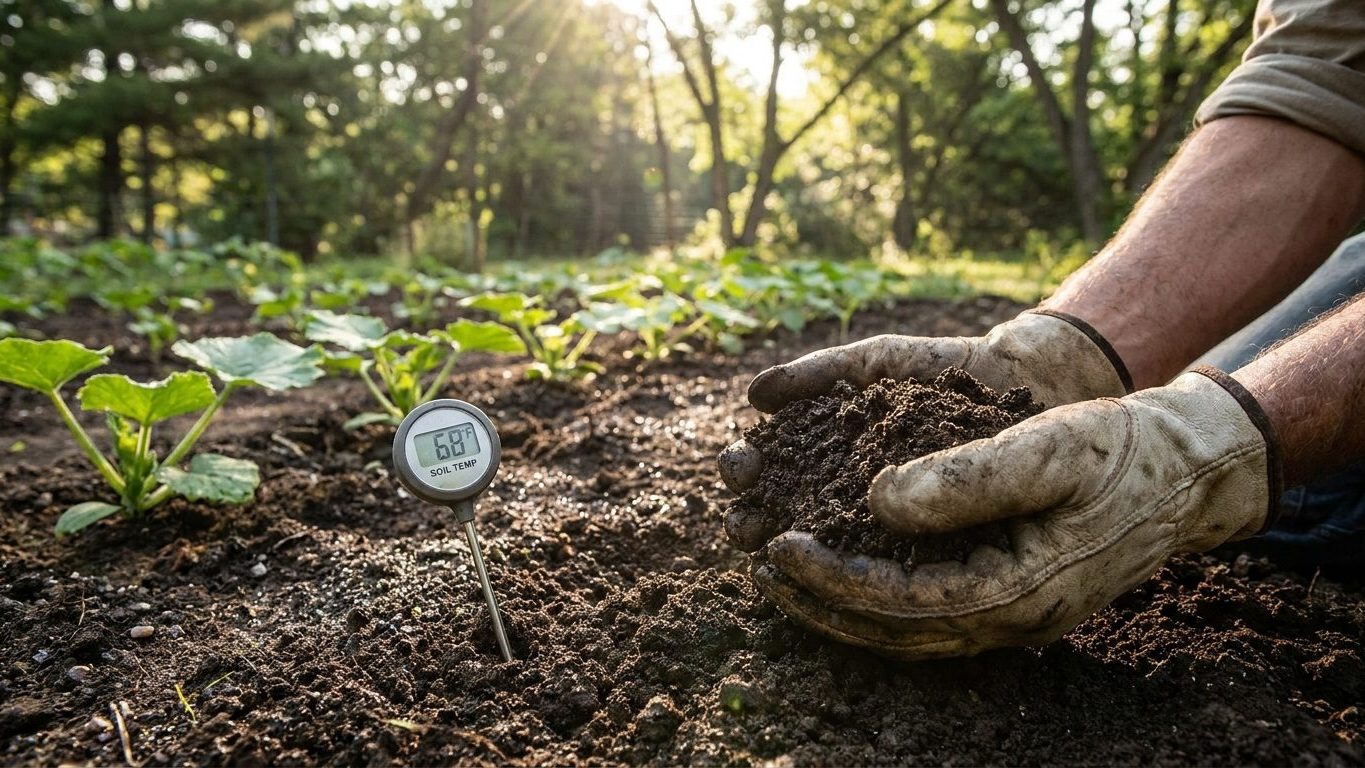
Soil warmth by feel is the first check. Push a hand into the planting bed at the depth seed will go. Squash germinates poorly in soil that still feels cool or damp-cold, regardless of what the March 28 to April 10 frost band suggests about the calendar; waiting until that same soil feels warm and dry enough to crumble is a better signal than the date itself.
The first flush of male flowers is the second. Squash plants typically send out solitary male flowers before the females appear, and the timing of that first flush relative to the region’s own heat pattern says something about how a particular yard is running compared to the 70.7-days-above-90F average: a flush that shows up unusually early may mean a warmer-than-typical microclimate, which shifts the safe planting window earlier too.
First true leaves, the set that appears after the initial rounded cotyledons, mark the point a seedling has actually established rather than just sprouted. How quickly that happens after sowing, compared to what a gardener expects from past seasons in the same bed, is a rough read on whether that particular spot runs warmer or cooler than the county average, which is the kind of detail no frost-date table will ever capture.