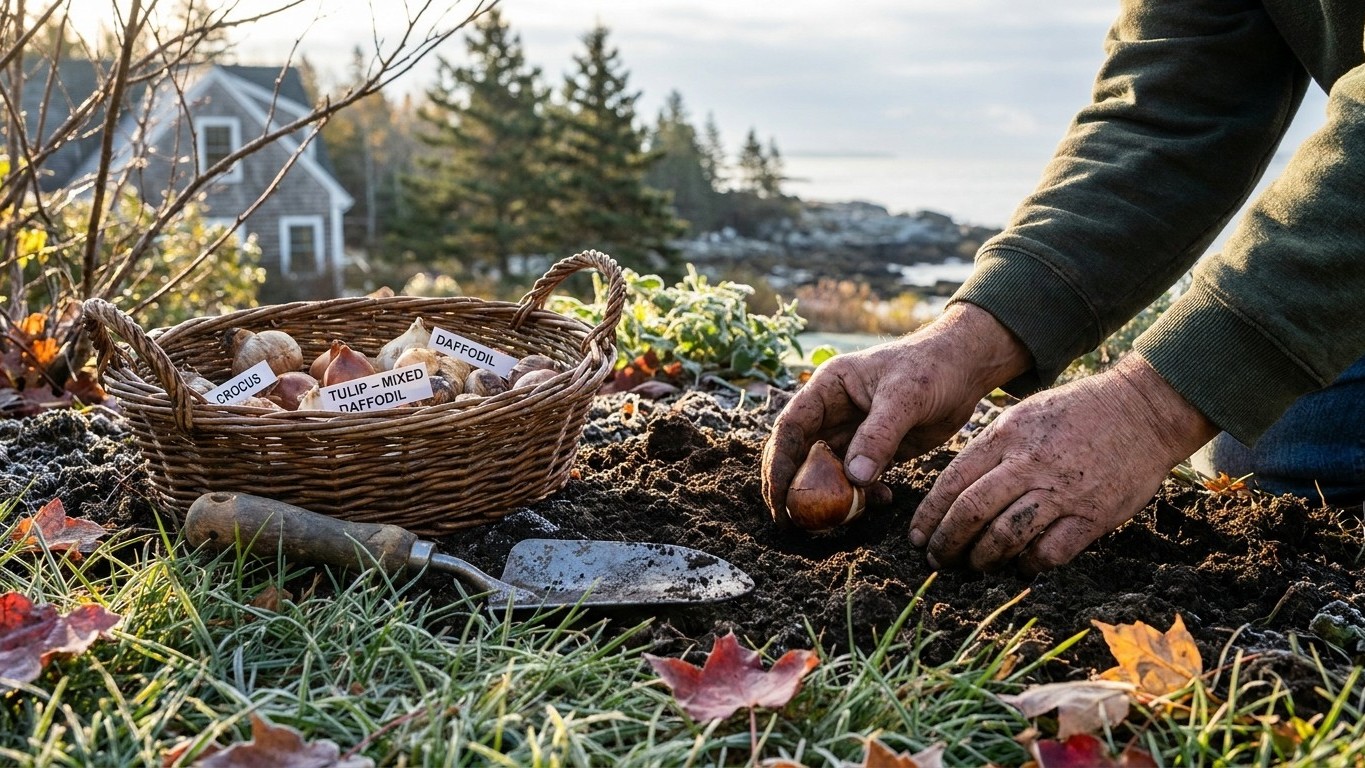

Maine spans hardiness zones 3b to 6a, which means the planting calendar that works in Portland can be three weeks off in Aroostook County. Here’s what actually happens once spring bulbs go into Maine soil, and which ones are wasting their bulbs. Gardeners without reliable in-ground beds, or those dealing with especially harsh microclimates, can sidestep much of this timing pressure by Growing Spring Bulbs in Containers in Maine instead.
When to plant bulbs in Maine

Portland’s first fall frost lands somewhere between October 9 and October 21, based on 30-year climate normals from NOAA. That date is the anchor for bulb planting, not the calendar month. Spring bulbs want to go into the ground roughly six weeks before the soil freezes solid, which in coastal Maine puts the working window in mid-September through late October, tapering earlier the farther north or inland you garden.
The two ends of that window fail differently. Plant too early, while soil is still warm from summer, and a tulip or daffodil bulb can push top growth before real cold sets in. That green shoot gets caught by the first hard freeze and dies back, weakening the bulb before it has even finished rooting. Plant too late, after the ground has started to lock up, and the bulb goes in without enough time to grow roots before winter. It survives, usually, but comes up in spring looking thin and undersized, or sometimes doesn’t come up at all that first year.
An average, not a promise
Worth saying plainly: October 9 to October 21 is an average frost window built from three decades of weather data. Half of all years in that record fell earlier than the window, and half fell later. A gardener who plants by the calendar date alone, ignoring the actual weather in a given fall, is gambling against a coin flip. Watching the soil and the forecast beats trusting a fixed date, especially inland where frost can arrive a full two to three weeks ahead of the coastal reference point.
The practical move is to treat the frost window as a planting deadline rather than a planting date. Get bulbs in the ground by early-to-mid October along the coast, earlier inland, and don’t wait for a hard freeze to prompt you. Soil temperature, not air temperature, is what the bulb responds to, and soil cools more slowly and predictably than the air above it.
Whether your winter is cold enough
Spring bulbs aren’t just surviving winter, they’re using it. A tulip, daffodil, or crocus bulb needs a sustained cold period to trigger the internal chemistry that produces a flower stem the following spring. Most spring bulbs require twelve to fourteen weeks with soil temperatures below about 45°F. Skip that exposure and the bulb usually still produces leaves, but no flower, or a flower bud so short it never clears the foliage. That number matters everywhere in this guide series, because it’s the yardstick against which any bulb, in any state, gets judged, and it’s the same chilling requirement gardeners recreate deliberately when Forcing Spring Bulbs Indoors in Maine.
Maine clears that bar with room to spare. The reference station in Portland records a coldest-month average minimum temperature of 15.6°F, well below the 45°F threshold, and that cold arrives early and holds late. Soil in coastal Maine drops below 45°F by late fall and doesn’t climb back above it until well into spring. Inland and northern Maine, colder still, clear the same threshold even more decisively. This is a state where the chilling requirement is the least of a gardener’s worries.
Cold enough for everything on the standard list
What that margin buys is simplicity. Gardeners in warmer states have to pre-chill tulip and hyacinth bulbs in a refrigerator for about twelve weeks before planting, keeping them away from ripening fruit and vegetables because the ethylene gas they release kills the flower bud inside the bulb. Nobody in Maine needs to do that. The ground does the chilling on its own schedule, months before a fruit bowl would ever come into it.
| Bulb | Cold required | What Maine delivers | Verdict |
|---|---|---|---|
| Tulip | 12-14 weeks below 45°F | Cold arrives by October, holds into April | Ample margin, no pre-chilling needed |
| Daffodil / Narcissus | 12-16 weeks below 45°F | Same extended cold season | Ample margin |
| Crocus | 8-15 weeks below 45°F | Cleared several times over | Ample margin |
| Hyacinth | 8-13 weeks below 45°F | Cleared easily | Chilling fine; watch drainage instead |
| Allium | 8-10 weeks below 45°F | Cleared easily | Ample margin |
The one caution that survives this table isn’t about chilling at all. Hyacinths tolerate Maine’s cold without complaint but resent wet feet, and a heavy clay soil that holds water through a thaw can rot the bulb regardless of how well it was chilled. That’s a drainage problem, not a cold problem, and it’s worth keeping the two separate.
Which bulbs suit Maine
Bulbs whose hardiness range comfortably includes zones 3b through 6a are the ones that come back year after year here without special handling. The following list reflects hardiness range, not just cold tolerance for one season, since a bulb has to survive winter and get its chilling right to reward a gardener over multiple years.
- Daffodil / Narcissus, zones 3-8
- Crocus, zones 3-8
- Snowdrop (Galanthus), zones 3-7
- Siberian squill (Scilla siberica), zones 2-8
- Grape hyacinth (Muscari), zones 3-8
- Allium, zones 3-8 depending on variety
- Species and Darwin hybrid tulips, zones 3-7
A hardiness range is a guideline, not a fence. A bulb rated to zone 4 can still limp along in a sheltered spot against a south-facing foundation in zone 3b, where reflected heat and wind protection buy it a few extra degrees. The same bulb planted in an exposed, open bed nearby can die in a winter that barely troubles its sheltered neighbor. Microclimate matters as much as the map.
Bulbs that disappoint in Maine
Some bulbs sold in garden centers every fall simply aren’t built for this climate, and the failure shows up in specific, recognizable ways rather than a vague “it didn’t work.”
- Anemone blanda, zones 5-8: often survives one winter, then fails to return, having never really been hardy here to begin with.
- Ranunculus, zones 8-10: rots in the ground over winter; treat it strictly as a dig-and-store annual in Maine, not a bulb left in place.
- Freesia and ixia, zones 9-10: these South African natives have no realistic path to surviving a Maine winter and shouldn’t be planted expecting a return bloom.
The common thread in all three is a first-year display that looks fine, followed by nothing the second spring. That gap between planting excitement and second-year disappointment is exactly what a hardiness range is supposed to warn against.
What digs them up here
Squirrels and voles are selective, and the selection comes down to chemistry rather than appetite. Daffodils and other members of the allium family contain compounds that make them bitter or mildly toxic to rodents, so they get left alone in the ground. Tulips and crocus contain nothing of the sort and are, from a squirrel’s perspective, just another root vegetable.
- Bulbs rodents target: tulip, crocus, hyacinth
- Bulbs rodents leave alone: daffodil, allium, snowdrop, Siberian squill
The one measure that consistently works is laying galvanized wire mesh directly over a newly planted bed, pinned down at the edges, and leaving it in place until the ground freezes hard. Squirrels dig in fall, when soil is loose; once the ground locks up, the threat mostly passes and the mesh can come off. Repellent sprays marketed for this purpose wash off with the first rain or heavy dew and need reapplying constantly to do anything at all, which makes them a poor match for an unattended fall planting bed.
Where to check for your own county
Every figure in this guide, the frost window, the coldest-month minimum, the hardiness zone range, comes from data centered on Portland. Maine runs from that mild coastal edge up through zone 3b country near the Canadian border, and a planting date calculated for the capital region can be off by two to three weeks for a garden in Aroostook or Piscataquis County.
The University of Maine Cooperative Extension is the land-grant resource built specifically to close that gap, with county offices that track local frost dates and soil conditions rather than relying on a single statewide average. A call or visit to the extension office in your own county will confirm whether the general Maine picture in this guide holds true for your specific piece of ground, or needs adjusting for elevation, latitude, or distance from the coast.