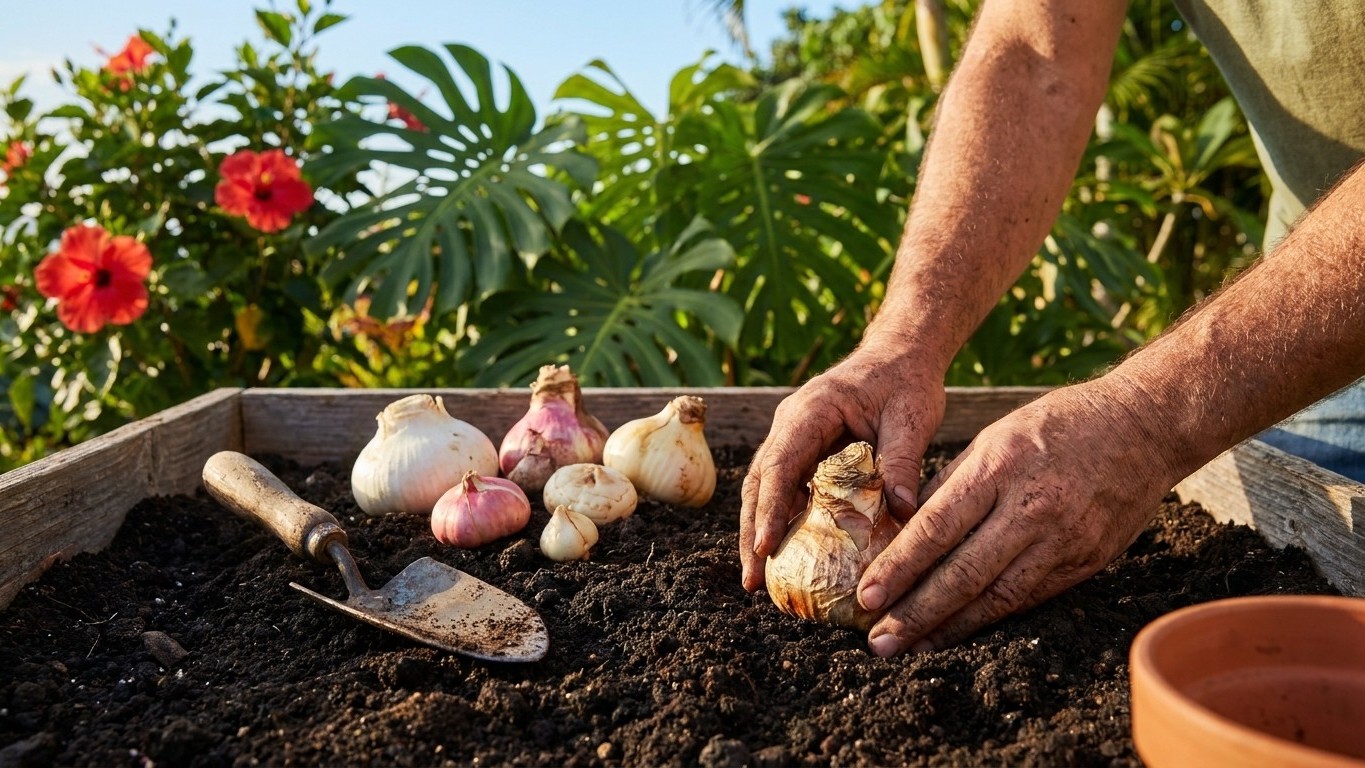

No spring bulb blooms reliably here without help, because Hawaii’s winter never gets cold enough to trigger flowering. The coldest month in Honolulu averages a 66.8°F low, nowhere near the chill a tulip or daffodil requires. Some bulbs still work well in island gardens. Here’s which ones, and what it takes to force the rest.
When to plant bulbs in Hawaii

Forget the frost calendar. NOAA’s climate data for Honolulu shows no measurable freeze in inhabited areas at all, not once in the 1991-2020 record. Frost exists in Hawaii only on the summits of Mauna Kea, Mauna Loa, and Haleakala, thousands of feet above where anyone gardens. A planting schedule built around “weeks before the first frost” simply has no anchor point here.
What governs timing instead is rainfall, elevation, and which side of an island a garden sits on. Hawaii runs on two seasons: a drier stretch from roughly May through October, and a wetter one from November through March, with windward slopes catching far more rain than leeward ones even a few miles away. That wet season is the real hazard for any bulb planted in island soil, cold-loving or not, because waterlogged ground rots a bulb faster than any winter chill ever could.
For bulbs that don’t need refrigeration
Plant amaryllis, crinum, rain lily, agapanthus, and paperwhite narcissus at the start of the drier season. That gives roots time to establish before the heavier winter rains arrive, and it sidesteps the rot risk that comes with planting into saturated soil.
For bulbs pulled straight from a refrigerator
If you’ve pre-chilled a tulip or daffodil for the recommended twelve weeks, get it into the ground as soon as the chilling period ends, and choose the driest pocket of the garden you have, ideally a raised bed or a large pot with generous drainage holes; see Growing Spring Bulbs in Containers in Hawaii for how to set that up properly. Every extra week the bulb sits in wet island soil is a week working against it. And unlike the mainland, where a grower can at least count on half of years landing close to an average frost date, Hawaii offers no such rhythm to plan around. The first heavy winter rain of the season shifts from island to island and year to year, so the window for these bulbs is short and somewhat improvised. For a full walkthrough of the chilling and planting process, see Forcing Spring Bulbs Indoors in Hawaii.
Whether your winter is cold enough
Here’s the number that decides everything else on this page: most spring bulbs need twelve to fourteen weeks with soil temperatures below about 45°F to form a flower bud inside the bulb. Skip that cold spell and the plant still grows, it just doesn’t bloom, or it sends up a stem too short and weak to notice. That threshold, twelve to fourteen weeks below 45°F, is the yardstick against which every variety on this page gets measured.
Honolulu’s coldest month averages a 66.8°F minimum. That’s not close to 45°F, it’s more than 21 degrees above it, and that gap never closes anywhere near sea level in the islands. A gardener in Vermont or Minnesota clears the chill requirement with room to spare and worries about the opposite problem, soil freezing solid. Hawaii sits at the far other end of that spectrum: the soil here never gets cold enough for a classic spring bulb to know winter happened at all.
That means every traditional spring bulb, tulip, daffodil, crocus, hyacinth, allium, needs artificial chilling to bloom in Hawaii, full stop. There’s no natural workaround, no sheltered microclimate at sea level that gets you there. Pre-chilling means twelve weeks in a refrigerator, bulbs stored away from apples, bananas, and other ripening fruit, because the ethylene gas they give off destroys the flower bud forming inside the bulb. Skip that precaution and a chilled bulb can fail for the same reason an unchilled one does.
Be honest with yourself about what this buys you. A refrigerator-chilled tulip in Hawaii typically flowers once and is done. It won’t naturalize, won’t return next year on its own, because the ground here still can’t deliver the cold it needs the following winter. Planting tulips in a Hawaiian garden and expecting a perennial bed is money spent on a one-season display, nothing more.
| Bulb | Weeks of cold below 45°F required | What Honolulu’s coldest month delivers | Verdict |
|---|---|---|---|
| Tulip (Tulipa) | 12-14 weeks | 0 weeks (66.8°F average minimum) | Fails untreated; refrigerate 12 weeks, expect one bloom only |
| Daffodil, trumpet types (Narcissus pseudonarcissus) | 12-14 weeks | 0 weeks | Same as tulip; leaves without flower if not pre-chilled |
| Crocus | 12-14 weeks | 0 weeks | Fails untreated; also prone to rot in wet island soil |
| Hyacinth | 12-14 weeks | 0 weeks | Same as tulip |
| Allium | 12-14 weeks | 0 weeks | Foliage only without chilling; rots easily in humidity |
| Paperwhite narcissus (Narcissus tazetta) | 0 weeks required | Not needed | Blooms reliably untreated, no chilling required |
Which bulbs suit Hawaii
The bulbs that actually thrive here aren’t the ones people picture when they think “spring bulb.” They’re warm-climate bulbs whose hardiness range already covers Hawaii’s USDA zones (the state spans 9a to 13a) and whose biology never asked for a cold season in the first place.
- Amaryllis / Hippeastrum (hardiness zone 8-11): blooms on schedule with no chilling, thrives in the island’s warm, humid air.
- Crinum lily (zone 7-11): tolerant of heat and heavy rain, comes back reliably year after year.
- Rain lily (Zephyranthes) (zone 7-10): flowers in flushes after rain showers, well matched to Hawaii’s wet-season rhythm.
- Agapanthus (Lily of the Nile) (zone 8-11): does best at slightly higher, cooler elevations but handles lowland gardens too.
- Paperwhite narcissus (Narcissus tazetta) (zone 8-11): the one true daffodil relative that needs no cold at all to flower.
The bulbs that disappoint are the classic mainland spring lineup, and they don’t fail quietly. A tulip or hyacinth planted straight into Hawaiian soil without pre-chilling usually pushes healthy-looking leaves and then nothing else, no flower stalk at all. Crocus corms often rot outright before they even get that far, done in by soil that stays warm and wet through what would be their dormant season elsewhere. Daffodils of the trumpet type (not the paperwhite kind) manage a weak, short-stemmed bloom at best without chilling, and most gardeners who’ve tried it once don’t try again.
Hardiness range is a guide, not a guarantee. A bulb rated for zone 9 can still struggle in an exposed, wind-scoured lowland spot and do noticeably better tucked against a house wall or under light afternoon shade a few miles away. That’s especially true across Hawaii’s islands, where windward and leeward sides of the very same mountain can differ by feet of annual rainfall.
What digs them up here
Hawaii breaks the usual bulb-pest rule right away: there are no squirrels and no voles anywhere in the islands. That’s a genuine break from most mainland gardens, where those two animals decide half the planting strategy before a single bulb goes in the ground.
The actual threats here are different animals entirely. Feral pigs root through garden beds and will tear into anything planted at shallow depth, bulbs included, treating a flower bed no differently than a patch of forest floor. Rats, common across the islands, gnaw at soft bulb tissue when other food is scarce, though they’re less selective than squirrels and don’t reliably avoid the toxic bulbs the way mainland rodents do.
- More vulnerable to rooting and gnawing: tulip, crocus, hyacinth
- Left alone more often, thanks to bitter or toxic sap: daffodil, allium, amaryllis, crinum
The daffodil and allium family owe their protection to the same alkaloids that make them unpalatable to nearly everything, amaryllis and crinum carry a similar toxic edge in their bulbs. For the more vulnerable bulbs, buried hardware cloth around the planting bed does more good than any spray, since repellents wash off fast in a climate that gets regular rain most months of the year. Raised beds or large pots also cut down on pig damage simply by putting the bulb out of easy reach.
Where to check for your own county
Every figure on this page comes from Honolulu, and Hawaii is not a state where one city’s climate stands in for the rest. The islands span multiple USDA hardiness zones, from roughly 9a to 13a, and elevation changes the picture fast, a garden a few thousand feet up in Kula on Maui or Volcano on Hawaii Island sits in noticeably cooler conditions than a lowland Honolulu yard just miles from the coast.
A planting recommendation built around the state capital can miss badly at either edge of that range, especially on upland or windward ground where rainfall and temperature both diverge sharply from the reference station used here. For guidance tuned to a specific address, the University of Hawaii’s College of Tropical Agriculture and Human Resources (CTAHR) extension service and its county offices are the resource built for exactly that gap between statewide averages and one particular garden.