
Growing cover crops in Ontario means working around two hard facts: the ground here freezes solid every winter, and the frost-free stretch runs roughly 169 days on average. Species selection, timing, and how you kill the crop in spring all follow from those two numbers, plus one you’ll need to confirm locally through your provincial extension service.
When the soil is warm enough in Ontario
The question every gardener asks first is when to put seed in the ground. The number people reach for is the last spring frost, and at Toronto Lester B. Pearson International Airport, the reference station Environment and Climate Change Canada uses for this region’s 1981-2010 climate normals, that date averages April 30.
Treat that figure with respect, not certainty. It’s a mean calculated from thirty years of records, which means in roughly one year out of two, frost lands after April 30, sometimes by a few days, sometimes by considerably more. Use it as the midpoint of a risk window, never as a green light to plant. And a province this size is not one climate zone: the Pearson airport reading describes the Toronto area specifically, while gardens farther north or at higher elevation in Ontario routinely run weeks behind it.
Frost date is a proxy, not the real trigger
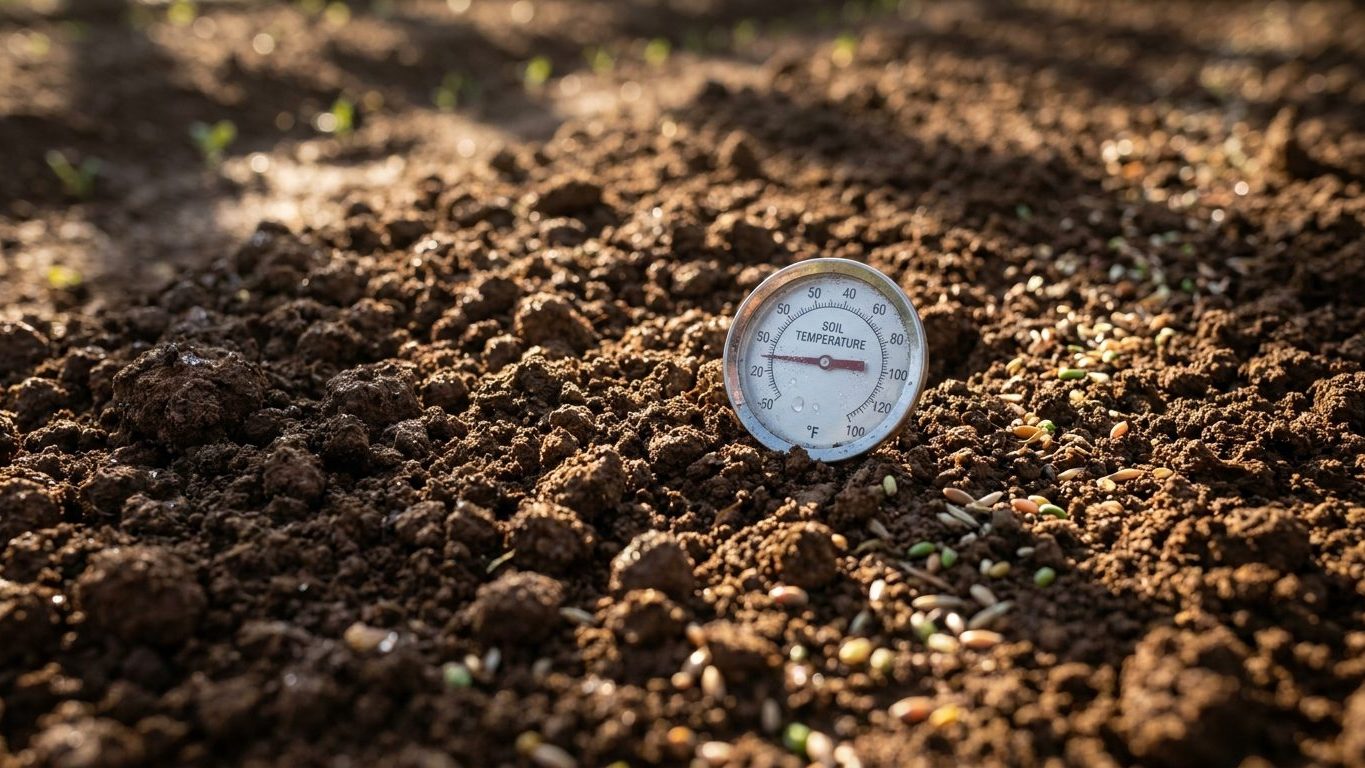
Here’s the part that trips people up: cover crops don’t actually care about air frost. They care about soil temperature, and soil warms on its own schedule, days or sometimes weeks after the last frost risk has passed. That’s why the calendar date is only a rough proxy for the condition that matters.
Cool-season species like oats, field peas, hairy vetch, and crimson or red clover germinate at soil temperatures well below what warm-season options need, so they can go in earlier in the shoulder season without waiting for the ground to fully warm. Buckwheat and sorghum-sudangrass, by contrast, want soil that has genuinely heated up, which in most Ontario gardens means waiting past the April average, not planting on it.
Seeding rate is a question your extension office answers better than any generic figure could. It depends on the species you’ve chosen, whether you’re broadcasting or drilling the seed, and what you’re after: a dense stand for weed suppression needs more seed per square foot than a thinner planting meant mainly to scavenge leftover nitrogen. Ontario’s Ministry of Agriculture, Food and Rural Affairs, reachable through ontario.ca/page/agriculture-and-food, publishes rate guidance tuned to regional conditions that a blanket number never could.
Termination stays mechanical on this site: mowing, crimping, cutting, or simply letting a hard winter frost finish the job before spring. No herbicide step belongs in a home garden cover crop cycle.
How long the season lasts here
Subtract the two dates and you get the working window: from the April 30 average last frost to the October 16 average first fall frost at the same Pearson station, Ontario gardeners get roughly 169 frost-free days, call it a bit over five and a half months.
That’s a meaningfully long window, and it changes what’s worth attempting. A short season, the kind some northern territories get, forces a single sowing and makes every week count. A window closer to 169 days opens up a second act: a cool-season crop early, a summer vegetable or cover crop in the middle stretch, and often room for a fall-sown cover crop after the main harvest comes in, especially once you account for cool-season species that tolerate light frost on both ends.
What the length means for transplanting
With this much runway, the usual argument for direct-seeding everything to save time loses some of its force. There’s enough season to justify starting certain crops indoors and transplanting out, then still following with a cover crop before the October frost line arrives, rather than treating cover cropping as an either-or against your vegetable calendar.
The practical move is to plan backward from October 16. Count back the number of days your chosen cover crop needs to establish enough biomass before hard frost, and that tells you the latest safe sowing date for a fall planting. Anyone stacking two plantings into one Ontario season should work through the timing math in more depth in the succession sowing guide on this site, since the same 169-day window sets the ceiling for how many rounds fit.
Remember that both ends of this window are averages, not fixed points, so build in a buffer of a week or two on each side when you’re deciding how tightly to pack a succession plan.
Heat and water in Ontario
This is where a lot of cover crop advice goes generic, talking about heat stress and drought as if every territory faced the same summer. Ontario’s defining climate feature for cover crop purposes isn’t a scorching summer at all. It’s the winter on either side of it.
The first fall frost, averaging October 16 at the Pearson reference station, sets the last realistic sowing date for anything you want established before growth stops. Miss that window and a cover crop simply won’t put on enough biomass to matter, no matter how good the seed is. The other number that carries real weight is the coldest month’s average daily minimum: 13.6°F. That figure, not the record low and not a seasonal average, is what decides which species survive Ontario’s winter standing in the garden and which don’t.
Mulch versus a spring task
Species that winterkill reliably at 13.6°F turn into a flat, dead mulch by spring with no work required. Oats behave this way here: cold enough to knock them out completely, which makes them one of the simplest cover crops an Ontario gardener can grow, since nature handles termination. Push the same oats into a milder territory where winters don’t dip that low, and they can survive to reseed themselves, turning a convenient winterkill crop into a weed problem the following year. Cereal rye and hairy vetch, on the other hand, often push through Ontario’s winter minimum and need to be cut or crimped by hand come spring.
Ontario’s hardiness rating at the Toronto reference point sits at 7a on the Canadian system, which uses seven climate variables rather than the single temperature threshold the USDA scale relies on. The two numbering systems don’t translate directly, and Natural Resources Canada is explicit that a single Canadian zone can span several USDA zones at once, so this 7a figure should never be read against USDA zone charts elsewhere. It describes winter survival conditions specifically at the Toronto reference station, not a province-wide guarantee, and it’s the number worth checking your own species choices against before assuming anything overwinters.
Which cover crops suit Ontario
Given a 169-day window bookended by real winter, the species that fit fall into a handful of clear categories rather than any single named product.
| Type | Season fit in Ontario | Termination behavior |
|---|---|---|
| Cool-season grasses (oats, barley) | Early spring or fall sowing, ahead of summer heat | Reliable winterkill at 13.6°F average winter minimum |
| Winter-hardy grains (cereal rye, winter wheat) | Late-season sowing, growth resumes in spring | Survives winter, needs mowing or crimping |
| Legumes (field peas, hairy vetch, clovers) | Shoulder-season sowing, some overwinter | Varies by species, mechanical cutting typical |
| Warm-season broadleaf (buckwheat) | Mid-season only, after soil has warmed | Winterkills easily, dies with first hard frost |
A humid Ontario summer, common enough given the province’s proximity to the Great Lakes, makes disease resistance a real consideration for anything left standing into late summer, since damp, still air is exactly what mildew and fungal issues favor. That pushes the practical advice toward airflow: wider spacing or lower seeding density for species prone to foliar disease, rather than the densest planting a bag of seed technically allows.
What this page won’t do is hand you a cultivar name. The specific varieties that perform best in Ontario trials change from year to year and differ by region within the province, and a name printed on a generic page can’t account for that. The Ontario Ministry of Agriculture, Food and Rural Affairs, at ontario.ca/page/agriculture-and-food, tracks locally trialled varieties and current seeding guidance, and that’s the recommendation actually worth following. Refusing to guess here isn’t a gap in the advice. It’s the honest version of it.