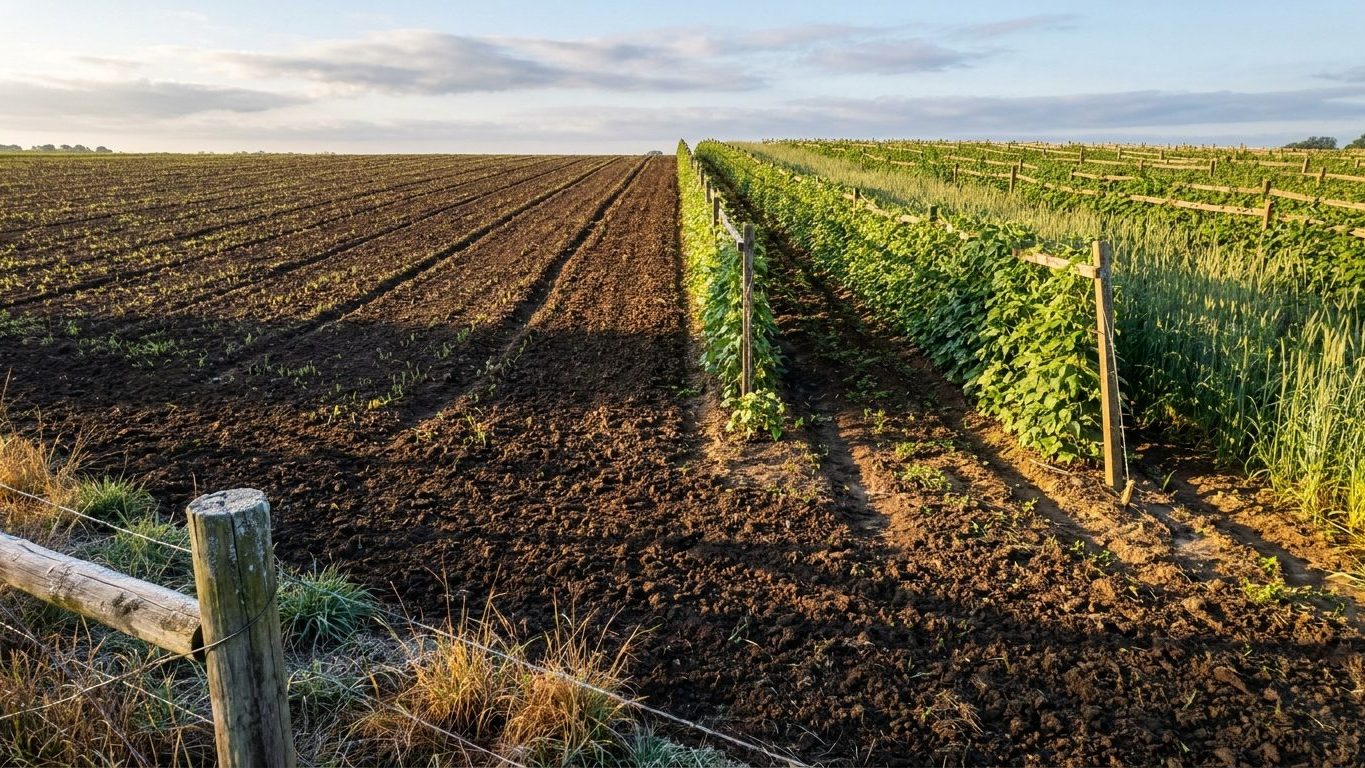

Cover crops in Ontario follow two windows built around the province’s average frost dates: frost-tender species go in after the mean last spring frost of April 30, and fall-seeded species need to be in the ground with enough time to establish before the mean first fall frost of October 16. Both dates are averages, not guarantees, which changes how you should actually use them.
The short answer for Ontario
Sow frost-tender cover crops such as buckwheat, sudangrass, or cowpeas only after the risk of frost has passed, and treat April 30 as the midpoint of that risk, not the end of it. Environment and Climate Change Canada’s own normals show that in one year out of two, the last frost at the Toronto Pearson reference station lands later than April 30. That is not a rounding quirk. It means a coin-flip’s worth of years still carry a frost after the date most calendars print in bold. Growers who sow tender cover crops right on April 30 are gambling on the better half of that coin flip.
Fall cover crops work off the other end of the season. The mean first fall frost at the same station falls on October 16, and the same caution applies in reverse: half the years bring frost earlier than that. Non-hardy fall covers like oats, field peas, or forage radish need roughly six to eight weeks of active growth to put on useful biomass before frost stops them cold, which points to a sowing window of mid-August to early September for most of southern Ontario. Winter-hardy species such as cereal rye or hairy vetch are far more forgiving. They keep growing after a light frost and can go in as late as early October, right up against that mean frost date, because they are built to survive the winter rather than beat the calendar.
| Cover crop type | Sowing window | What limits it |
|---|---|---|
| Frost-tender summer covers (buckwheat, sudangrass, cowpeas) | After last spring frost risk, into May | Killed by any frost after emergence |
| Non-hardy fall covers (oats, field peas, forage radish) | Mid-August to early September | Need 6-8 weeks before frost stops growth |
| Winter-hardy fall covers (cereal rye, hairy vetch, winter wheat) | Into early-mid October | Tolerant of frost, limited by hard freeze and daylight |
None of this is a fixed rule so much as a set of odds worth knowing before you buy seed.
What will not work here
The mean minimum temperature of Ontario’s coldest month sits at -10.2 °C (13.6 °F) at the reference station, and that single figure rules out more than it might seem to at first glance. It is not the record low, it is the average nightly low across the coldest month, which means most winters dip at least that far on an ordinary night, not just during a rare cold snap. Cover crops marketed as “winter hardy” in warmer catalogs, including some clover and radish varieties bred for milder regions, can fail here in an exposed field with no snow cover, simply because an average winter night already sits well below their tolerance.
Sowing frost-tender summer covers too early runs into the same probability problem from the other direction. Because the last spring frost only averages out to April 30, and lands later in roughly half of all years, a planting made in early April is betting against those odds. Buckwheat and sudangrass in particular have no frost tolerance at all. A single cold night after emergence and the stand is gone, and there is no second chance once the seed has been used.
On the fall side, waiting past early September to sow a non-hardy cover crop cuts into the same margin from the other end. These species need those six to eight weeks of growth to build the root mass and biomass that make a cover crop worth planting in the first place. Sow them in late September instead of early September, and they may barely germinate before the mean frost date of October 16 arrives, let alone the years when frost comes earlier still. A short window sown late is functionally the same as no cover crop at all, just with the seed cost attached.
Close plant spacing is its own separate failure point in a province where summer humidity can run high in the southern counties. Dense stands of a cover crop like clover, sown thick to smother weeds, trap moisture at the canopy and invite fungal disease in a wet August, which is exactly the season non-hardy fall covers are trying to establish in.
What changes across Ontario
Every figure above comes from one station, Toronto Pearson, which Natural Resources Canada places in Canadian plant hardiness zone 7a. That number describes the area around that station and nothing farther afield. Ontario is not a single climate, and a province stretching from the Lake Erie shoreline up toward the northern reaches of the Canadian Shield cannot share one frost date or one hardiness zone across all of it.
The Canadian hardiness system itself is built on seven climate variables, not the single minimum-temperature figure the USDA system uses, and Natural Resources Canada is explicit that its zones do not convert cleanly to American ones. A single Canadian zone can overlap several USDA zones at once. That matters here because it means quoting a number like 7a only tells a reader something useful if they know it applies to the specific municipality it was measured for, not to “Ontario” as a whole.
A reader gardening near the Pearson station can use the dates and figures on this page with reasonable confidence. A reader farther north, at higher elevation, or well inland from the moderating effect of the Great Lakes should expect a shorter season on both ends: a later last spring frost, an earlier first fall frost, and a colder mean minimum in the depths of winter. How much colder is not something this page can answer with a single number, because no single station’s data can stand in for a province this size. The honest move is to treat the dates here as a starting point for the milder part of the province, and to check a personal hardiness zone against the official map rather than assume it matches Toronto’s.
Where to check this for your own county
This page draws its dates from one weather station and one hardiness zone reading, which makes it a provincial reference point, not a county-level plan. Ontario’s own agriculture resource, published at ontario.ca/page/agriculture-and-food, is the place to look for anything closer to a specific county or region.
Two things are worth searching for once there. First, a local planting calendar, if one exists for the specific crop district in question, since Ontario’s agricultural regions range from the early, warm counties near Lake Erie to the shorter, cooler seasons farther north and east. Second, any listing of cover crop varieties that have actually been trialled in that county’s soil and climate, rather than varieties simply marketed as suitable for “Ontario” in general. Trial data from a nearby research station or county office reflects real local frost patterns and soil conditions in a way that a provincial mean frost date cannot.
A county-specific recommendation will almost always beat a provincial one, for the same reason a neighbor’s garden journal often beats a printed almanac: it was built from what actually happened on ground close to home. This page can tell a reader the general shape of the season across southern Ontario. It cannot tell them what happened in their own township last October, and that gap is exactly what a provincial or regional extension resource is built to fill.
Checking this against your own garden
Every date on this page is an average pulled from one weather station, and the most reliable correction to it is not another chart but a reader’s own observation of their own ground. Three checks, none needing anything more than a hand and a pair of eyes, tell more about a specific plot than any calendar date can.
The first is soil warmth by feel. Push a bare hand a few inches into the bed before sowing a frost-tender summer cover crop. Cool but not cold soil that a hand can sit in comfortably for several seconds is generally warm enough for buckwheat or cowpeas, regardless of what the calendar says about April 30.
The second is how quickly true leaves appear after a fall cover crop is sown. Oats or field peas that push their first true leaves within about a week of sowing are growing in soil that is still warm enough to support them. A slower, patchier emergence is a sign the soil has already cooled past the point where a full six-to-eight-week growth window is realistic that season, whatever the sowing date says.
The third is the first light frost that nips the tips of the cover crop’s leaves. That moment, not the mean date of October 16, is the real end of active growth for that particular plot in that particular year. A garden in a low-lying frost pocket will see that nip well before a garden on a gentle slope a few miles away, and no provincial average can tell a reader which one they are standing in.