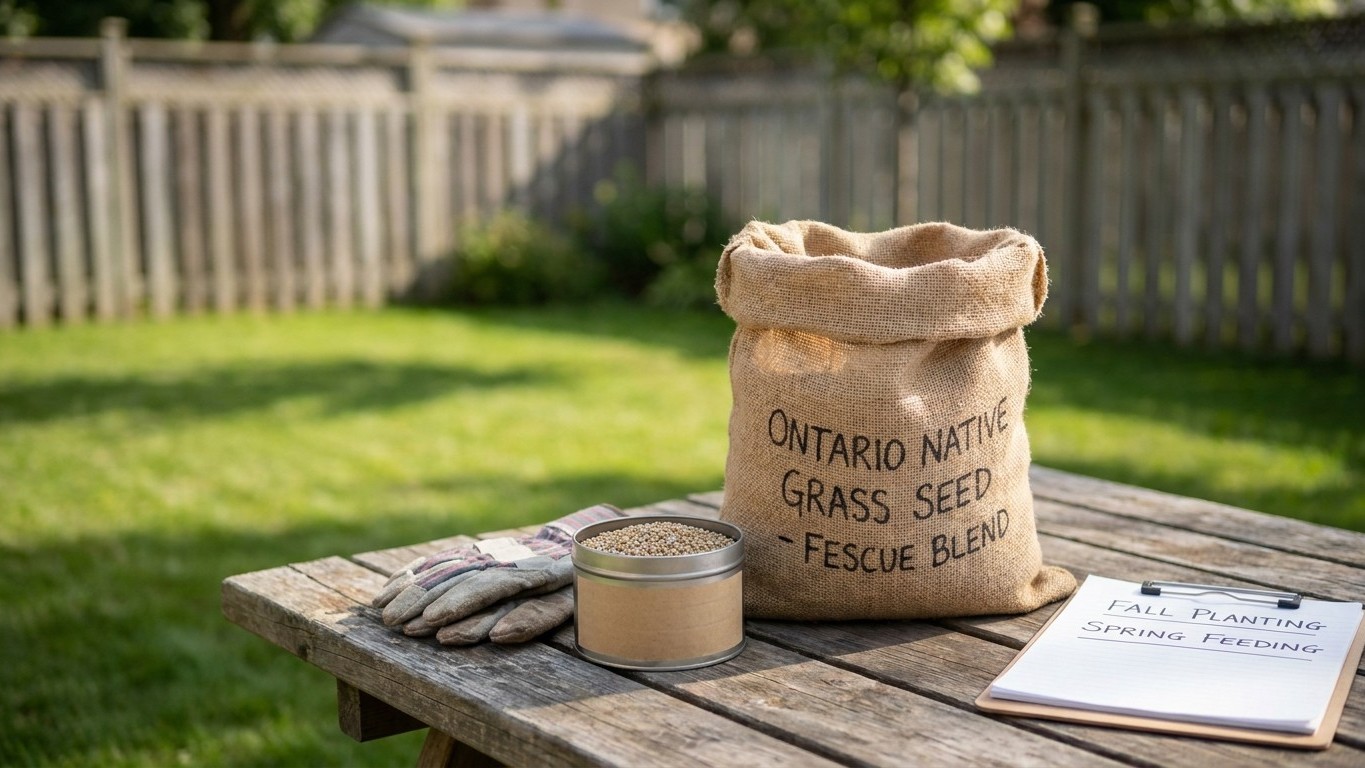

Toronto’s sticky Augusts make it tempting to think this is warm-season lawn country, the kind of place Bermuda grass or Zoysia would thrive. It isn’t. The winters here run cold enough, on average, that only cool-season turf like Kentucky bluegrass, tall fescue and perennial ryegrass survives to see another spring. If your lawn is thin or patchy right now, the single most useful move is to mark mid to late September on the calendar. That’s when seed actually takes root here, not May.
Which grass belongs in Ontario

The number that actually decides this is winter, not summer. Environment and Climate Change Canada’s 1981-2010 climate normals for the Toronto Lester B. Pearson International Airport station put the mean daily minimum of the coldest month at -10.2°C (13.6°F). That’s cold enough to kill a warm-season lawn outright no matter how the summer behaves. The same normals show only 6.08 days a year reaching 32.2°C at that station, a handful of scorching afternoons rather than a long hot season. Put those two figures together and the answer is cool-season turf, the same category most of the northern United States relies on.
The species that actually hold up here are Kentucky bluegrass, tall fescue, perennial ryegrass and the fine fescues, with rough bluegrass filling the shaded, damp corners the others struggle with. Clemson Cooperative Extension’s HGIC 1214 and Penn State Extension both list this as the standard cool-season lineup, and nothing about a Toronto winter argues against it. Kentucky bluegrass spreads by rhizome and knits into the densest, most self-repairing turf of the group, but it’s slow to establish from seed alone. Tall fescue germinates faster and shrugs off more foot traffic and dry stretches once it’s rooted, at the cost of a coarser blade underfoot. Perennial ryegrass comes up within days and gets mixed into bluegrass seed for exactly that reason, to hold bare soil while the slower species fills in behind it.
Bermuda grass, zoysia and St. Augustine, the species that dominate lawns from the Carolinas south, are built to go dormant and brown at the first real cold snap and green up again once soil temperatures climb. In a climate where the coldest month averages ten degrees below freezing overnight, they don’t get the chance to green up. That’s a winter-survival failure, not a summer heat shortfall. The days-above-32°C count matters far less here than what the thermometer does in January.
None of this is uniform across the province. The Pearson Airport station sits west of downtown Toronto and reads its own microclimate. Ottawa and the far north see colder winter minimums than this figure, and the Niagara Peninsula runs milder. If you garden well outside the Greater Toronto Area, treat this figure as a starting point rather than the number for your own yard.
When to seed or sod here
Clemson Cooperative Extension’s HGIC 1203 splits lawn establishment by grass type: warm-season species go into the ground around May, when soil is warming, and cool-season species go in during a fall window instead. Since Ontario is cool-season country, the fall window is the one that matters here, and it runs from mid to late September. Soil is still warm enough for fast germination, air temperatures have dropped enough that fungal disease pressure eases, and the new grass gets several weeks to root before the ground freezes.
Anchor that window against the region’s own frost calendar rather than a generic date. Environment and Climate Change Canada’s 1981-2010 normals put the average first fall frost at Toronto Lester B. Pearson International Airport at October 16. That’s a mean, not a guarantee: in one year out of two, the actual first frost lands later than that date, and in the other half it lands earlier. Seeding in mid to late September gives new grass roughly three to five weeks of growing weather before that average frost date, which is enough for cool-season seed to root down even though the top growth is still thin.
Sod works on a slightly wider window than bare seed because the roots are already established, so a homeowner laying sod can push a little later into fall or start a little earlier in spring without the same establishment risk. Spring seeding is possible too, but it competes with crabgrass and other warm-weather weeds that germinate as the soil warms, which is exactly the competition fall seeding avoids. If you’re north of the Greater Toronto Area, or at higher elevation, shift the whole window earlier: the frost that ends the growing season arrives sooner there than at Pearson Airport, and seed sown on the Toronto calendar can get caught out.
The feeding calendar that fits this climate
Nitrogen timing follows the grass’s own growing season, not the wall calendar. A cool-season lawn does most of its root growth in fall, as top growth slows and the plant banks energy below ground, so that’s when the bulk of the year’s nitrogen should go down. Clemson’s HGIC 1219 Tall Fescue Maintenance Calendar, written for the same cool-season species Ontario relies on, puts the heaviest feeding in the September and November windows rather than in spring.
Rates and timing
Working from that calendar, a reasonable target is around 1 pound of actual nitrogen per 1,000 square feet at each fall application, split between an early-fall feeding in September and a second, later one closer to the end of the growing season. A light spring feeding can follow once the lawn greens up, but it should be smaller than either fall application. Heavy spring nitrogen pushes soft top growth right when the plant should be building roots, and that soft growth is exactly what struggles later in the season.
- Early to mid September: first and largest feeding, roughly 1 lb N per 1,000 sq ft
- Late fall, before the ground cools further: second feeding, similar rate
- Spring green-up: a lighter feeding only, not a repeat of the fall rate
Skip summer nitrogen altogether on a cool-season lawn. Feeding heavily through the hottest stretch of the year pushes growth right when the grass is naturally slowing down to cope with heat, and it can make brown patch and other summer diseases worse rather than better. For the full month-by-month breakdown this schedule is drawn from, Clemson’s Tall Fescue Maintenance Calendar lays out each application in sequence.
Mowing height and watering here
Cool-season grasses in this climate do better left taller than most homeowners assume. Kentucky bluegrass and perennial ryegrass hold up well mowed between 2.5 and 3.5 inches. Tall fescue and the fine fescues prefer to stay taller still, in the 3 to 4 inch range, since a longer blade shades the soil, holds moisture and crowds out germinating weed seed. Whatever the species, follow the one-third rule: never remove more than a third of the blade height in a single cut, which usually means mowing more often in a wet spring and less often in a dry August.
| Species | Mowing height | Growth habit |
|---|---|---|
| Kentucky bluegrass | 2.5 to 3.5 in | Spreads by rhizome, self-repairs |
| Tall fescue | 3 to 4 in | Bunch-type, deep-rooted |
| Perennial ryegrass | 2.5 to 3.5 in | Bunch-type, fast germination |
| Fine fescues | 3 to 4 in | Fine blade, shade tolerant |
| Rough bluegrass | 2.5 to 3 in | Spreads by stolon, prefers damp shade |
Watering
An inch of water a week, from rain or the hose combined, is the common starting rule for cool-season turf. What changes it here is the run of hot, humid stretches through mid-summer, when evaporation climbs and a lawn on sandy soil can dry out faster than that rule accounts for. Clay-heavy soil, common across much of southern Ontario, holds moisture longer and can go a few extra days between waterings without stress showing. Water deeply and infrequently rather than a little every day. Frequent shallow watering trains roots to stay near the surface, which is exactly the habit that makes a lawn collapse the moment a dry week hits.
What goes wrong on lawns in Ontario

The specific failures here follow directly from the climate. A humid stretch in July or August, especially after a run of warm nights, is prime conditions for brown patch, a fungal disease that shows up as roughly circular patches of thinned, tan-brown grass with a darker, wet-looking ring at the edge in the early morning. It thrives on the combination of heat, humidity and nitrogen-rich growth, which is one more reason to hold off on summer feeding.
A hot, dry stretch produces a different failure that looks similar to the untrained eye: the whole lawn fades to a straw-brown color and stays that way for weeks. That’s dormancy, the plant’s own drought survival strategy, and it is not dead. Cool-season grass shuts down top growth to conserve water and greens back up once rain returns and temperatures ease, usually within a couple of weeks. Pulling up a few blades and checking the crown, the white base where blade meets root, is the way to tell a dormant lawn from a genuinely dead one, since a healthy crown stays firm and pale rather than mushy or blackened.
A mild winter, meanwhile, is a weed problem more than a disease problem. Cool-season weeds like chickweed and annual bluegrass keep growing through winters that never deliver a hard, sustained freeze, and they get a head start on the lawn come spring. A similar mild-winter weed pressure shows up on lawns in Prince Edward Island, another cool-season province working against the same coastal-influenced winters. Farther west, the dormancy-versus-dead confusion plays out differently again on the arid lawns covered in Wyoming lawn care, where dry-season browning is the default rather than the exception.
Local help
A soil test settles more arguments about a struggling lawn than any calendar can, since pH and nutrient levels vary by yard even within the same neighborhood. Ontario’s Ministry of Agriculture, Food and Rural Affairs, reachable through the province’s agriculture and food page, is the place to start for a soil test and for county-level advice that accounts for conditions well outside the Toronto reference figures used above.
Common questions
Can I grow Bermuda grass anywhere in Ontario?
Not reliably. Bermuda grass is a warm-season species built to go dormant in the cold and regrow from surviving crowns once soil warms, and Ontario’s winter minimums are cold enough that those crowns don’t reliably make it through. Stick to the cool-season species covered above instead.
Why did my new grass die over winter when I seeded in September like everyone says?
Check the actual date you seeded against the region’s frost timing rather than the calendar month alone. Seed sown very late in September, or into a fall that turned cold earlier than the average frost date, may not have had enough weeks to root before freeze-up. Sod or an earlier September seeding date gives more of a safety margin.
Is it too late to seed if it’s already October?
It’s marginal. Once you’re past the region’s average first frost window, new seed is racing against dropping soil temperature rather than working with it. Sod is the safer choice that late, or wait for the following September.
Do I need to feed my lawn in spring at all?
A light feeding is fine once green-up starts, but it should be smaller than either fall application. Heavy spring nitrogen pushes soft top growth at the expense of the root development the lawn needs to handle summer stress.
My lawn is brown right now but it’s not summer or winter. What’s going on?
Rule out both mechanical causes and disease before assuming drought. Pet urine spots, a dull mower blade tearing rather than cutting the grass tip, and fungal disease all produce brown patches outside the seasonal pattern, so check the shape and edges of the browning before reaching for water or fertilizer.