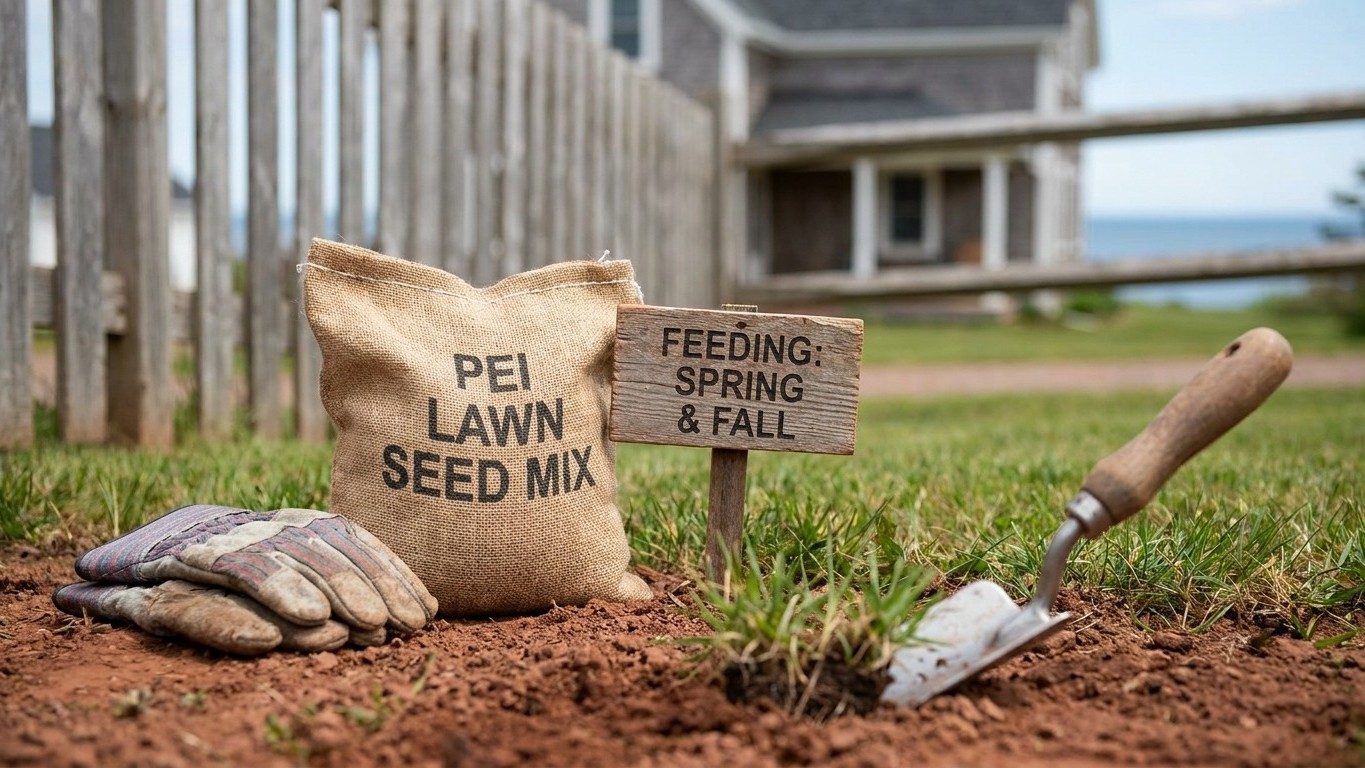

Prince Edward Island sits solidly in cool-season turf territory. Environment and Climate Change Canada’s 1981-2010 climate normals for Charlottetown record zero days a year at or above 90°F and a coldest-month minimum of -12.1 °C, numbers that put warm-season grasses like Bermuda or zoysia out of the question and leave the cool-season species as the only real choice here. Start by checking your existing lawn, or any bag of seed you’re about to buy, against that list before spending money on a species that has no business surviving an Island winter.
Which grass belongs in Prince Edward Island

The two numbers that decide this are climate, not soil or slope. Environment and Climate Change Canada’s Charlottetown station recorded an average of 0.0 days a year at or above 90°F in the 1981-2010 climate normals, and a coldest-month mean minimum of -12.1 °C. The first figure rules out any grass that needs sustained summer heat to grow. The second rules out anything that can’t survive a hard freeze. Together they point in one direction only: this is cool-season turf territory, not a borderline case, and not a transition zone where a reader has to weigh trade-offs between two seasons of grass.
That clears the way to name real options. Clemson Cooperative Extension’s HGIC 1214 factsheet and Penn State Extension both list Kentucky bluegrass, tall fescue, perennial ryegrass, fine fescues and rough bluegrass as the cool-season species suited to a climate like this one, and a closer look at Prince Edward Island lawn Best grass options breaks down how each one performs here, while The Prince Edward Island Lawn Care Calendar, Month by Month lays out when to seed, feed and mow each of them through the year. Kentucky bluegrass spreads by rhizome and fills in bare patches on its own, which matters on a lawn that takes winter damage most years. Tall fescue tolerates drought and wear better than bluegrass and is the usual pick for a lawn that gets foot traffic. The fine fescues, including creeping red, chewings and hard fescue, handle shade and thin, sandy soil better than bluegrass does, which suits parts of the Island where topsoil runs shallow. Perennial ryegrass establishes fast from seed and is often mixed in with bluegrass for that reason, though it wears out faster over several winters than the others. Rough bluegrass is the shade specialist of the group and struggles badly in full sun.
Why the other season isn’t an option
Bermuda grass, zoysia and St. Augustine need long stretches of heat to grow at all, and none of them survive a winter with a coldest-month minimum in the teens Fahrenheit. With zero days above 90°F most summers, a warm-season lawn here would spend the entire year either dormant or dying. That’s not a matter of picking a hardier warm-season cultivar. The climate itself rules the category out, not just individual varieties within it.
When to seed or sod here
Clemson Cooperative Extension’s HGIC 1203 factsheet gives the general rule for the whole cool-season zone: seed or sod in late summer to early fall, not spring, because cool-season grass germinates fastest in soil that’s still warm while air temperatures are dropping. Spring seeding works too, but a fall-seeded lawn gets a full autumn and the following spring to establish roots before it has to face a summer.
On Prince Edward Island, that fall window has to be anchored on the Island’s own frost date, not a generic month. Environment and Climate Change Canada’s 1981-2010 normals put the average first fall frost at Charlottetown at October 17. That is a mean, not a guarantee. In roughly half of all years the first frost arrives later than that, and in the other half it arrives earlier. New grass seed needs several weeks of frost-free growth to root before winter, which means the safer window closes well before the average date itself, not on it.
What moves the window on the Island
Charlottetown’s frost date is the reference figure, not a province-wide fact. Inland and upland districts away from the moderating effect of the surrounding water often see their first frost weeks earlier than the Charlottetown average, which pulls the safe seeding window earlier too. A lawn on higher ground, or further from the coast, should plan on getting seed down sooner rather than counting on the same calendar as a Charlottetown yard. Anyone establishing a new lawn from seed a province over, in Quebec, is working against an even tighter and earlier fall window for the same reason, since a shorter frost-free season pushes every step back.
Sod sidesteps some of this risk because it’s already rooted, so it can go down later into the fall than seed can, right up until the ground is too cold to work. Seed is the cheaper option but the riskier one this late in the year, and a September planting beats an October one by either method.
The feeding calendar that fits this climate
Nitrogen timing follows the grass’s growing season, not the human calendar. A cool-season lawn like the ones that belong on Prince Edward Island does most of its root growth in spring and fall, goes semi-dormant in summer heat, and is at its most vulnerable to disease if it’s pushed with heavy nitrogen right before a hot, humid stretch. That’s the reverse of a warm-season lawn, which is fed through late spring and into summer while it’s actively growing and left alone in fall.
Fall is the main feeding, not spring
For the species that actually grow here, the heaviest nitrogen application of the year belongs in early autumn, timed to build root reserves before winter rather than to force top growth. A lighter application earlier in fall or in spring rounds out the year, but a lawn fed hard in June and starved in September has the priorities backward for this climate.
Clemson Cooperative Extension’s tall fescue maintenance calendar, HGIC 1219, lays out a full season-by-season schedule for that species, including the amount of nitrogen to apply, given in pounds of actual nitrogen per 1,000 square feet rather than pounds of fertilizer product off the shelf. Read the current version before buying fertilizer, since the exact rate is adjusted over time and a fertilizer’s nitrogen content varies by brand. The same fall-first principle applies whether a lawn is straight tall fescue, a Kentucky bluegrass stand, or a mixed blend, even though the Clemson calendar itself was written for a state further south and warmer than this one.
Skip nitrogen altogether during the hottest, most humid stretch of the growing season if the lawn shows any stress, since a flush of soft new growth right before humid weather is exactly what invites fungal disease into a cool-season lawn. That trade-off matters more here than the exact number on the bag.
Mowing height and watering here
Mowing height
Tall fescue and Kentucky bluegrass both do best cut on the taller side, generally in the 2.5 to 3.5 inch range once the lawn is established, and fine fescues can be kept a little shorter than that. A taller cut shades the soil, holds moisture longer between rains, and crowds out germinating weed seed better than a close-cropped lawn does. Whatever the exact height, follow the one-third rule: never remove more than a third of the blade length in a single mow. Scalping a cool-season lawn back hard in one pass stresses the crown and opens the door to the same fungal problems that heavy summer nitrogen invites.
Watering
An inch of water a week, from rain and irrigation combined, is the figure most often quoted for a cool-season lawn in active growth, applied in one or two deep sessions rather than a daily sprinkle that only wets the surface. A few things push that figure up or down on Prince Edward Island specifically. With zero days a year averaging 90°F or above at the Charlottetown reference station, this climate doesn’t put the same evaporative demand on a lawn that a genuinely hot summer would, so established grass often needs less supplemental water here than the same species would in a hotter state. Sandy soil, common across much of the Island, drains fast and holds less water in reserve, which cuts the other way and means a sandy lawn dries out faster between waterings even at the same rainfall total. New seed is the exception to all of this: it needs the surface kept consistently damp, in short, frequent waterings, until it has germinated and been mowed at least once.
What goes wrong on lawns in Prince Edward Island

The problems that show up here follow directly from the climate, not from lawn care in general.
Brown patch in humid summers

A stretch of warm, humid weather, even without extreme heat, is enough to trigger brown patch on tall fescue and other cool-season turf. The disease shows up as roughly circular patches of thinned, discolored grass, often with a darker, wet-looking ring at the edge visible in early morning dew. It’s more likely on a lawn that was fed heavily right before the humid stretch hit, which is the main reason to hold off on nitrogen once summer humidity settles in.
Summer dormancy mistaken for death

A cool-season lawn that goes brown and stops growing in a hot, dry stretch is very often dormant, not dead. The crown survives underground and the grass greens back up once rain returns and temperatures drop, usually within a couple of weeks. Confusing dormancy with death leads a lot of people to reseed or resod a lawn that would have recovered on its own. The reverse problem shows up further inland, where a longer, hotter summer of the kind common in a transition-zone state like Illinois puts far more strain on cool-season turf than the Island’s short, mild summer does.
Weeds that never stop in a mild winter

A winter that stays mild for longer than usual lets cool-season weeds like chickweed and annual bluegrass keep growing through stretches that would normally shut them down, giving them a head start on the lawn itself come spring. A thick, well-fed stand of grass going into winter is the best defense against this, since bare or thin soil is exactly where those weeds get their foothold.
Local help
A soil test is the fastest way to find out what a particular Island lawn actually needs before buying fertilizer or lime, since pH and nutrient levels vary from one yard to the next even within the same county. The Prince Edward Island government’s agriculture section is the place to start for soil testing options and other county-level advice, and it’s worth checking before assuming the Charlottetown figures in this piece apply exactly to a lawn somewhere else on the Island.
Common questions
Can I grow Bermuda or zoysia grass on Prince Edward Island?
No. Environment and Climate Change Canada’s Charlottetown normals show a coldest-month minimum of -12.1 °C and zero days a year at or above 90°F, and both of those numbers rule out warm-season turf entirely rather than just favoring a hardier cultivar of it.
My lawn turned brown in August, is it dead?
Probably not. Cool-season grass on Prince Edward Island commonly goes dormant and browns during a hot, dry stretch, and it usually greens back up once cooler, wetter weather returns. Give it a few weeks before assuming it needs to be reseeded.
Can I still seed my lawn in October?
It’s risky. Environment and Climate Change Canada’s average first fall frost for Charlottetown is October 17, and that’s a mean date, so frost arrives earlier than that in roughly half of all years. Seed put down in October has little margin left to root before the ground freezes, and sod is the safer choice that late in the season.
How much nitrogen fertilizer should I use per application?
That depends on the product and the grass. Read Clemson Cooperative Extension’s tall fescue maintenance calendar, or a similar cool-season schedule, for the current recommended rate in pounds of actual nitrogen per 1,000 square feet, rather than guessing from the bag. Applying more than the lawn can use in one pass wastes fertilizer and raises the risk of disease.
Do I need to water new grass seed every day?
Yes, until it germinates. New seed needs the top layer of soil kept consistently damp, which usually means short, light waterings once or twice a day rather than one deep soak a week. That changes back to normal deep, infrequent watering once the grass has been mowed a couple of times.