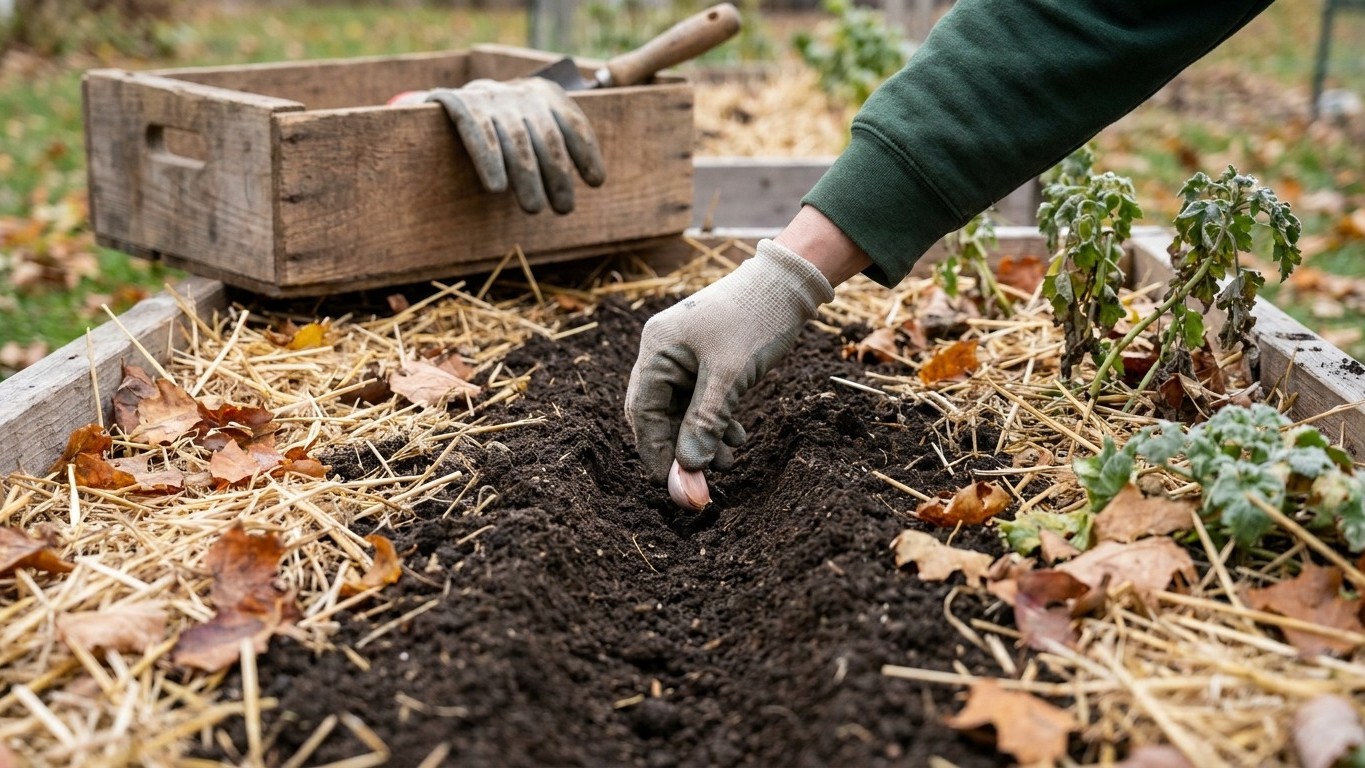

By November, most of Ontario has already passed its average first fall frost, so new outdoor plantings of anything tender are done for the season. What still makes sense: garlic and shallots going into workable soil, bare-root stock, cold frames holding a few hardy greens, and forcing rhubarb or chicory indoors. The real work this month happens with pruners, seed catalogs, and storage bins, not a trowel.
What goes in the ground in November

The average first fall frost at the Toronto Pearson station lands October 16, which means November across most of Ontario opens after that threshold has already come and gone. That date is a mean, not a guarantee: in one year out of two, frost actually arrives later than October 16, so a mild stretch in early November doesn’t mean the window is still open for tender crops. It means the opposite. Ground temperatures are falling, and in the north and along the snowbelt counties east of Lake Huron, soil may already be crusting or freezing at night.
For most of the province, new plantings of anything frost-sensitive are simply not on the table this month. But that doesn’t mean the ground is idle. Garlic cloves and shallots can still go in as long as the soil is workable, ideally with a heavy mulch of straw or shredded leaves over top to buffer the freeze-thaw cycles that heave bulbs out of loose ground. Bare-root fruit trees, roses, and shrubs, where nursery stock is still available, can be planted while the soil takes a shovel, since the plant is fully dormant and skips the stress of an active growing season.
What still fits under cover
Cold frames and low tunnels can carry over crops that were already established before frost, like mâche and spinach, buying a few more weeks of slow growth. And this is the month to force rhubarb crowns or chicory roots in a dark, cool space indoors for tender, blanched stalks and leaves, a small trick that turns dormancy into a harvest. Southern counties near Lake Erie and the Niagara Peninsula typically hold workable soil longer than inland or northern districts, so garlic planting there can stretch further into the month.
What to start under cover
Seed-starting math this month runs backward from the average last spring frost of April 30, and for most warm-season crops, that’s still months away, too far out to justify starting seedlings now. Tomatoes, peppers, and squash started in November would be leggy and rootbound long before the ground is ready for them.
What does make sense under cover right now is sowing hardy greens like mâche, spinach, or claytonia directly into an unheated cold frame or greenhouse bed, aiming for slow winter growth and an early spring harvest rather than a fast crop. Microgreens and sprouts on a kitchen counter don’t care about frost dates at all, and they’re a reliable way to keep fresh greens coming through the darkest stretch of the year.
Alliums destined for spring transplanting, like onions and leeks grown from seed, are sometimes started under lights this early by growers chasing the longest possible season. That’s a gamble worth naming plainly: start too soon and the seedlings sit rootbound and stressed for months before the April 30 average frost clears; wait too long, into January or February, and most home gardeners still hit their transplant window with plenty of size on the plants. For the typical backyard grower, holding off is the safer bet.
What is ready to pick
Outdoor harvests thin out fast once November settles in, and honestly, for many gardens the fresh outdoor picking season is close to over. But a handful of crops actually improve after frost rather than suffering from it. Kale, Brussels sprouts, and leeks all convert starches to sugars once temperatures drop, so a frost-touched kale leaf often tastes sweeter than the one picked in September. Leeks especially can be left in the ground under a thick mulch and pulled as needed well into winter in milder years.
Cold frame crops, mâche, spinach, arugula, continue producing small pickings on sunny days even as outdoor growth stalls completely. Indoors, sprouts and microgreens fill the gap for anyone wanting something green on the plate weekly.
This is also the month to start checking stored crops on a regular schedule. Squash, potatoes, and onions tucked away in a root cellar or cool basement corner need a weekly look for soft spots, sprouting eyes, or the telltale smell of rot starting in one corner of the bin. One squash with a soft spot, left in contact with the others, can take down a whole crate faster than most gardeners expect. Culling the bad one immediately protects the rest.
The jobs that matter this month

November carries plenty of real deadlines, even with nothing new going into the soil. Dormant pruning of fruit trees, grapevines, and cane fruit belongs here: once the leaves have dropped and the plant is fully dormant, the branch structure is easy to see and cuts heal without the stress of active sap flow. Waiting until late winter still works in many climates, but doing it now spreads the workload and gets ahead of any late-winter thaw that might rush the job.
Seed catalogs are worth ordering from early. Popular and heirloom varieties sell out over winter, sometimes months before spring planting even starts, so a November order beats a February scramble for a sold-out variety.
Soil testing and amending pays off now too. Lime or compost worked into beds in November has the whole winter to mellow into the soil before anything gets planted in spring. Turning a compost pile stocked with fall leaves keeps decomposition moving through the cooler weeks, and cleaning, sharpening, and oiling tools before they sit unused all winter saves rust damage and a frustrating spring scramble.
A few more jobs worth fitting in before the ground locks up: repairing raised bed frames and fencing while the garden is empty, mulching garlic rows and perennial beds for insulation, draining hoses and irrigation lines before a hard freeze cracks them, and sketching out next season’s crop rotation on paper while this season’s layout is still fresh in memory.
What not to do in November
The most common mistake this month is trusting a mild afternoon over the calendar. A warm stretch in early November doesn’t undo the fact that the average first fall frost already passed back on October 16; it just delays the next cold snap by a few days. Planting anything tender outdoors on the strength of one warm week is a bet that rarely pays off.
Uncovering cold frames or pulling back mulch after a few mild days is the same mistake in reverse. Protection put in place for a reason should stay in place until the weather has genuinely settled, not just improved for an afternoon.
Feeding nitrogen this late in the season is another classic misstep. Fertilizer applied to shrubs, perennials, or lawns in November pushes soft new growth that has no time to harden off before a hard freeze, leaving that new growth far more vulnerable to winter injury than the plant would have been left alone.
And skipping the weekly check on stored crops is a mistake that compounds quietly. Rot spreads from one potato or one squash to its neighbors well before it’s visible from across the room, so the crates that get ignored in November are often the ones half-lost by midwinter.
Checking this against your own county
A province-wide month is a starting point, not an instruction. The frost dates cited here come from a single station, Toronto Pearson, and Ontario stretches across lake-effect snowbelts, elevation changes, and a north-south gradient that shifts real planting windows by weeks in either direction. A garden near Windsor and one near Sudbury are not working from the same calendar, even in the same month.
For local adjustments, the Ontario Ministry of Agriculture, Food and Rural Affairs is the place to check regional guidance and planting resources specific to your part of the province.
Common questions
Can you plant garlic in Ontario in November?
Yes, as long as the soil is still workable. Garlic and shallots are among the few crops that go into the ground this month, ideally with a heavy mulch layer to protect the cloves through freeze-thaw cycles over winter.
What hardiness zone is Ontario for planting?
The reference city used for this page sits in Canadian hardiness zone 7a, based on Natural Resources Canada’s Plant Hardiness Site. This is the Canadian system, built on seven climate variables, and it does not convert directly to the USDA zone system used elsewhere on this site. Treat it as a local guide, not a province-wide constant.
Is it too late to start seeds in November in Ontario?
For warm-season vegetables, yes, since the average last spring frost isn’t until April 30 and seedlings started this early would be rootbound long before transplant time. Hardy greens in a cold frame and indoor microgreens are the exceptions worth starting now.
What vegetables survive frost in Ontario?
Kale, Brussels sprouts, and leeks all tolerate frost well and often taste better after a cold snap converts starches to sugars. Leeks can stay in the ground under mulch and be harvested through much of the winter in milder years.
Gardeners who plant by the Moon can check the November 2026 moon planting calendar, a tradition rather than a proven method.
Related guides
Elsewhere? See what to plant in November in every state and province.