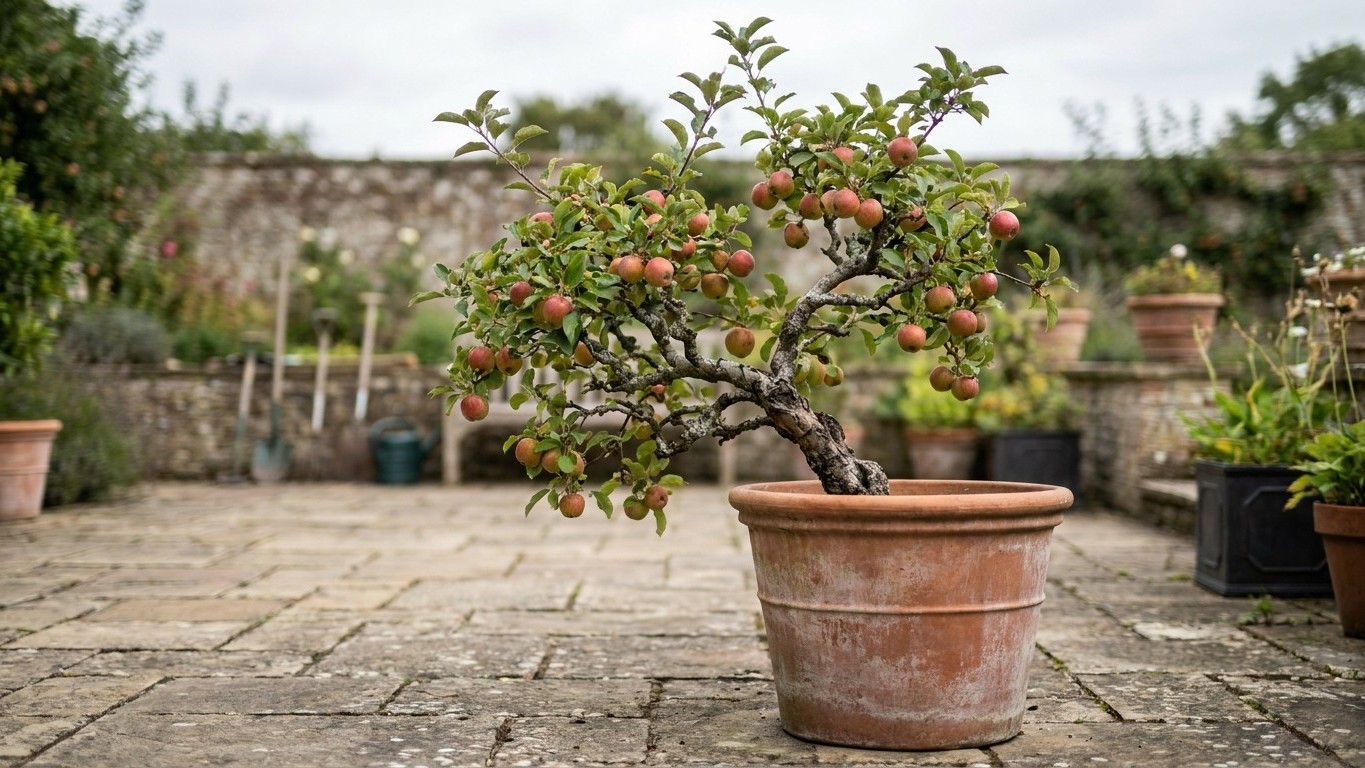

Pick timing for Oregon apples runs off the fruit’s own signals, not a fixed date on the calendar, and it splits sharply by region. West of the Cascades, in the Willamette Valley around Portland, early varieties come off the tree by late summer while late keepers wait until just ahead of the first fall frost. East of the Cascades, in the high desert, the season compresses and finishes sooner. How long the fruit lasts afterward depends entirely on which kind you picked: some apples are done within weeks, others outlast the whole winter in cold storage.
When apples are ready to pick in Oregon
Reading the fruit’s own signals
Ripeness in an apple is a set of signals the fruit gives off, and reading them beats circling a day on the calendar every time. The background color under the blush shifts from hard green to a softer yellow or cream. Cut one open and check the seeds: pale or greenish still means wait, dark brown means the sugars have finished building. Lift the apple with a slight twist rather than yanking it. If the stem lets go easily, cupped in your palm, the fruit is ready. If it resists, give it another week.
In the Willamette Valley, with Portland as the reference point, that ripening window sits between the region’s own frost dates. Bloom follows the last spring frost, which NOAA’s 1991-2020 climate normals place between March 6 and March 21 for the Portland station (30 to 70 percent freeze probability band). Early-season varieties then finish in mid to late summer, mid-season varieties come off through early fall, and the latest keepers hang on the tree until the weeks just before the first fall frost, dated November 11 to November 27 at that same station. A longer, cooler finish is what gives those late apples the dense flesh and acidity that let them store.
Hardiness versus bloom timing
Hardiness is a separate question from timing, and it is worth settling here. Portland’s coldest month averages a daily minimum of 36.2 degrees Fahrenheit, per those same NOAA normals. That is mild enough that winter cold is rarely what threatens an established apple tree west of the Cascades. It only becomes a real risk for a young tree caught by an unusually sharp cold snap, not during a normal winter.
East of the Cascades, in central and eastern Oregon’s high desert, none of those Portland dates apply. Winters run colder and the frost-free season is shorter, which compresses picking into a narrower stretch and tends to push it earlier than in the valley. No local source used for this analysis breaks out separate frost dates for that side of the state, so growers there should treat the valley window as context, not a schedule to copy.
Oregon State University’s Extension Service (extension.oregonstate.edu) publishes county-level guidance and tracks variety performance across the state’s different growing regions, which is the better first stop before setting a picking date for a specific orchard.
Which ones keep, and which must be eaten
Storage life is set at bloom, not at harvest. It comes down to which variety category you are holding, and the differences are large enough to plan around before the bins even come out of the orchard.
Sorting a mixed harvest
Early-season, thin-skinned varieties bruise if you look at them wrong, and their flesh softens fast once picked. Treat these as a short window: eat them, cook them, or press them for cider soon after harvest. Trying to hold them into winter mostly produces mealy, soft fruit and wasted storage space.
Mid-season varieties buy more time, holding well into fall, long enough to get through the season without racing to use them all at once. Late-season varieties are the ones built for the root cellar. Denser flesh, higher acidity, and thicker skins let them hold for months under proper cold storage, sometimes lasting well into the following year if conditions stay close to freezing and humid the whole time.
| Harvest timing | Typical keeping quality | Best use |
|---|---|---|
| Early season (mid to late summer) | Short, a couple weeks at most | Fresh eating, sauce, cider |
| Mid-season (early fall) | Moderate, several weeks to roughly two months | Fresh eating, baking, short-term storage |
| Late-season (weeks before the first fall frost) | Long, several months in cold, humid storage | Winter storage, cider aging, long keeping |
A quick rule for sorting a mixed harvest: soft ones go first, hard dense ones go to the back of the cold space. Any apple that already shows a bruise or soft spot should be used immediately, since it will not improve and can spread rot to whatever sits near it.
Storing them through a Oregon winter
Good storage means chasing two things at once: cold and humidity. Apples want an environment close to freezing, with the air humid enough to keep the skins from wrinkling. Get either one wrong and the fruit goes soft or shrivels weeks earlier than it should.
Getting the cold right west of the Cascades
West of the Cascades, that target is harder to hit passively than it sounds. Portland’s coldest month averages a daily minimum of 36.2 degrees Fahrenheit, which sits inside a usable storage range on paper, but that figure describes only the coldest month’s average low, not a guarantee that an unheated garage or shed holds steady there through an entire winter. A detached, uninsulated space in the Willamette Valley will swing warmer on mild stretches and colder on the rare hard freeze, and either swing shortens how long the fruit lasts. A basement corner, a dug root cellar, or a dedicated refrigerator set near freezing gives far more consistent results than an unheated outbuilding alone.
East of the Cascades, in the region’s high desert, winters run colder, which in principle makes an unheated shed a more reliable cold box for longer stretches. No source used for this analysis publishes a coldest-month figure for that side of the state, so treat that as a general regional tendency rather than a number to plan around.
A few habits protect the fruit wherever it is stored. Keep apples away from potatoes and other ethylene-sensitive produce, since apples give off ethylene gas as they age and speed up spoilage nearby. Store fruit in single layers or shallow crates rather than deep piles, so one soft apple does not spread through the whole bin. Check the stored fruit every couple of weeks and pull anything that has turned before it takes its neighbors with it. Wrapping individual late-season apples in paper slows moisture loss and can add a few extra weeks in a marginal space.
What goes wrong here
Rain is the recurring problem west of the Cascades. Wet autumns can split ripening fruit, and the same moisture that fills the Willamette Valley’s reservoirs also feeds apple scab and brown rot on the tree. Picking a variety right at its ripeness window, rather than leaving it on the tree through a soaking fall rain, avoids a lot of that damage before it starts.
The bloom-timing trade-off
The other common failure traces back to bloom timing, and it deserves a plain answer. Portland’s mild winters, averaging a 36.2 degree daily minimum in the coldest month, already supply enough accumulated cold for the standard apple varieties suited to the valley. There is little reason to reach for a low-chill variety bred for a warmer climate, and doing so backfires here: a low-chill tree breaks dormancy on less cold and blooms earlier, which pushes flowering toward or inside the last-frost window of March 6 to March 21. A frost that lands on open blossoms can wipe out most of that year’s crop. The safer choice in this territory is a variety suited to its own cool, wet winters rather than one imported for a milder one.
Storage failures usually come down to temperature drift rather than the fruit itself. An unheated garage that feels cold enough in December can run several degrees warmer during a mild stretch, and apples held there soften faster than the same fruit would in a steady root cellar. Growers who lose apples mid-winter are more often losing them to a space that will not hold a consistent temperature than to the variety they picked. Codling moth is also established across Oregon’s apple-growing regions, and untreated fruit can carry hidden larvae into storage, where the damage only shows up weeks later.
Common questions
How do you know an Oregon apple is ready to pick?
Check the background color under the blush (green fading to yellow or cream), cut one open to see if the seeds have turned dark brown, and lift the fruit with a slight twist. If the stem releases easily, it is ready.
Do winters in the Willamette Valley get cold enough to damage apple trees?
Rarely. Portland’s coldest month averages a daily minimum of 36.2 degrees Fahrenheit, per NOAA’s 1991-2020 normals, which is mild enough that winter cold is not usually the limiting factor for an established tree in that part of the state.
What’s the risk of choosing an early-blooming apple variety near Portland?
It can bloom before or during the last-frost window, dated March 6 to March 21 at the Portland station. A frost hitting open blossoms can destroy most of that season’s crop, which is why a low-chill or early-flowering variety is a poor fit for this climate.
Where can I find local Oregon apple growing guidance?
Oregon State University’s Extension Service, at extension.oregonstate.edu, publishes county-level advice and tracks variety performance across the state’s different growing regions.