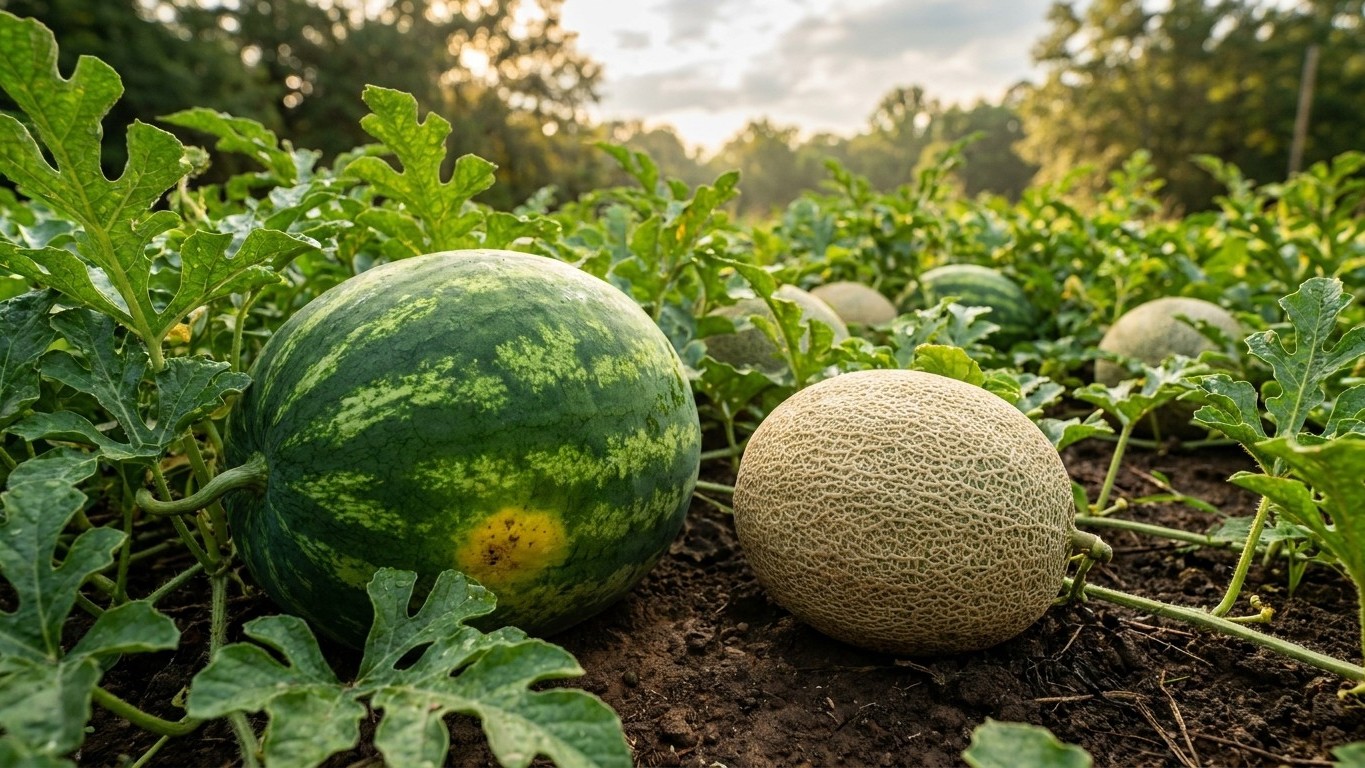

West of the Cascades, Oregon’s growing season runs long but never gets very hot. That combination favors fast-maturing cantaloupe and muskmelon types over anything bred for sustained desert heat. Big slicing watermelons and honeydews that need weeks of 90-degree days are a tougher bet here than smaller, quicker melons built for moderate summers.
The short answer for Oregon
The frost-free window at the Portland reference station runs from roughly March 6-21 for the last spring freeze to November 11-27 for the first fall freeze. That’s a long season on paper, easily seven to eight months. But length isn’t the limiting factor for melons in this part of the state. Heat is. The same station averages just 11.9 days a year at or above 90F. Melons ripen on accumulated heat, not calendar days, and a plant that needs three or four weeks of genuinely hot weather to finish its fruit simply won’t get it here most summers.
That reshapes the decision by type rather than by variety name. Cantaloupe and muskmelon types generally set and ripen fruit with less sustained heat than large watermelons, which makes them the more reliable choice west of the Cascades. Charentais-style melons, bred in cooler European growing regions, tend to tolerate the same limited heat load better than melons developed for the American South or Southwest. Watermelon is not off the table, but the calculus shifts toward smaller, quicker-maturing types rather than the large 80-to-100-day slicing varieties that expect a long run of hot afternoons to build sugar. Honeydew, which typically wants more heat than cantaloupe to sweeten properly, is the riskiest of the common types to plant here without extra help like black plastic mulch or row cover to trap warmth.
None of this comes from a general melon-growing guide. It comes directly from what the Portland-area normals show: a frost-free window long enough to matter, paired with a heat budget thin enough to eliminate anything that treats “long season” and “hot season” as the same thing. Central and eastern Oregon sit in a different climate entirely, high desert with a much shorter frost-free window. Anyone gardening east of the Cascades needs a different set of numbers, not an adjusted version of these.
What will not work here

Long-season watermelon varieties are the clearest mismatch. Types that expect 85 to 100 days of consistently warm weather to finish are betting on a heat supply this region doesn’t reliably provide. With only 11.9 days a year reaching 90F, a plant counting on multiple weeks of that kind of warmth to convert sugars properly is gambling against the climate record, not just a bad year.
The dry summer compounds the heat problem rather than easing it. June through August brings only about 2.7 inches of rain total at the reference station, and July, the peak growing month for melons, averages just 0.51 inches. Melon plants carry a wide, relatively shallow root system and a heavy demand for steady moisture once fruit starts sizing. A watering schedule built around “once a week” fails here, especially on sandy soil where that same thin rainfall drains through in hours rather than lingering for days. Anyone growing melons on lighter soil in this region needs to water more like every two to three days during fruit set, not treat July’s near-drought conditions as a season to coast through.
Slow-to-flower varieties run into a second problem tied to the frost dates. The last spring frost can land as late as March 21 in a given year, and gardeners who wait until well after that date to transplant, as is often necessary since melons hate cold soil, are already eating into the limited hot-day budget before the plant has even flowered. A melon type that needs an extra two or three weeks just to produce its first female flowers is stacking a slow habit on top of a thin heat supply, a combination that tends to end in fruit that never finishes ripening before the first fall frost arrives in mid-to-late November.
Dense, tightly spaced plantings are a smaller risk here than in a humid state, since the region’s low summer rainfall keeps foliar disease pressure down compared to the Southeast. But close spacing still limits airflow, and the Willamette Valley’s morning fog in late summer can be enough to trigger powdery mildew on crowded vines even without heavy rain.
What changes across Oregon
Oregon’s USDA Plant Hardiness Zone range, based on the average annual extreme minimum temperature, spans from 4a to 9b. That is one of the widest spreads of any state, and it means there is no single answer to “what zone am I in” for a page written at the state level. A 4a reading points to a location with brutally cold winter extremes, the kind found in high-elevation or high-desert parts of the state. A 9b reading describes a location with a winter low that barely dips below freezing, typical of milder coastal or low-valley spots. Those two gardens are not gardening the same crop calendar, even in the same state.
For melons specifically, that zone range is a proxy for something more useful: how much a gardener’s local summer heat and season length likely differ from the Portland reference numbers. A gardener at higher elevation or further from the moderating influence of the coast and valley floor should expect a shorter frost-free window than the March-to-November range cited here, and likely fewer hot days rather than more. That points toward leaning even harder on fast cantaloupe types, starting transplants indoors three to four weeks before the last expected frost, and using black plastic mulch or low tunnels to add heat rather than relying on open-ground planting.
A gardener in a milder, lower-elevation part of the Willamette Valley or closer to it is working with conditions closer to the Portland station’s normals, and has more room to try a slightly longer-season cantaloupe or a compact watermelon type without extra season-extension tricks.
The USDA Plant Hardiness Zone Map is the tool built for that, and it’s worth pulling up before choosing a variety based on anything written here.
Where to check this for your own county
The Oregon State University Extension Service is the source built to close that gap. A statewide article has to talk in ranges and reference stations. A county extension office talks in local plantings that have actually been tried in that specific stretch of soil and elevation.
Two things are worth hunting for once there. First, a local planting calendar, usually published by county or by the nearest agricultural extension office, that gives a transplant date range calibrated to that county’s own frost data rather than the Portland station. Second, any variety trial results or extension bulletins naming melon types that have actually performed in that county’s growing conditions. Oregon’s spread from coastal fog to high desert means a cantaloupe that thrives in one county’s trial plots might struggle two hours away, and extension trial data is the closest thing to a real-world test a home gardener can access without running the experiment themselves.
A county recommendation beats a state one every time, for the simple reason that it’s measured closer to the reader’s own soil and sky. Treat this as the first filter, and the county office as the second, more precise one.
Checking this against your own garden
Climate normals describe an average year. The actual year in a specific backyard is its own thing, and three simple checks tell a gardener more about their own microclimate than any regional date.
Soil warmth by feel is the first and most direct signal. Melon roots stall in cold soil regardless of what the calendar says, so pressing a hand into the planting bed a few inches down and feeling for warmth, not just dryness, is a better transplant trigger than counting days from the last frost. Soil that still feels cool to the touch in late March, even after the frost date has passed, is telling the gardener their spot runs colder than the regional average, whether from shade, elevation, or heavy clay that holds winter chill.
The first flush of male flowers is the second signal worth tracking. Melons produce male flowers before female ones, and a plant that’s slow to flower at all, weeks after nearby gardens are showing blooms, is flagging either insufficient heat or a nutrient problem specific to that plot.
The appearance of the first true leaves, the ones that follow the initial round seed leaves and start to show the plant’s actual leaf shape, marks the point where a seedling has moved past its most fragile stage. A stretch of true leaves that’s slow to fill in, compared to what the same variety does in a neighbor’s garden, is often the clearest early clue that a particular spot runs cooler or drier than the rest of the property, worth noting before the next planting season rather than guessing again from scratch.