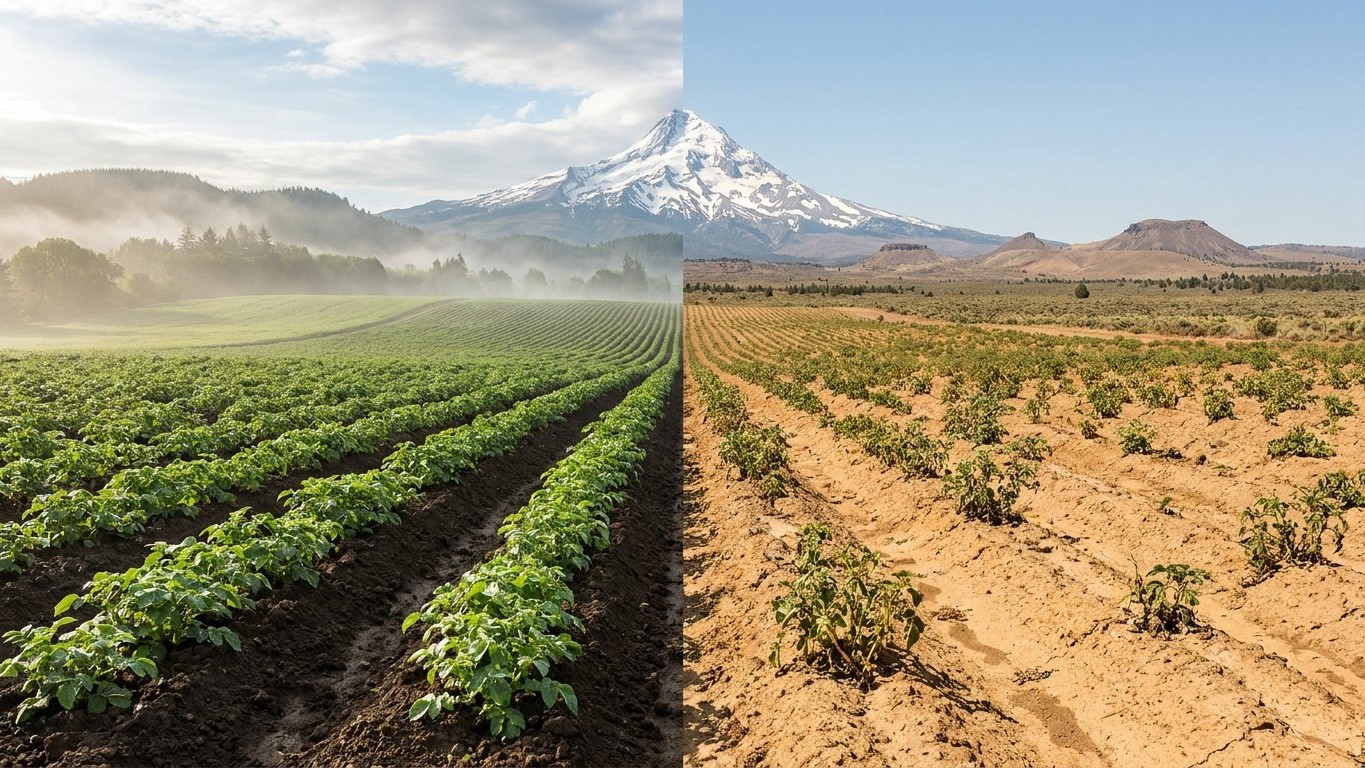

Oregon’s growing season splits sharply at the Cascades, and that split decides which potatoes work where. West of the mountains, near Portland, the frost-free window opens between March 6 and March 21 according to NOAA NCEI climate normals. East and central Oregon run on high-desert timing that’s shorter and hotter, so a variety that thrives in the Willamette Valley can stall in Bend or Redmond. Season class, not brand name, is what actually matters.
The short answer
For a reference point, Portland’s last spring frost falls between March 6 and March 21, based on the 32°F freeze-probability data in NOAA NCEI’s 1991-2020 U.S. Climate Normals for that station. That window is the anchor for west-side planting, but it isn’t a statewide number. Central and eastern Oregon sit in high-desert country with a much tighter season, and treating the Portland date as gospel for Bend or Burns will get a gardener into trouble fast.
The variety question follows straight from that split. West of the Cascades, gardeners have room to grow early, mid-season, and late-season potatoes, because the frost-free stretch is long enough to let a late crop fill tubers before fall rain and cold shut things down. East of the Cascades, the calculus tightens. Utah State University Extension’s potato fact sheet lays out the mechanism plainly: potatoes go in the ground as soon as soil temperature reaches 50°F, which typically lands 14 to 21 days before the last frost date. That’s an early start almost everywhere in Oregon, frost risk or not, because the plant needs cool soil to root before top growth takes off.
Where the state’s growing zones part ways is in what happens after that early planting. In the Willamette Valley and the coastal strip, moderate summer temperatures let a late-season crop keep filling tubers for months without the soil overheating. In the high desert, the ceiling comes fast: once soil temperatures push past 90°F, the University of Maine Cooperative Extension’s bulletin on potato production notes that tuber set and fill simply stop. Watering more doesn’t reverse it. That single fact reshapes variety choice for anyone gardening east of the mountains: an early-season type dug before the heat peaks will outperform a late-season type that’s still trying to bulk up in July soil that’s baking.
So the short answer has two parts. On the west side, all three season classes, early, mid-season, and late, are workable, and the choice comes down to how a crop will be used, since baking types and boiling types come from different backgrounds within those classes. On the east side and in the central basin, early-season types planted at the first 50°F soil reading and dug before peak summer heat are the safer bet, because the season simply doesn’t leave room for a late crop to finish before the soil turns hostile.
What actually decides it
Soil temperature, not the calendar
The planting trigger isn’t a date on a seed packet. It’s soil temperature. Utah State’s fact sheet ties planting to the soil hitting 50°F, which usually happens 14 to 21 days ahead of the last frost date for a given location. That’s a mechanism, and it travels: whatever the local last-frost window looks like, a gardener works backward from it, checks soil temperature directly with a probe thermometer a few inches down, and plants once that 50°F mark is hit, frost risk notwithstanding, because potato seed pieces tolerate cool soil far better than they tolerate a late start.
The heat ceiling that ends the season early
The second mechanism is the one gardeners tend to miss until a harvest disappoints them. Once soil temperatures climb above 90°F, tuber set and fill are inhibited, according to both Utah State and the University of Maine sources. This isn’t about the plant wilting or looking stressed above ground. It’s happening underground, invisibly, and no amount of irrigation corrects it once the soil has crossed that line. That’s why the count of 90°F days in a given part of Oregon matters more than the frost date does for deciding variety and timing. A location that logs many days above that threshold through summer needs a plan built around an early spring crop dug before the heat sets in, not a season-long planting nursed through July and August.
Applying it to a place this page hasn’t named
Take a garden somewhere between the Willamette Valley and the high desert, in foothill country with cooler nights than Bend but warmer summers than Portland. The reasoning still holds: check soil temperature in spring, plant at 50°F, then estimate how many days that garden typically sits above 90°F over the summer. If that stretch is short, a late-season variety has room to finish. If it’s long and sustained, shift toward an early-season variety and plan the harvest for early-to-mid summer rather than fall, dodging the heat window entirely rather than fighting it.
How to do it
- Source certified seed potatoes rather than grocery-store tubers or saved stock from a previous crop; uncertified seed carries virus that saved tubers can’t be checked for at home, and that virus load builds year over year once it’s in the soil.
- Check soil temperature directly with a probe thermometer a few inches deep in the planting bed, rather than relying on air temperature or the calendar.
- Plant seed pieces once soil reaches 50°F, which lands roughly 14 to 21 days before the local last frost date, per Utah State University Extension.
- West of the Cascades, near a Portland-type frost window of March 6 to March 21, choose season class based on intended use: early types for a quick harvest, late types where the summer stays mild enough for extended tuber fill.
- East of the Cascades or in the central basin, favor early-season types and time planting so the crop can be dug before soil temperatures push past 90°F in summer.
- Hill soil around the base of the plants as they grow to keep developing tubers covered and shielded from direct heat and light.
- Monitor summer soil temperature where feasible, and if a heat spell threatens to push soil above 90°F for an extended stretch, prioritize digging early crops rather than waiting for a fuller size that heat-stalled tubers won’t reach anyway.
- Harvest and cure tubers according to their intended use, digging baking types and boiling types once the vines have died back, and storing them in a cool, dark space away from further heat exposure.
What goes wrong
- Planting by the calendar instead of soil temperature. A gardener who waits for a fixed date rather than checking soil temperature either plants too early into cold, wet ground that rots seed pieces, or too late, missing the 14-to-21-day window ahead of the last frost that Utah State’s fact sheet describes. The fix is a soil thermometer, checked directly in the bed, not a date circled on a calendar.
- Growing a late-season variety in a high-heat location. East of the Cascades, a late-season type planted with west-side timing in mind often stalls once soil temperatures cross 90°F mid-summer, leaving small, underfilled tubers at harvest. The remedy is matching season class to the local heat pattern before planting, favoring early types where summer heat runs high and long.
- Assuming irrigation fixes heat-stalled tubers. Watering more once soil has passed 90°F does not restart tuber fill, because the inhibition described by Utah State and the University of Maine is a temperature response, not a moisture deficit. The only remedy is timing the crop, through early planting, to finish before that heat window arrives.
- Using uncertified or saved seed. Tubers saved from a previous harvest or bought as table stock can carry virus invisibly, and that virus can depress yield for the life of the planting. The fix is certified seed potatoes each season, sourced specifically as seed stock rather than eating potatoes.
- Applying one frost date to the whole state. The March 6 to March 21 window from NOAA NCEI applies to the Portland-area station it’s drawn from, not to central or eastern Oregon’s high-desert timing. The remedy is checking local frost data and soil temperature for the specific growing location rather than borrowing a west-side figure.
Common questions
Can I plant the same potato variety statewide in Oregon?
Season class matters more than the variety name. Early-season types travel well across the state’s climate divide, since they finish before either west-side rain or east-side heat becomes a problem, while late-season types are better suited to the milder, longer summers west of the Cascades.
What soil temperature should I check before planting?
Utah State University Extension ties planting to a soil temperature of 50°F, reached 14 to 21 days before the local last frost date. Checking soil directly with a probe thermometer is more reliable than going by air temperature or a fixed calendar date.
Does watering help if it gets too hot for my potatoes?
No. Once soil temperature passes 90°F, tuber set and fill are inhibited regardless of moisture, according to both Utah State and University of Maine Cooperative Extension sources. The only working remedy is timing the crop so it finishes before that heat threshold is reached.
Why does certified seed matter so much?
Uncertified seed, including saved tubers or grocery-store potatoes, can carry virus that isn’t visible at planting time but reduces vigor and yield. Certified seed potatoes are checked for that risk before sale, which saved or store-bought tubers are not.