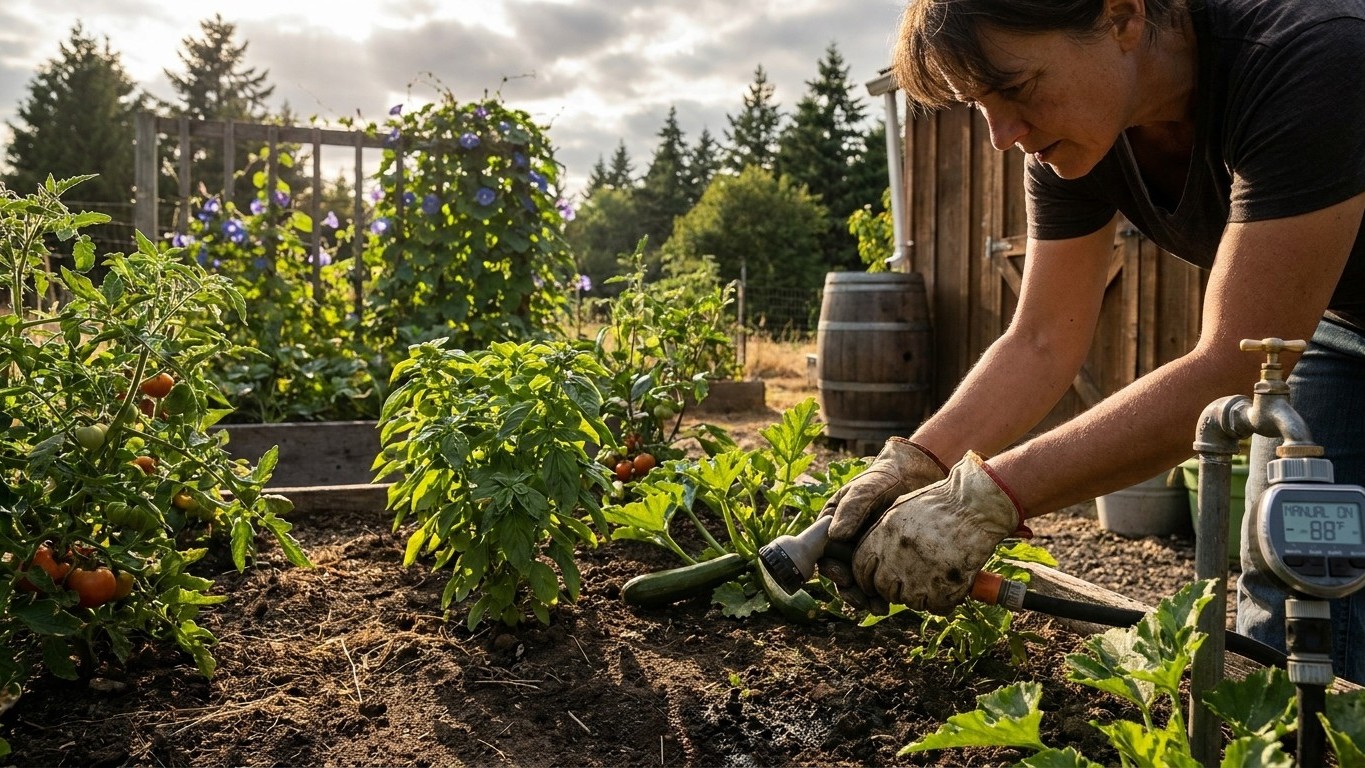

West of the Cascades, Oregon runs on a simple summer script: warm, dry weeks strung together, water arriving from a hose instead of the sky. A garden bed needs about an inch of water a week no matter what state it’s in, but Oregon’s dry-summer pattern and USDA zones spanning 4a to 9b mean the timing and technique change block by block. Here’s what that means for a watering can, a hose timer, or a rain barrel, and for gardeners relying on pots and other containers, the specifics are covered in Watering Pots and Containers in Oregon.
What the climate asks of you

Two numbers set the terms of a Oregon summer. At the Portland reference station, the average is 11.9 days a year at 90F or hotter, a NOAA Climate Normals figure that rules out any illusion of a cool, forgiving growing season. That’s not a brutal desert count, but it’s enough heat pressure that a garden left unwatered for a week in July shows it fast. The second number that matters just as much, July’s rainfall totals falling to a trickle west of the Cascades, isn’t one this guide will round or guess at. Anyone planning irrigation around a specific rainfall figure should pull the current month-by-month normals for their own station from NOAA NCEI or ask the local extension office, because a statewide average would mislead more than it helps.
What can be said with confidence: Oregon’s growing season is bookended by frost dates that already flag how short the margin is in some places. Around Portland, the last spring freeze typically falls between March 6 and March 21, and the first fall freeze lands between November 11 and November 27, per NOAA’s 1991-2020 normals. That’s a workable window for most vegetables and ornamentals in the Willamette Valley. But those dates describe the west side only. Central and eastern Oregon sit in high desert territory, with far shorter frost-free stretches and summer heat that behaves differently from the marine-influenced valley climate. A watering schedule built for Portland’s frost calendar and Portland’s July dryness will not transfer cleanly to Bend or Burns.
Why the arithmetic still favors the hose
Even in a wetter year, an inch of rain a week is not something a dry Oregon summer delivers reliably, and the driest month locally is close enough to bare that most of that inch has to come from the gardener’s hand. Add sandy or fast-draining ground, common in parts of the high desert and along some valley terraces, and the math gets worse: the same rain that would sit for days in heavy clay disappears in hours in sand. A garden on light soil in a dry month is effectively on irrigation, not on rainfall, for most of the summer.
How much, how often
The rule that matters more than any calendar is depth over frequency, a principle covered in detail in Watering Through a Dry Spell in Oregon, and one that applies whether the source is a hose, a timer, or a rain barrel.com/oregon/garden/watering/containers/”>Watering Pots and Containers in Oregon, and one that applies just as much to in-ground beds as it does to pots.com/oregon/garden/watering/dry-spell/”>Watering Through a Dry Spell in Oregon. A quick daily splash wets an inch of soil and trains roots to stay shallow, right where the sun bakes them hardest. A deep soak that reaches six to eight inches down pulls roots deeper, into ground that stays cooler and holds moisture longer between waterings. That single shift, deep and infrequent instead of shallow and daily, does more for drought resilience than any product on a garden center shelf.
Knowing when to water beats watering on a fixed schedule. Push a finger, or a trowel, two inches into the soil near the base of a plant. If it’s dry at that depth, it’s time. If it’s still damp, wait. This simple check works regardless of what the forecast says, and it adjusts automatically for whatever the sky actually delivered that week.
Soil texture changes the frequency, not the principle. Sandy ground, common in parts of central and eastern Oregon, holds very little water and drains fast, so it needs shorter, more frequent soakings even though each one uses less water per session. Heavy clay, more typical in parts of the Willamette Valley, holds a week’s worth of water but drowns roots if it’s soaked again before it dries out, and it should never be walked on or worked while still wet. Given how little rain falls in a typical Oregon summer month, most home gardens here are running on irrigation for the bulk of the season, with rainfall as a bonus rather than the plan.
A watering routine that works
- Check soil moisture two inches down at the base of the plant before turning on any hose or timer.
- Water early in the morning, ideally before 9 a.m., so moisture soaks in before heat and evaporation take their share.
- Aim the water at the base of the plant and the root zone, keeping it off the leaves to limit fungal problems.
- Soak deeply enough to reach six to eight inches into the soil, then stop, rather than running a light sprinkle for a set number of minutes.
- Wait until the finger-and-trowel check shows dry soil again before repeating, adjusting the interval for sandy versus clay-heavy ground.
Restrictions and rules
Watering restrictions are common across Oregon in summer, and they shift from one water provider to the next and from one year to the next depending on reservoir levels and stream flows. Some municipal systems set odd-even day schedules by address, others cap outdoor watering to certain hours, and some move through stages tied to drought severity. None of that is fixed enough to print as a permanent rule here, and treating a rule from one city as statewide guidance is a common mistake.
The only source worth trusting is the local water provider or municipal utility, since they publish the current stage, the allowed days and hours, and any exceptions for drip irrigation or hand-watering. Given how thin summer rainfall runs west of the Cascades and how much hotter and drier conditions get east of them, checking before setting a timer or an automatic system is the safer habit, not an optional extra. Oregon State University’s Extension Service, at extension.oregonstate.edu, is a reliable starting point for connecting to county-level resources and current guidance if the water provider’s site doesn’t spell things out clearly.
Rules also tend to tighten fastest in the years that matter most, meaning a dry spring with low snowpack in the Cascades often triggers earlier and stricter restrictions by midsummer. Checking in June, before the driest weeks hit, beats finding out mid-July that hand-watering is the only option left.
Using less
Cutting water use in an Oregon garden comes down to a handful of techniques that each solve a different part of the problem, from evaporation to root depth to timing. Layered together, they can cut outdoor water use by a wide margin without shrinking what actually gets planted.
- Mulch, two to three inches deep, over soil and around root zones slows evaporation dramatically and keeps soil temperature more stable, which matters most during the days pushing past 90F.
- Drip irrigation or soaker hoses deliver water directly to the root zone instead of spraying it into the air, cutting the losses that come with overhead sprinklers on a hot, breezy afternoon.
- Grouping plants by water need, rather than scattering thirsty annuals among drought-tolerant natives, means each zone gets exactly what it needs instead of an average that overwaters some plants and underwaters others.
- Working organic matter into the soil, especially into fast-draining sandy ground, improves how much water the soil holds between waterings, stretching the interval between soaks.
- Rain barrels, where local rules allow them, capture roof runoff that would otherwise disappear into a storm drain: an inch of rain falling on a thousand square feet of roof works out to roughly 600 gallons of water.
That last figure matters more in the wet season than the dry one here. Oregon’s fall, winter, and spring months west of the Cascades deliver the bulk of the annual rainfall, so barrels fill fastest then and are worth having ready before the dry stretch sets in. Once the driest summer weeks arrive and rain slows to almost nothing, a barrel sized for a typical winter storm can run dry within days of steady garden use, which makes it a supplement to a hose, not a replacement for one, during the hottest part of the year.
Common questions
Is it legal to water my lawn every day in Oregon?
It depends entirely on the local water provider’s current rules, which vary by city and by drought year. Some allow daily watering, others restrict outdoor watering to specific days or hours. Checking directly with the municipal utility before setting a schedule is the only reliable way to know.
What time of day should I water my garden in Oregon?
Early morning, generally before 9 a.m., is best because it gives water time to soak into the soil before the day’s heat drives evaporation, and it keeps leaves from staying wet overnight, which can invite fungal disease.
Do I need to water differently in eastern Oregon than in Portland?
Yes. Eastern and central Oregon sit in high desert conditions with shorter frost-free seasons and different soil types than the Willamette Valley, so both the watering frequency and the growing calendar shift. The frost dates and rainfall patterns for the Portland area do not apply statewide.
How can I tell if my soil is sandy or clay-heavy without a lab test?
A simple squeeze test works: damp soil that holds a shape and feels slick is likely clay-heavy, while soil that falls apart and drains quickly through your fingers leans sandy. This affects how often watering is needed, even when the weekly total stays the same.