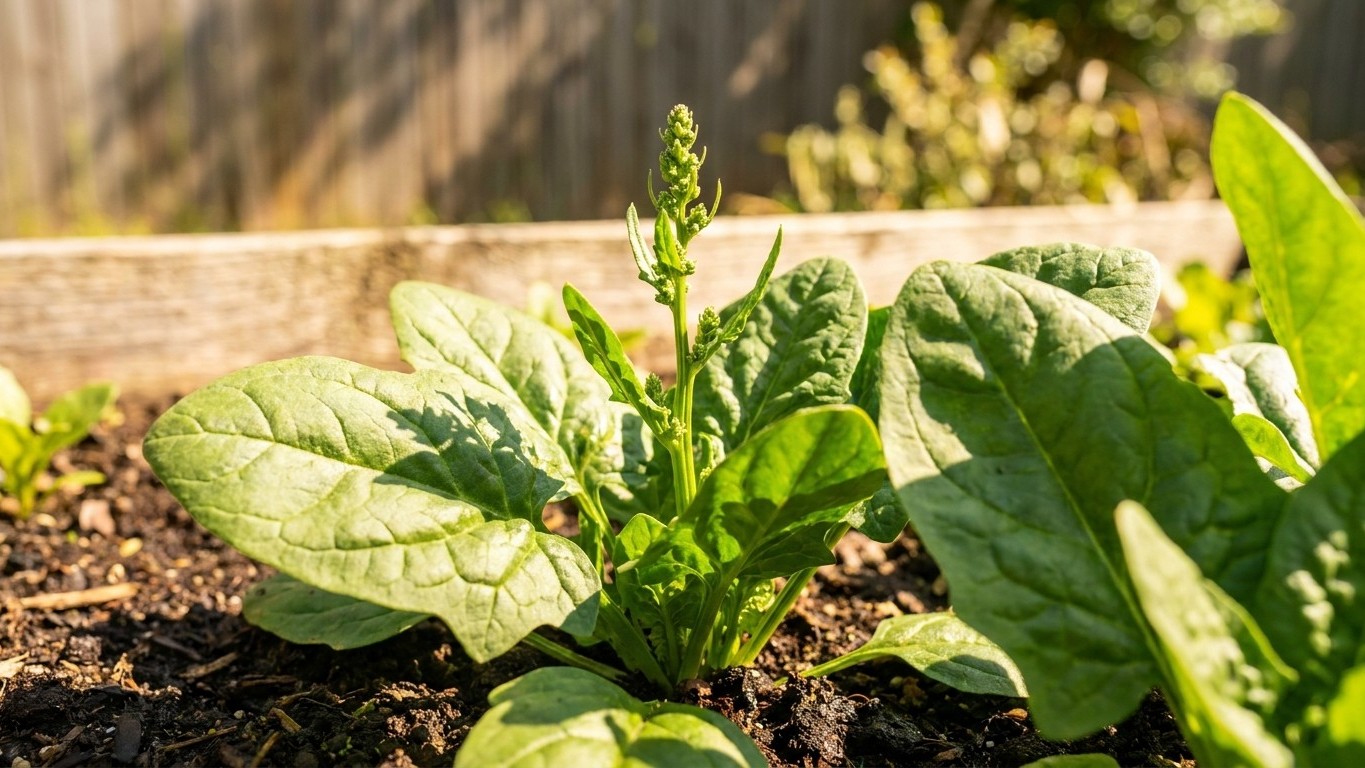

Cut spinach in Pennsylvania during two cool stretches: spring, from a March sowing until the heat arrives, and fall, from a late-summer sowing until frost ends the season. Summer is closed. Once cut, the leaves keep about two weeks at best, and only at 32°F, a temperature most refrigerator doors never reach. Below are the reasons for each limit, the dates for Philadelphia (the mildest corner of the state), and how to shift them north.
The short answer
Philadelphia gets 14 h 50 of daylight on the longest day of the year. That figure comes from a latitude calculation that ignores atmospheric refraction, which adds roughly seven minutes of real daylight. For spinach, a day that long is a bad sign. Utah State University Extension is plain about it: spinach bolts during long days and warm temperatures. Long days alone are enough to start the flower stalk, with no heat wave required.
That changes what a cool summer can do for you. A mild July in the Poconos or a damp August in Erie does not buy extra weeks of leafy growth, because the plant reads the calendar as well as the thermometer. The northern tier sits farther from the equator than Philadelphia, so its longest day runs longer still. Don’t mistake this for the onion rule, where long days build the crop. For spinach, the same variable works against you.
Day length and heat, together
So the limit here is both. Day length sets the outer edge of the season, and heat narrows it further. Spinach grows best where temperatures stay at or below 75 F, and that same number marks where leaves turn bitter. Philadelphia averages 24 days a year at 90 F or higher (NOAA NCEI climate normals, reference station Philadelphia). A 90-degree day is far beyond 75, so the days that hurt spinach outnumber those 24 by a wide margin. Even a spring that stays under the heat line is quietly lengthening the days toward that 14 h 50 peak.
Practically, you cut in the weeks when the weather and the daylight are both on your side: spring after an early sowing, fall after a late-summer one. For the early warning signs of a plant turning, see Will Spinach Bolt Early in Pennsylvania? And for the full-season picture, start with Growing Spinach in Pennsylvania.
How long it keeps once cut
The UC Davis Postharvest Technology Center calls spinach highly perishable and says it will not maintain good quality for more than two weeks. That is a ceiling, not a plan. The optimum is 32°F with 95 to 98 percent relative humidity. Wilting, yellowing and decay climb after 10 to 14 days, and faster at 41 to 50°F, which is about what a home refrigerator actually holds. (The full sheet is at UC Davis Postharvest, Spinach.)
At home, that means the back of the bottom shelf, not the door. The door swings warm every time someone grabs the milk, and at those temperatures spinach yellows in days. Wrap the leaves loosely so some moisture stays in, and cut only what you will use soon. Spinach left standing in a cool bed keeps better than spinach left in a crisper drawer.
How long the spring window really is
Spring spinach is a race between sowing and heat. Sow two to three weeks before the last frost, and growth stops being good above 75 F. Here is how to count the gap for your own ZIP code.
- Find the last frost. For Philadelphia, NOAA NCEI’s most recent 30-year climate normals put the 32°F freeze probability band at March 29 to April 6. The northern tier and the Alleghenies run two to four weeks later, so by simple arithmetic that is roughly April 12 to May 4 in those areas.
- Subtract two to three weeks. In Philadelphia that puts sowing at about March 8 to March 23. In the colder parts of the state it means roughly March 22 to April 20. The window for getting seed in the ground is only about two weeks wide in either place.
- Watch the 75 F line. This is weather, not a date. The facts behind this page carry no calendar day for when highs settle above 75 F, and any date I gave you would be a guess. Track the forecast highs instead.
- Count the weeks between. The gap runs from your sowing date to the first stretch of highs held above 75 F. Spring dates differ between a Philadelphia garden and a Potter County one, but so does the arrival of heat. In a mild year, an early sowing gets a long run. In a spring that jumps to the 80s early, it gets very little.
- Cut early and often. Take outer leaves as they reach eating size, and cut the whole plant when a seed stalk begins to rise from the center.
The source publishes no days-to-maturity figure for spinach, so I won’t hand you a number of weeks from sowing to first cutting. The honest forecast is that spring here is measured in weeks, not months, and it closes from the warm end.
Cutting while the leaves are still sweet
Morning is the best time to cut, when leaves are cool and full of water. Spring crops also draw their own visitors, since slugs and other pests thrive in cool, damp weather; What Eats Spinach in Pennsylvania, and When covers who shows up and when. Once the heat arrives, resist the urge to “let it grow a bit more.” Past 75 F the leaves turn bitter, and the plant is already moving toward flowering.
The autumn crop, and when the soil lets you sow
Fall spinach works backward. Pick a realistic harvest date, then subtract 50 to 75 days. That is Utah State University Extension’s guidance for a fall crop: plant 50 to 75 days before the date you want to harvest. Two things pin down the ends of that count, and neither is the cold you might expect first.
Warm soil blocks the sowing
Seed germination drops off when the soil is above 80 F. Late summer in Pennsylvania can hold that heat for weeks, since soil lags behind air and a sunny bed keeps its warmth after the days start to cool. Philadelphia sees 24 days a year at 90 F or higher, and the soil remembers them. So in the hot parts of the state the window opens when the soil falls, not when the calendar says September.
A soil thermometer in the seed row removes the guesswork. If the bed is still too warm, shade it with cloth or water the row before sowing to pull the temperature down. The shortening days after the June solstice work in your favor, since the day length that triggers flowering is fading. Heat is the only gatekeeper left.
Frost sets the other end
For Philadelphia, the first fall frost lands between November 5 and November 16 (NOAA NCEI climate normals, 32°F freeze probability band). Count back 50 to 75 days from those dates:
- From November 5: sow between about August 22 and September 16.
- From November 16: sow between about September 2 and September 27.
The early end of that range is theoretical in a hot year, because the soil may still be above 80 F. The practical window is whichever part of those dates the soil allows. The northern tier and the Alleghenies generally see frost sooner, so count back from an earlier date there. The figures on this page cover Philadelphia only, and I don’t have a published fall frost date for the northern counties.
As of early October, a sowing made now would take 50 days to reach even the low end of that count, landing past the mid-November frost band. That ends the fall window for a harvest ahead of frost in the southeast. Next year, mark the soil temperature, not just the date.
Common questions
Can I cut spinach in a Pennsylvania summer?
Not reliably. Long days trigger flowering with or without heat, and Philadelphia’s longest day offers 14 h 50 of daylight. The summer crop you might manage in a shaded corner is bitter above 75 F and will bolt. Plan on spring and fall.
How do I know when to cut the whole plant?
When a seed stalk begins to rise from the center, cut the whole plant. That signals the plant has started to flower, and leaf quality drops fast afterward. Until then, take outer leaves and leave the center to keep growing.
How long does cut spinach last in the refrigerator?
Two weeks is the ceiling, according to UC Davis, and only at 32°F. At the 41 to 50°F a home fridge actually holds, spinach yellows in days. Store it at the back of the bottom shelf, not in the door, and use it quickly.
Which variety should I grow?
The Utah State source names four varieties: Bloomsdale, Melody, Teton and Olympia. It gives no data about any of them, such as bolting resistance or days to maturity, so I can’t tell you one beats another. Whichever you choose, the sowing dates above matter more than the name on the packet. One last detail from the storage research: spinach left uncut in a cool bed still outlasts anything in a refrigerator drawer.