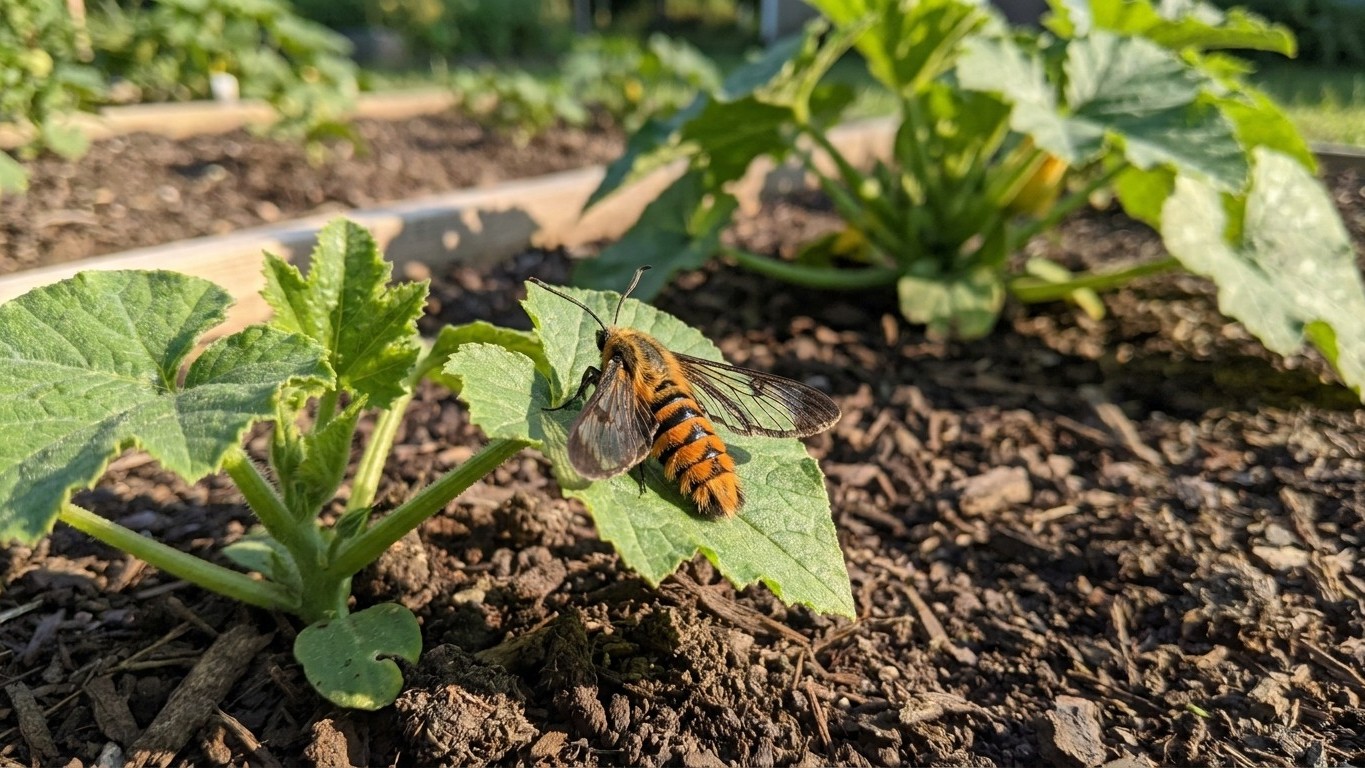

In Pennsylvania, squash vine borer moths usually start emerging in late June, with the heaviest egg-laying pressure hitting home gardens through mid-July and into early August. That window shifts by region: southeastern counties near Philadelphia often see activity a week or two earlier than the mountains of north-central PA. The pest produces one generation a year across most of the state, though a partial second flight has shown up in warmer seasons in the southeast.
Squash vine borer (Melittia cucurbitae) isn’t a beetle despite its name. It’s a moth, and an odd-looking one at that, day-flying and often mistaken for a wasp because of its orange-and-black coloring. The damage it causes, though, is anything but subtle once you know what you’re looking at.
When It Shows Up Across Pennsylvania

Timing tracks with soil warming, not the calendar. Overwintering pupae sit in cocoons an inch or two below the soil surface, and they need a stretch of warm ground before adults chew their way out. In the Philadelphia suburbs and lower Susquehanna Valley, that often means moths flying by the third week of June. Further north and at higher elevations, places like Potter or Bradford County, first emergence tends to lag into early July.
Once moths are active, they don’t waste time. Females lay eggs singly at the base of squash, zucchini, and pumpkin plants, right where the stem meets the soil. A single female can lay 150 to 200 eggs over her lifespan, spreading them across a garden or a whole planting of squash over several weeks. That’s why “spraying once and moving on” almost never works against this pest.
Why Northern and Southern PA Gardens See Different Pressure
Growers in USDA zones 6b and 7a (roughly the Philadelphia metro, the Lehigh Valley, and parts of southwestern PA along the Ohio River) deal with a longer window of vulnerability simply because the season starts earlier and stays warm longer. Gardeners in zone 5a, up in the Poconos or the Allegheny Plateau, get a shorter, more compressed borer season, but it can still be plenty damaging if squash is planted early and vines are already thick and hollow by the time moths arrive.
Spotting the Damage Before the Vine Collapses
The frustrating part of squash vine borer is that the plant often looks fine right up until it doesn’t. A zucchini plant can be thriving one week and wilted flat the next, and by then the larva has already been feeding inside the stem for days.
Look for these signs at the base of the plant, right around the soil line:
- Small holes in the main stem near ground level, sometimes leaking a yellowish, sap-like ooze
- Piles of moist, sawdust-like frass (the larva’s droppings) pushed out through those holes
- Sudden wilting of one or more leaves, or an entire vine, even when soil moisture looks adequate
- A stem that feels soft, hollow, or collapses when gently pressed near the base
Cut into a wilted stem lengthwise and you’ll usually find a cream-colored, brown-headed caterpillar, sometimes just one, sometimes several, feeding on the inner pith. Mature larvae reach close to an inch long and can hollow out several inches of stem tissue before they’re done, which is exactly why the plant above that point starts to starve.
What Actually Stops It in a Pennsylvania Garden
Nothing works as a single fix. Squash vine borer control is really a stack of smaller tactics, and the ones that matter most depend on catching the pest before the larva disappears inside the stem, because once it’s in there, sprays are close to useless.
Row Covers and Timing Tricks
Floating row covers placed over squash beds at planting, and kept on until female flowers appear, block egg-laying moths from ever reaching the stems. The catch is pollination. Squash needs bees to set fruit, so covers have to come off once blossoms open, or gardeners need to hand-pollinate under the cover using a small paintbrush to transfer pollen from male to female flowers each morning.
Staggering plantings helps too. A second, later sowing of summer squash in early July often escapes the worst of the first moth flight and produces a harvest even if the first planting gets hit hard. This works particularly well in southeastern PA, where the growing season is long enough to support it.
Mechanical Removal, the Unglamorous Fix That Works
If a stem is already showing frass, slitting it open lengthwise with a sharp knife, picking out the larva, and then mounding moist soil over the wound can save the plant. Squash stems will root at the nodes if buried, so covering a damaged section with soil often lets the vine push out new roots downstream of the injury and keep growing. It’s tedious work, checking stems every few days through July, but it’s one of the few methods that reliably saves an already-infested plant.
Insecticide Timing Matters More Than Product Choice
Because larvae tunnel into the stem within a day or two of hatching, insecticides only have a narrow window to work, on the eggs and newly hatched larvae, before they’re protected inside the plant. Products containing Bacillus thuringiensis (Bt) or spinosad, applied directly to the base of the stems weekly starting when moths are first spotted, can reduce new infestations. Coverage needs to focus on the crown of the plant and the first foot of vine, not the leaves, since that’s where eggs are laid.
Home gardeners who want to time applications can track moth activity with yellow sticky traps or by watching for the adult moths themselves, which fly during the day and are easy to spot resting on leaves or hovering near plant bases in bright sun.
Sanitation and Soil Work Between Seasons
The pupae that start next year’s infestation are sitting in the soil right now, in gardens across Pennsylvania, wherever squash grew this season. Pulling and destroying vines at the end of the season, rather than tilling them under intact, removes larvae still feeding inside old stems. Tilling the soil in fall or early spring, especially in beds where squash grew, breaks open overwintering cocoons and exposes pupae to cold temperatures and predators like birds.
Rotating squash, pumpkins, and gourds to a different part of the garden each year, ideally 100 feet or more from the previous spot, also cuts down on emerging moths finding host plants close to where they overwintered.
Choosing Varieties That Shrug It Off
Not every squash is equally vulnerable. Varieties in the species Cucurbita moschata, which includes butternut squash and the long, curling Tromboncino, have solid, less hollow stems that make them far harder for larvae to tunnel through successfully compared to the hollow-stemmed Cucurbita pepo types like zucchini, yellow summer squash, and most pumpkins. Gardeners who’ve struggled with vine borer for years often find that switching part of their planting to butternut cuts losses dramatically, even without changing anything else about their growing routine.
Winter squash types in general tend to fare better than summer squash, partly because of stem structure and partly because their longer, sprawling vines can root at multiple points along the ground, giving the plant more places to recover if one section gets damaged.
None of these tactics is foolproof on its own, but Pennsylvania gardeners who combine early monitoring, a row cover during the vulnerable seedling stage, and a fall cleanup of old vines consistently report fewer total losses than those relying on a single method. The pest isn’t going away, but a wilted zucchini in July doesn’t have to mean the whole squash patch is done for the season.
Related guides
- Squash vine borer in New York: When It Shows Up and What Stops It
- Squash vine borer in Delaware: When It Shows Up and What Stops It
- Squash vine borer in Prince Edward Island: When It Shows Up and What Stops It
- Squash vine borer in Quebec: When It Shows Up and What Stops It
- Squash vine borer in Ohio: When It Shows Up and What Stops It
- Squash vine borer in Kentucky: When It Shows Up and What Stops It