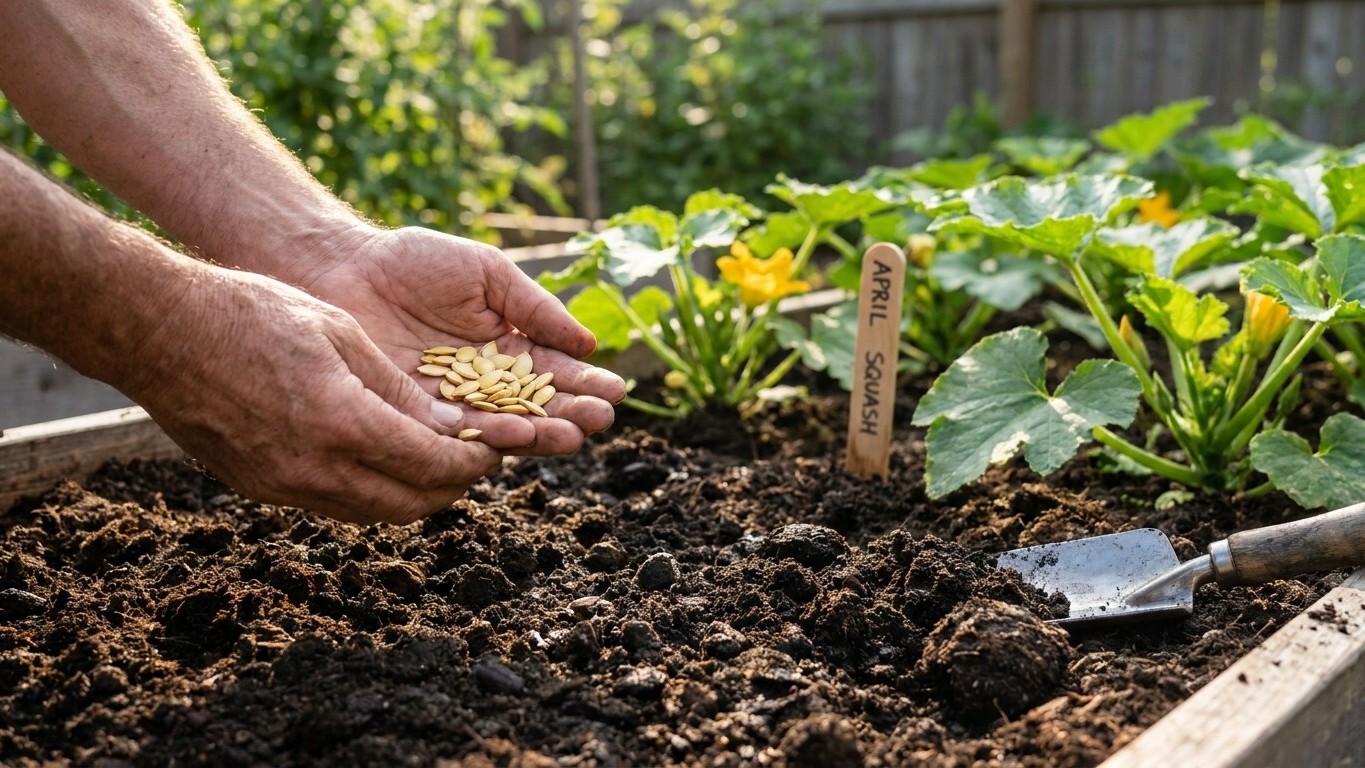

Summer squash goes in the ground after the last spring frost has passed and the soil has warmed, which at the Philadelphia reference station means mid-to-late April at the earliest. Everywhere else in Pennsylvania, count on that window sliding later, sometimes by a full month.
The short answer for Pennsylvania
The state’s last spring frost, tracked at the NOAA reference station in Philadelphia, falls between March 29 and April 6. That date range is a 30-70% freeze probability band, not a guarantee. It means that even in the mildest corner of the state, there’s still a meaningful chance of a freeze in the days on either side of it. Summer squash has zero frost tolerance. A single night at 32F kills the seedlings outright, so the safe sowing window opens after that band closes, once soil temperatures have climbed into the 60s.
In practice, that puts direct-seeding for the Philadelphia area somewhere from mid-April into early May, with transplants going in a week or so earlier under row cover if a gardener wants a head start. The catch is that this date only applies near the reference station itself. The FACTS available for this page cover Philadelphia’s frost data specifically, and the caution attached to it is explicit: the northern tier and the Alleghenies run two to four weeks later in spring. This page doesn’t have a separate frost-date data set for Erie, the Poconos, or the high ridges around State College, so it can’t hand out a specific date for those areas. What it can say is that a Philadelphia-area planting date, applied literally in a higher, colder part of the state, will get seedlings killed.
The fall side of the calendar matters just as much for summer squash, because the crop matures fast and a second sowing in early-to-mid summer often produces a cleaner fall harvest than the spring planting, which tends to fade under squash bugs and powdery mildew by August. The first fall frost at the reference station lands between November 5 and November 16. That’s a long season to work with near Philadelphia. It also carries the same caution: the northern tier and Alleghenies see frost two to four weeks earlier in the fall, which shortens the window for a second planting considerably in those areas.
So the honest short answer: near Philadelphia, aim for mid-to-late April through early May for the first sowing, with a second sowing possible into early July for a fall crop. Everywhere else in the state, shift both dates later by one to four weeks depending on elevation and latitude, and don’t treat the Philadelphia numbers as your own.
What will not work here
The single biggest mistake with Summer Squash in Pennsylvania is planting by the calendar instead of by the soil. A last-frost date that reads “March 29 to April 6” tempts people to sow in early April. But that date is a freeze probability, not a soil-temperature reading, and squash seed sown into cold, wet April soil simply rots before it germinates. Pennsylvania springs are notoriously slow to warm because of the same clay-heavy soils common across much of the Piedmont and ridge-and-valley regions. Soil lags several weeks behind the air.
Heat is the other side of the failure equation, and it works differently than most gardeners expect. Philadelphia averages 24.0 days a year at or above 90F. That’s a real but moderate heat load, not the kind of relentless summer that shuts down squash pollination the way it does in the Deep South. The actual risk here isn’t heat killing the plants. It’s the combination of that heat with the region’s rainfall pattern that decides whether the harvest holds up through August.
Summer rainfall averages about 12.7 inches across June, July and August, broken down as June 4.04 inches, July 4.38 inches, and August 4.29 inches. That’s a reasonably wet summer by national standards, but it almost never arrives evenly. It comes in scattered thunderstorms that dump an inch in twenty minutes and then nothing for ten days. On the clay soils common through central and eastern Pennsylvania, that pattern holds moisture at the surface long enough to keep foliage damp overnight, which is exactly the condition powdery mildew and bacterial wilt need to take hold on summer squash leaves. A gardener who waters on a fixed weekly schedule, assuming the “12.7 inches” figure means the garden is basically covered, will find the plants stressed between storms and then soaked with standing water on clay after them. Neither extreme suits squash roots, which want even moisture, not a boom-and-bust cycle.
Close spacing compounds the humidity problem. Summer squash planted at the tight end of a seed packet’s range, common when gardeners are trying to squeeze more plants into a small raised bed, blocks airflow between leaves. Combined with Pennsylvania’s humid summer air and clay soil’s tendency to hold moisture, tight spacing turns a normal mildew season into a plant-killing one by mid-July.
What changes across Pennsylvania
Pennsylvania’s USDA hardiness zone range runs from 5a to 7b, under the USDA Plant Hardiness Zone Map’s system, which is built on a single variable: the average annual extreme minimum winter temperature. That’s a two-and-a-half-zone spread inside one state’s borders, and it means there is no single planting date that honestly covers Pennsylvania. A 5a reading, found in the higher elevations of the Alleghenies and parts of the northern tier, describes winters roughly 20 to 25 degrees colder at their extreme than a 7b reading near Philadelphia. That difference doesn’t just affect winter survival of perennials. It’s a reasonable proxy for how late spring arrives and how early fall frost shuts the garden down, which is exactly why the frost-date caution attached to the Philadelphia figures calls out the northern tier and the Alleghenies by name: two to four weeks later in spring, and correspondingly earlier in fall.
What that means for a squash grower in practice is a compressed season at the colder end of the state. Someone gardening in a 5a pocket isn’t just planting a few weeks later in spring, they’re also likely losing those weeks off the back end of the season too, since an early fall frost cuts short any hope of a July-sown second crop reaching harvest. Someone in the 7b corner near Philadelphia has both a longer window and enough spare season to reliably fit two summer squash plantings into a single year, spring and midsummer.
Altitude matters here in a way flat-state gardeners rarely have to think about. Two towns at the same latitude, one in a river valley and one on a ridge a thousand feet higher, can differ by a full hardiness zone. Cold air also pools in valley bottoms on clear, still nights, so a garden at the low point of a property can see frost when a garden on a nearby slope doesn’t.
This page can’t tell an individual reader which zone applies to their own yard. It also can’t tell them where in that 5a-7b range they personally fall. What it can say is that the range is wide enough that a gardener should treat both the Philadelphia frost dates and the mid-state or northern estimates as starting points to check locally, not final answers.
Where to check this for your own county
The reliable next step is Penn State Extension. This is the land-grant university extension service for Pennsylvania, and it publishes county-level guidance that this statewide page simply doesn’t have room, or data, to cover.
Two things are worth searching for specifically once there. First, a county or regional planting calendar, since Penn State Extension’s local offices adjust vegetable planting windows to their own frost records rather than relying on a single statewide date. A county calendar built from local frost history will be more accurate than the Philadelphia-based range cited on this page, especially for anyone gardening in the northern tier, the Alleghenies, or at elevation, where the two-to-four-week lag noted earlier actually applies.
Second, look for summer squash varieties that Penn State’s trial programs or local master gardener groups have actually tested in your county’s growing conditions. Squash bugs, vine borers, and powdery mildew pressure vary block by block in this state depending on humidity, air drainage, and how many other cucurbits are grown nearby, and county-level trial results reflect that local pressure in a way a national seed catalog description can’t.
It’s worth being direct about the hierarchy here: a county recommendation beats a state one, every time, and this page is the state one. Nothing here is wrong, but it’s built from a single reference station’s climate normals and a statewide hardiness zone range, both of which smooth over the exact kind of local variation, a frost pocket, a windy ridge, a warm south-facing slope, that decides whether a squash planting succeeds three weeks earlier or three weeks later than the number written here.
Some gardeners also time this by the Moon: when to plant zucchini by the moon, as almanac tradition rather than fact.
Checking this against your own garden
None of the dates above beat what the garden itself is showing on any given week. Three signs are worth checking by hand before trusting a calendar date over them.
Soil warmth by feel is the first and most useful. Push a bare hand a couple of inches into the planting bed in the morning. If it still feels cold and damp rather than merely cool, the soil hasn’t caught up to the air temperature yet, no matter what the frost-date calendar says, and squash seed sown into it will likely rot rather than sprout.
The first flush of male flowers on an already-growing plant is the second signal, and it tells a different story: it means the plant has enough heat and daylight behind it to start reproductive growth, which is a decent proxy for whether conditions are stable enough to expect fruit to follow once female flowers appear a week or two later.
The appearance of the first true leaves, the serrated ones that follow the rounder seed leaves, is the third. Seedlings that sit at the seed-leaf stage for an unusually long stretch are usually sitting in soil that’s too cold or too wet for vigorous growth, a local condition no statewide calendar can predict but one that shows up clearly in the bed itself within a week of sowing.