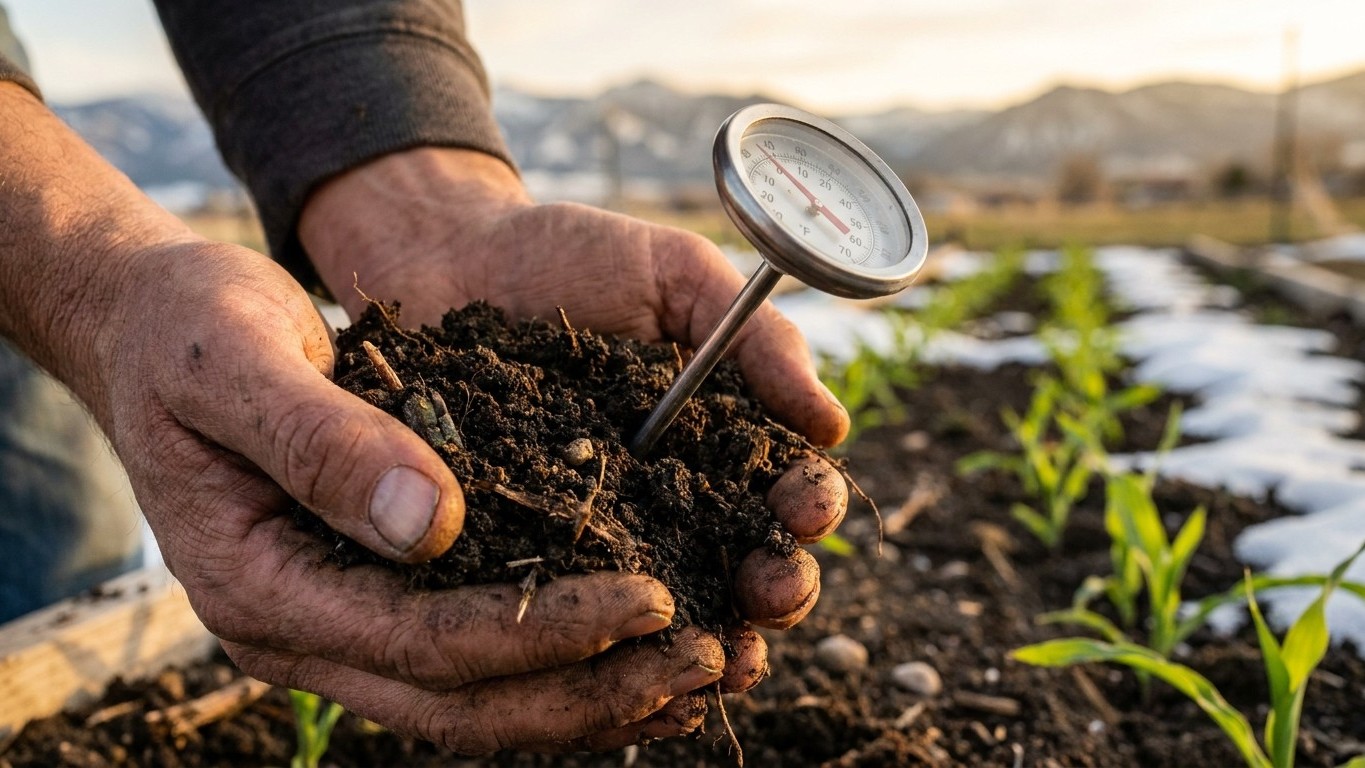

Yes, sweet corn ripens in Pennsylvania, but the calendar is tighter than most gardeners assume. The state’s growing season runs long enough for even a slow-maturing variety in most counties, provided the soil is warm enough at planting and the crop’s clock is checked against local frost dates rather than a seed packet’s national average.
The short answer
Corn doesn’t care what the calendar says about the last frost. It cares about soil temperature, and that number arrives later than the frost-free date most gardeners circle on the calendar. Pennsylvania’s last spring frost falls between March 29 and April 6, according to NOAA’s 1991-2020 climate normals for the Philadelphia reference station. Soil at 60 F, the threshold sweet corn actually needs before germination succeeds, shows up well after that date. The air can be frost-free while the ground underneath is still too cold for a seed to do anything but rot.
This gap matters because it’s the single most common reason home gardeners lose a planting before it ever breaks the surface. A calendar says plant in early April. The soil, still cold from winter, says wait. Waiting a few extra weeks for the ground to catch up costs nothing and saves the seed. For a closer look at how to time this correctly, see When to Sow Sweet Corn in Pennsylvania.
Once the soil clears 60 F, the second clock starts: sweet corn needs 60 to 90 days from planting to maturity, depending on the variety. This is really the crux of Will Sweet Corn Ripen in Pennsylvania?, since the question is whether that window closes before the first fall frost arrives. In Pennsylvania, that first fall frost lands between November 5 and November 16 at the reference station. Counting from a soil-warm date sometime in mid-to-late spring through to early-to-mid November leaves a stretch of well over 200 days, more than enough room for even the slower end of the 60-to-90-day range.
| Milestone | Date range |
|---|---|
| Last spring frost | March 29 to April 6 |
| First fall frost | November 5 to November 16 |
| Days needed for corn to mature | 60 to 90 days from planting |
That margin is a statewide average, though, and it hides real variation. Philadelphia is the mildest corner of Pennsylvania. The northern tier and the Alleghenies run two to four weeks later in spring, which pushes back both the frost-free date and the soil-warming date behind it. Summer heat load matters too: the reference station averages 24 days a year at 90 F or above, which drives water demand and heat stress during the weeks corn is filling its ears. A garden in the mountains won’t see nearly that many hot days, and its corn will mature more slowly as a result, even from the same seed packet.
Does a late variety fit here?
Both ends of the maturity range work in most of Pennsylvania, but the reasons differ, and the margin isn’t identical everywhere.
A 60-day variety
A fast-maturing type is the low-risk choice almost anywhere in the state. Even accounting for a soil-warming delay that pushes planting into the back half of spring, and even in the northern tier where frost clears two to four weeks later than the Philadelphia average, a 60-day corn has room to spare before the first fall frost arrives in early-to-mid November. This is also the variety that tolerates a mistake. If a cold snap delays planting, or a rainy stretch pushes the soil-warm date back further than expected, a 60-day crop can absorb the setback and still finish before frost. It’s the forgiving option, and in a state with this much regional spread in frost timing, forgiveness has real value.
A 90-day variety
The slower variety fits too, but with less slack. Counting from a soil-warm date to a November fall frost, the statewide window is wide enough to accommodate 90 days without trouble in the milder, southeastern part of the state. Where the calculation tightens is in the northern tier and the Alleghenies, where spring arrives two to four weeks later. That later start eats directly into the same 90 days, and a gardener there should plant as soon as the soil genuinely clears 60 F, without lingering, if a 90-day variety is the plan. It doesn’t rule the late variety out. It does remove the cushion a 60-day corn would carry into the same soil and same fall frost date.
What goes wrong here
- Planting before the soil is warm. Air temperature above freezing doesn’t mean the ground is ready. Sweet corn needs soil above 60 F to germinate reliably, and that threshold in Pennsylvania comes well after the last spring frost. Seed sown into cold ground either rots or comes up weak and uneven. The remedy is patience: check soil temperature directly rather than trusting the frost-free date, and hold off until the ground itself has caught up with the season.
- Choosing a variety too slow for the local window. A 90-day corn planted late, or planted in a county where spring runs two to four weeks behind the state average, can run out of season before the first fall frost in November. The remedy is matching the variety to the county, not to the seed rack: a 60-day type is the safer bet anywhere the local frost calendar runs late, and a 90-day type belongs in gardens that can get seed into warm soil early and reliably.
- Losing sweetness to a neighboring planting. This failure has nothing to do with Pennsylvania’s climate and everything to do with what’s tasseling nearby. Sweet corn comes in types (su, se, and sh2) that lose their characteristic sweetness if they tassel at the same time as each other, or alongside field corn. The published guidance from Utah State University Extension gives no isolation distance to plant by, so don’t plant by one. What matters is timing: stagger plantings or choose varieties that won’t tassel together, and grow each type in its own block of at least three rows rather than a single thin row, since that block shape is what allows the ears to pollinate properly within their own planting.
Checking this against your own county
Everything above is built on a single reference station, and Pennsylvania is a big enough state that a single station can’t speak for all of it. A garden in the Alleghenies or the northern tier is working from a frost calendar that runs weeks behind the numbers used here, which shifts both the safe planting date and how much room a 90-day variety really has before fall frost.
The most reliable way to confirm the actual window for a specific county is to check with Penn State Extension, the state’s land-grant extension service, at extension.psu.edu. Local extension offices track soil temperature and frost timing at the county level, which is the detail that decides whether a particular variety, planted on a particular week, has enough season left to finish before the ground freezes again.
Common questions
Can sweet corn be planted before the last frost in Pennsylvania?
No. The seed needs soil above 60 F to germinate, and that threshold arrives after the last frost date, not before it. Planting on the frost date alone risks cold, wet soil that rots the seed.
How do I know when sweet corn is actually ripe?
Check for three signs together: the silks have turned dry and brown, the husk is still moist and green, and a punctured kernel releases milky juice rather than clear liquid. Any one sign alone isn’t enough to confirm ripeness.
Is there a difference between the days-to-maturity number and the days after silk appears?
Yes, and they answer different questions. The 60-to-90-day figure counts from planting and tells you whether the crop fits the season at all. A separate count of 17 to 24 days from when silk first appears tells you which week to actually pick. Don’t confuse the two.
Do different sweet corn varieties need to be kept apart?
They need to avoid tasseling at the same time as each other, since su, se, and sh2 types cross and lose sweetness if they pollinate together. No isolation distance is published for this; the fix is staggered timing, not a measured gap between rows.