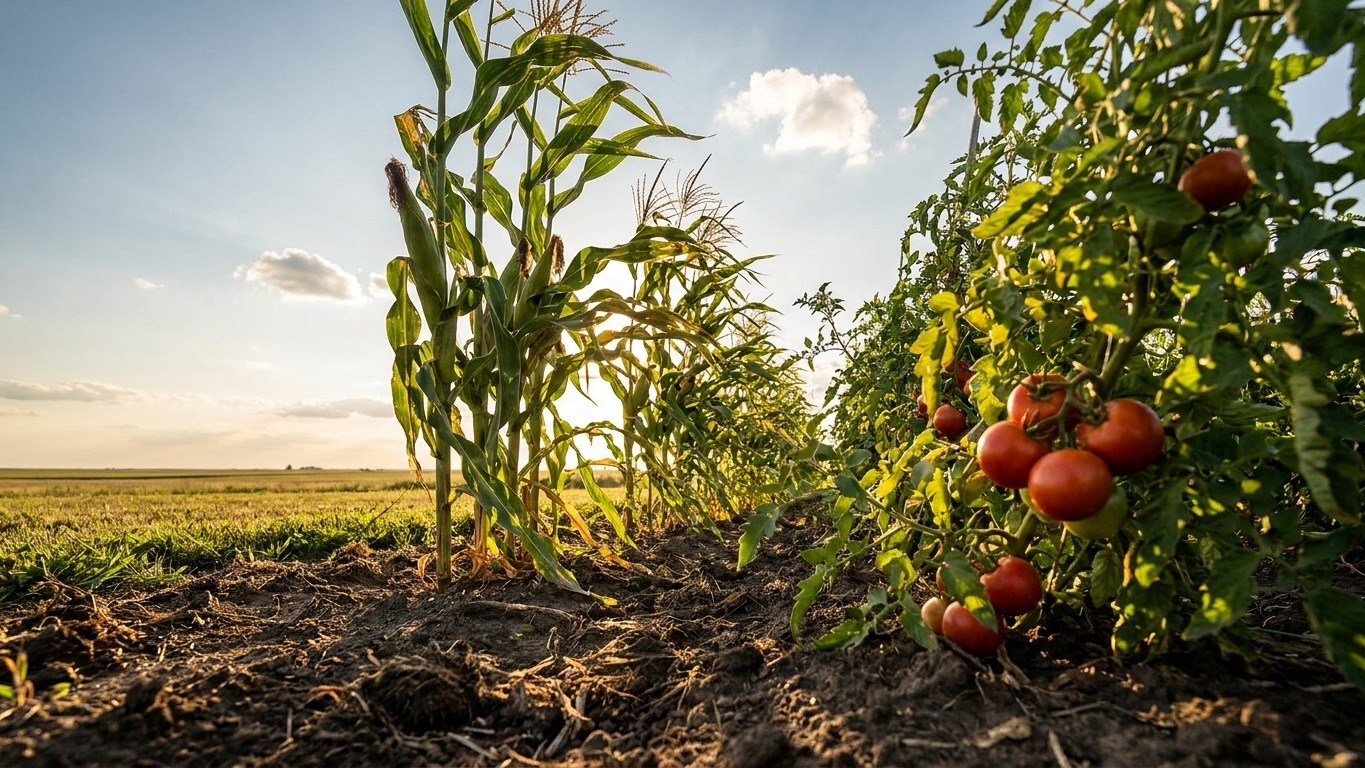

Sweet corn is ready when the silks have dried brown, the husks are still green and moist, and a punctured kernel squirts milky juice. In Pennsylvania, that moment can fall anywhere from early July to early fall, depending on when the seed went in and how far north the garden sits. Once an ear is picked, sugar starts leaving the kernel, and heat speeds it up. Below: how to read the plant, how long picked ears last, and which spot in your house comes closest to ideal. For the whole season, start with Growing Sweet Corn in Pennsylvania.
When sweet corn are ready in Pennsylvania
How do you tell an ear is ready to pick?
Look for three signs together, because any one of them can mislead you. The silks at the tip of the ear should be dry and brown. The husk should still be green, snug and moist. Then press a thumbnail into a kernel near the tip: milky juice means ready, clear and watery juice means a few more days, and a pasty or doughy kernel means you waited too long.
The calendar helps once you have a starting point. Watch the silks appear after the tassels shed pollen, and check the ears as the silks begin to brown. Write down the day you spot silks on the first ears. Then you will know which week to start testing, and the dates will shift with every summer’s weather.
Will a Pennsylvania planting ripen before the fall frost?
The planting date decides it, and the planting date follows the soil, not the frost. At the Philadelphia reference station, NOAA’s 1991-2020 Climate Normals put the last spring freeze (32 F, in the 30 to 70 percent probability band) between March 29 and April 6. The first fall freeze falls between November 5 and November 16. Philadelphia is the mildest corner of the state. The northern tier and the Alleghenies run two to four weeks later in spring, and their fall frost arrives sooner.
Soil at 60 F comes well after the last frost. Utah State University Extension says sweet corn needs soil above 60 F and then 60 to 90 days from planting. Clemson Cooperative Extension sets the floor for ordinary sweet corn at 50 F measured at the 4-inch depth, and says to wait for 65 F before sowing extra-sweet types. A surface reading runs warmer than the soil at seed depth, so push the thermometer down the full four inches. Where the season is shorter, a variety near the 90-day end may not finish before frost. Count forward from the day the soil warms, and compare the answer with your local fall frost date. The county extension office can give you that date. More on timing is in When to Sow Sweet Corn in Pennsylvania.
For a rough window, early plantings in the southeast of the state can be ready around early July, and late plantings in the north and the mountains can run into September. A garden sown in several stages will spread that harvest over weeks instead of a single weekend.
What decides how sweet the ears taste?
Sweetness depends on neighbors. Utah State University Extension warns that sweetness is lost if su, se and sh2 types tassel at the same time. It also recommends planting in blocks of three or more rows, so pollen lands where it should. The fix is timing. Stagger plantings so different types do not shed pollen together, or grow one type in a given season. Ears that reach ripeness are also what raccoons and birds are waiting for, and What Eats Corn in Pennsylvania, and When explains when to expect them.
Keeping them, and for how long
Ears begin losing sweetness the moment they leave the stalk. Clemson Cooperative Extension says it plainly: “Sweet corn loses sugar from the kernel rapidly at high temperatures… Sweet corn can be stored under optimal conditions for about five days, but will lose sweetness with each day of storage.” That is the real reason for the old advice to start the water boiling before you walk out to pick. Sugar leaves the kernel, and heat makes it leave faster.
Treat about five days as a ceiling. It applies under optimal conditions, which means cold and moist storage with the husk left on. A warm car, a sunny porch or a kitchen counter will shorten it, and every day inside that window still costs some sweetness. An ear eaten the day it is picked tastes better than one eaten on day five, even when both were stored perfectly.
Heat is a bigger factor in Pennsylvania than most people expect. The Philadelphia reference station averages 24 days a year at 90 F or more. An ear sitting in a basket on a 90-degree afternoon loses sugar much faster than one in the fridge. Carry a cooler or a bucket of shade to the garden, and bring the ears inside right away.
Which sweet corn type holds its sugar longest?
The genetics matter as much as the storage. Of the three common types, su loses sugar fastest, se holds it longer, and sh2 holds it longest. That is the practical reason to choose one over another, and it affects how you plan the harvest.
| Type | How fast sugar fades | What to do with it |
|---|---|---|
| su | Fastest | Eat first, ideally the day it is picked |
| se | Slower than su | Good for a few days of cold storage |
| sh2 | Slowest | Best keeper, but wait for 65 F soil at 4 inches before sowing |
The 65 F rule for sh2 matters. Clemson’s guidance separates ordinary sweet corn (soil at least 50 F at 4 inches) from extra-sweet types (65 F). The two numbers are not interchangeable. An extra-sweet seed sown into 50 F soil may rot instead of sprouting, which is why a gardener can succeed one year and fail the next after switching varieties. Ears that will not be eaten within a few days are better cut off the cob and frozen than left to fade in the fridge.
Where in the house that actually is
The refrigerator comes closest to the optimal conditions. A cold, steady, humid spot slows sugar loss, and the crisper drawer usually offers that. A heated kitchen is too warm, since sugar drains quickly at room temperature. A garage is no better, because its temperature swings with the weather and a hot afternoon can undo a cool night. A basement fares slightly better, though it is usually still warmer than a fridge.
The fridge has one catch. Some models run colder at the back wall or in certain drawers, and kernels can be damaged if they freeze. Others dry out ears left uncovered. A thermometer settles the question quickly, and these three checks cover the details:
- Read the temperature in the crisper drawer after a full day of normal use, and again after the door has been opened a few times.
- Keep the husks on and put the ears in a loose bag, so moisture stays in without trapping heat.
- Stay away from the back wall, where the coldest air blows out, and rotate ears toward the front each day.
Put a thermometer in the crisper drawer for a day before the first harvest. If you skip the check, a drawer that runs too warm will quietly cost you sweetness, and one that runs too cold can freeze kernels in a way you will not notice until dinner.
If the fridge is full of other produce, clear a shelf rather than stacking ears in a warm pantry. Corn is one of the few vegetables worth giving the best spot to, because it declines faster than almost anything else from the garden. An hour in a warm kitchen costs less than a day, but the damage still adds up.
Common questions
Can you pick sweet corn before the silks turn brown?
You can, but the ears are usually watery and bland. Brown silks, a green moist husk and milky juice from a punctured kernel should all agree. If the juice runs clear, give it another day or two and test again.
How long does sweet corn stay sweet after picking?
Clemson Cooperative Extension says sweet corn can be stored under optimal conditions for about five days, and that it loses sweetness with each day of storage. Treat five days as a ceiling. The su type fades fastest, se holds longer, and sh2 holds longest.
Does planting different sweet corn types together hurt the flavor?
It can. Utah State University Extension says sweetness is lost if su, se and sh2 types tassel at the same time. Stagger the plantings so the tassels do not overlap, and plant in blocks of three or more rows so pollination works well.
Is there time to grow sweet corn in northern Pennsylvania?
Often yes, if you pick a variety that matures in the short end of the 60 to 90 day range. Count that many days from the day the soil reaches 60 F, and compare the result with your local first fall frost. Your county extension office can confirm the dates for your area.