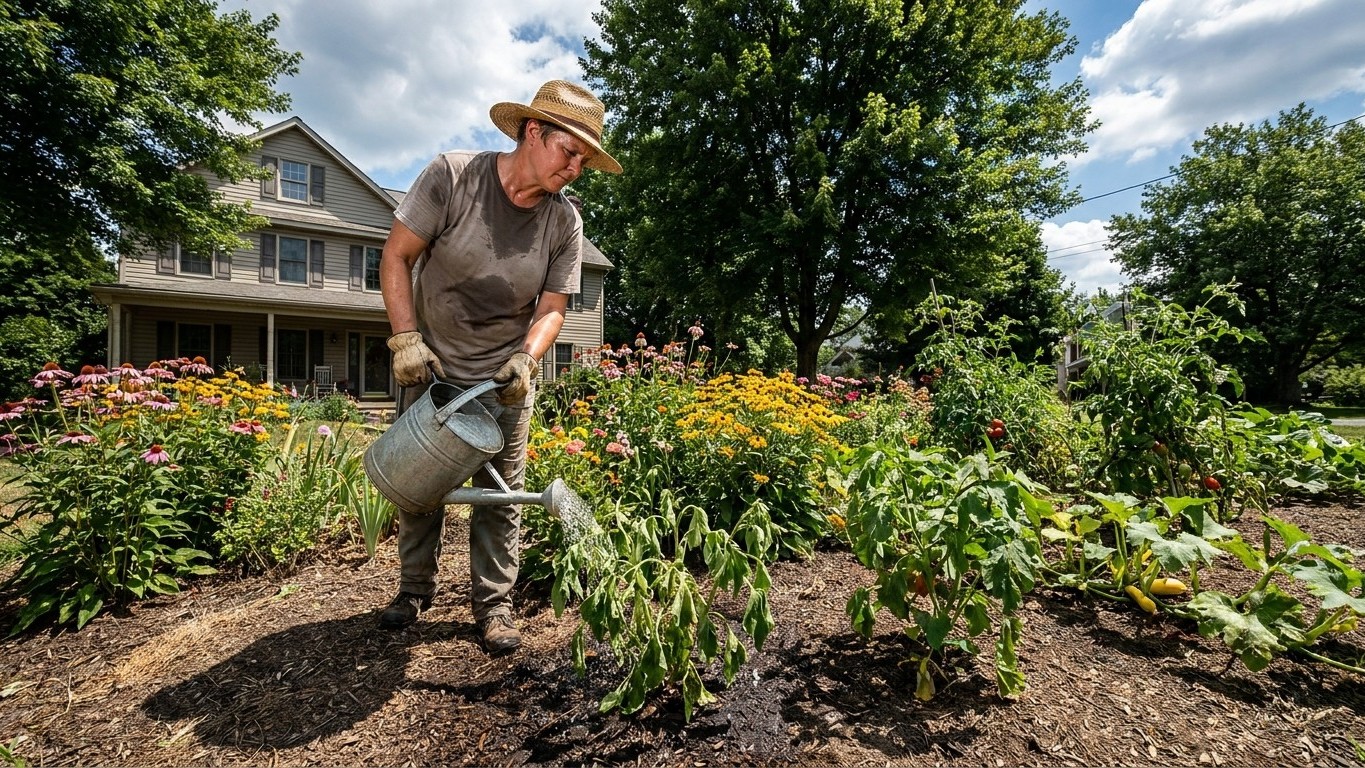

Pennsylvania gardens don’t run on a single watering schedule. The reference station in Philadelphia logs 24.0 days a year at 90F or hotter, and the state stretches across USDA zones 5a to 7b, meaning a garden in the Poconos and one in the Piedmont are playing by different rules even on the same July afternoon. Here’s how to water based on what your corner of the state actually gives you.
What the climate asks of you

Start with the number that tells you how brutal the season gets: 24.0 days a year reach 90F or higher, measured at the Philadelphia reference station under the NOAA 1991-2020 climate normals. That’s the figure that rules out treating Pennsylvania like a cool, forgiving climate all summer long. It also means the stretch from late June through August is when a garden’s water demand peaks hardest, since heat above 90F pulls moisture out of leaves and soil far faster than a mild 75F day.
Rainfall is the trickier half of the equation, and honestly, it’s the part that doesn’t reduce to one clean statewide number. Pennsylvania’s summer storms are patchy and convective, meaning one township gets soaked by an afternoon thunderstorm while a neighboring one twenty miles away stays bone dry. A gardener in the southeastern corridor near Philadelphia sees a different rainfall pattern than one in the Alleghenies or the northern tier, so a single “average summer week” figure would flatten real differences that matter for your beds. The honest move here is to check a local rain gauge or your county extension office rather than lean on a statewide average that might not describe your yard at all, and knowing how to approach Watering Through a Dry Spell in Pennsylvania can help you bridge those gaps when the storms skip your neighborhood entirely.
What doesn’t change from one end of the state to the other is the basic math: a vegetable or flower bed generally wants around an inch of water a week to keep growing steadily. Whatever the sky doesn’t deliver, the gardener has to carry, and in a state where summer rain arrives in bursts rather than steady drizzle, that often means long dry stretches between storms even in a “wet” month on paper.
Soil changes the equation, everywhere
Pennsylvania’s soils run from sandy, fast-draining ground in parts of the southeastern coastal plain fringe to heavy clay and glaciated till across much of the Piedmont and the north-central counties. The same rainstorm behaves completely differently depending on which one is under your feet. On sandy ground, that inch of rain drains through in a day or two and the bed is thirsty again fast. On clay, the same inch sits near the surface for a week, which sounds convenient until it starts suffocating roots that never dry out between waterings. Knowing which soil you’re standing on matters as much as knowing the rain totals.
How much, how often
The rule that holds up across every Pennsylvania soil type and USDA zone from 5a to 7b: water deep and infrequent, never shallow and daily. This applies just as much to Watering Pots and Containers in Pennsylvania as it does to in-ground beds. A quick daily sprinkle wets only the top inch or two of soil, and roots follow the water, staying shallow and vulnerable right where the sun bakes them hardest. A deep soak sends moisture down six inches or more, which trains roots to grow downward into cooler, steadier ground.
The test for whether a bed actually needs water is simple and doesn’t require a gadget: push a finger, or a trowel, two inches into the soil near the base of the plant. If it’s dry at that depth, water. If it’s still damp, wait. This matters more on clay soils, where the surface can look dry and crusty while the root zone underneath is still soaked, a mismatch that leads a lot of well-meaning gardeners to overwater and rot their own plants.
Sandy soils flip that risk the other direction. Because sand holds so little water, it calls for shorter but more frequent soakings rather than one big weekly dose that mostly drains past the root zone before the plant can use it. Clay, meanwhile, can hold a week’s worth of water, but working it or soaking it while it’s already wet compacts the structure and can drown roots outright. Timing on clay is less about the calendar and more about waiting for that two-inch test to come back dry.
Given how few consistently rainy days the driest stretch of a Pennsylvania summer offers, and how sharply that 24-day count of 90F-plus heat concentrates the real stress into a handful of weeks, most home gardens here end up on a supplemental watering routine rather than a purely rain-fed one during peak summer. Here’s a sequence that works across the state’s zone range:
- Check soil moisture two inches down at the base of the plant before doing anything else.
- Water early morning, ideally before 9 a.m., so moisture soaks in before the day’s heat and evaporation take over.
- Direct water at the soil and the base of the stem, never over the leaves, to avoid fungal issues that thrive on wet foliage overnight.
- On sandy soil, give a shorter soak every two to three days rather than waiting a full week.
- On clay soil, water less often but more deeply, and skip a scheduled watering entirely if the two-inch test still shows dampness.
- During the hottest stretch of summer, when days above 90F cluster together, check moisture every day even if the calendar says it isn’t a watering day.
Restrictions and rules
Watering restrictions aren’t rare in Pennsylvania, and they don’t follow a single statewide rulebook. Municipal water authorities and county conservation districts can and do issue their own guidance, especially during dry spells or drought watches declared by the state, and those rules shift year to year depending on reservoir levels and rainfall. A restriction active one July might be lifted the next, or tightened further if a dry pattern holds.
Because summer rainfall here is so unevenly distributed, and because parts of the state can go through real dry spells even in an otherwise average year, it’s worth checking with your local water provider before you set an automatic timer or plan a heavy watering schedule. Some municipalities post current watering days and hours directly on their websites; others require a call. Either way, a five-minute check beats a fine or a wasted trip to refill a barrel that wasn’t allowed to be used that week.
For anything specific to your county, from soil testing to current conservation notices, Penn State’s Extension service is the reliable starting point, since it connects to the county-level offices that actually track local rules and can point you toward your water authority’s current status.
Using less
Cutting water use in a Pennsylvania garden doesn’t mean cutting corners on plant health, it means being deliberate about where every gallon goes. A few techniques do most of the work:
- Mulch two to three inches deep around plants to slow evaporation, which can cut how often you need to water by roughly half on exposed sandy soil.
- Drip irrigation or soaker hoses deliver water straight to the root zone instead of the air, avoiding the loss that comes with overhead sprinklers on a breezy day.
- Grouping plants by water need means you’re not soaking a drought-tolerant native next to a thirsty vegetable just because they share a bed, which wastes water on the plant that didn’t need it.
- Working organic matter into the soil improves both extremes: it helps sandy soil hold moisture longer and helps clay soil drain better, softening the very soil problem described above.
- Rain barrels, where local codes allow them, capture roof runoff for later use. An inch of rain falling on a 1,000-square-foot roof yields about 600 gallons, so a single Pennsylvania thunderstorm can fill a barrel fast during a wetter stretch. The catch is that during the driest weeks of summer, the same weeks that line up with those 24 days above 90F, a barrel that isn’t being refilled by rain empties out quickly and can’t fully replace a hose.
None of these techniques work in isolation the way marketing sometimes suggests. Mulch without deep watering just insulates dry soil. A rain barrel without a plan for the dry weeks just becomes a decorative tank by August. Layering two or three of them, mulch plus drip plus grouped planting, tends to be what actually shows up as a lower water bill by the end of the season.
Common questions
Does the last spring frost date matter for when I start watering?
Around Philadelphia, the last spring freeze typically falls between March 29 and April 6, though the northern tier and the Alleghenies run two to four weeks later. Watering routines usually don’t kick into full gear until after that frost window closes and warm-season growth starts pulling moisture from the soil in earnest.
How does the first fall frost change my watering schedule?
Philadelphia’s first fall frost lands between November 5 and November 16, again running later in the colder northern and mountain regions. As that date approaches, growth slows and water demand drops, so it’s normal to taper watering frequency through October rather than keeping a summer-intensity schedule going.
Is my USDA zone the same as my neighbor’s if I live elsewhere in Pennsylvania?
Not necessarily. The state spans USDA zones 5a to 7b, a wide range driven by elevation and latitude, so a garden in the southeastern corner can be a full zone or two milder than one in the mountains. That range affects which plants survive winter, which indirectly shapes how much summer watering a mature, well-established plant needs versus a marginal one struggling at the edge of its zone.
Where do I find current watering restrictions for my specific area?
There’s no single statewide list, since rules come from individual municipal water authorities and county conservation districts. Your local water provider’s website or customer service line will have the current status, and Penn State’s Extension service can direct you to county-level resources if you’re not sure where to start.