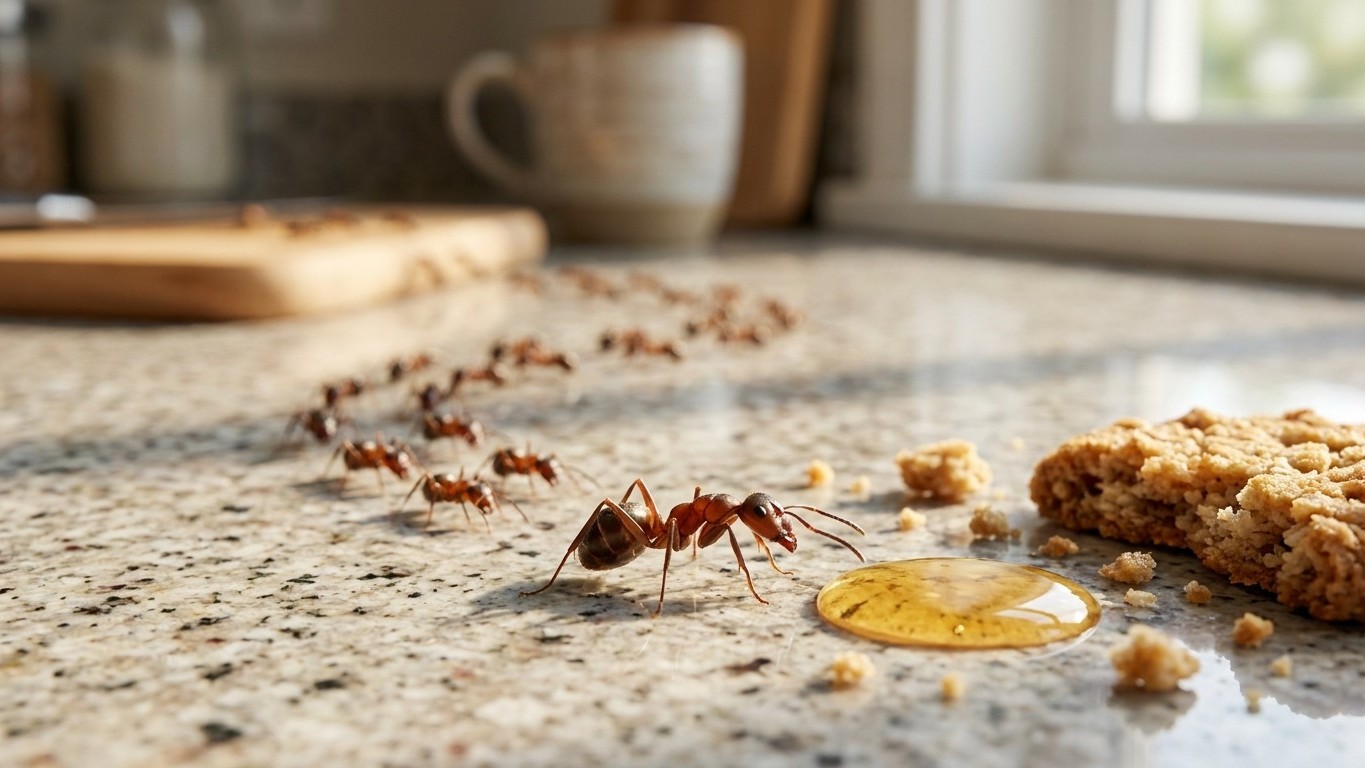

Ants show up inside because their outdoor food or water source dried up, got harder to reach, or a scout found a shortcut through a wall or door gap. It’s rarely about a dirty house. It’s about what’s easiest to find. Once one scout marks a trail with pheromone, the rest of the colony follows that exact path, which is why the ants you see are almost never the whole story.
What they are actually looking for

Every pest that ends up inside a house is chasing one of three things: food, water, or shelter. For ants, the split leans heavily toward the first two. A scout ant isn’t looking for a place to nest in your kitchen most of the time. It’s looking for something sweet, greasy, or protein-rich, and it’s looking for a damp spot to drink from. That distinction matters more than most people realize, because it changes what “cleaning up” actually needs to accomplish.
Different ants inside a house are chasing slightly different things, and knowing which one you’re dealing with changes where you look:
| Common indoor type | Primary attraction | Typical trail location |
|---|---|---|
| Sugar-seeking ants | Spills, crumbs, pet food, open containers | Countertops, pantry shelves, trash areas |
| Grease-seeking ants | Cooking residue, fryer splatter | Stovetops, range hoods, floor edges near appliances |
| Carpenter-type ants | Moisture-damaged wood, not the wood itself as food | Window frames, bathroom walls, under sinks |
| Moisture ants | Standing water, wet insulation, leaks | Basements, crawl spaces, under leaking pipes |
That last row is the one people miss. A species that comes for water isn’t going to be deterred by wiping down a countertop. If the draw is a slow drip under a bathroom sink or a damp crawl space, the ants will keep coming back no matter how many times the kitchen gets scrubbed, because the kitchen was never the point.
This is why the U.S. Environmental Protection Agency treats prevention as the starting point rather than an afterthought. As the agency puts it, “As a first line of pest control, IPM programs work to manage the crop, lawn, or indoor space to prevent pests from becoming a threat.” That sentence is doing more work than it looks like. It places managing the space itself, closing off the food, drying out the moisture, ahead of any spray, bait, or trap. Control methods come later in the sequence, not first.
Practically, this means the useful question isn’t “what kills ants” but “what is this specific trail feeding on.” Follow it back. If it ends at a pet bowl left out overnight, that’s a food problem. If it ends at a window sill that’s always slightly damp, that’s a moisture problem, and a very different fix.
How they get in
Ant entry points are almost always smaller than people expect, and checking them in order saves a lot of guesswork. Walk the perimeter of the house, inside and out, and go through these in sequence:
- Gaps around pipes and cables. Where water lines, gas lines, or electrical conduit pass through an exterior wall, the sealant often shrinks or cracks over the years, leaving a gap that looks too small to matter but isn’t.
- Door sweeps and thresholds. A worn sweep on an exterior door, especially a garage entry door or a sliding patio door, can leave a gap of just a few millimeters. For most ant species, that’s more than enough room.
- Window screens and frames. Torn screens get the attention, but a warped frame that no longer sits flush against the siding is often the bigger opening, and it’s easy to miss because the screen itself looks fine.
- Vents and weep holes. Foundation vents, dryer vents, and the small weep holes built into brick veneer are designed to let air and moisture out. They also let ants in, and they’re rarely screened well from the factory.
- What comes in on its own. Firewood stacked against the house, potted plants brought indoors for winter, and grocery bags set down on an outdoor step can all carry a hitchhiking scout or two straight past every other defense.
The gap size worth remembering here is the one at pipe and cable penetrations. Most homeowners assume a crack has to be visible to matter, but for ants a gap smaller than a pencil eraser is a functioning doorway. That’s the entry point most likely to get overlooked during a normal walk-through, because it doesn’t look like an entry point at all.
When they come, and why
Ant activity indoors tends to track outdoor conditions more than the calendar. A stretch of dry weather can push ants toward any moisture source they can find, including the one under a kitchen sink. Heavy rain can do the opposite, flooding out ground-level colonies and sending workers looking for dry shelter, which sometimes means a wall void or a crawl space. Cold weather at the tail end of a colony’s active season pushes some species to seek out a warm, stable spot to overwinter, and a house offers exactly that.
None of these triggers run on a fixed date, and that’s worth being clear about. What counts as a dry spell in one region is an ordinary summer in another, and the point in the year when a local colony starts looking for winter shelter varies by climate, elevation, and even by neighborhood. A threshold that applies in one state can be off by a full season somewhere else.
What stays consistent is the logic behind the timing: ants move toward whatever is scarce or missing outside. When conditions outside get harder, in either direction, dry or wet, hot or cold, the calculation shifts toward what’s reliably available inside a house. That’s the pattern to watch for, more than any specific week on a calendar.
Anyone trying to pin down when activity typically ramps up in their own area is better served by a regional resource than a national average. The site’s page on regional pest pressure breaks down what drives timing by area, which is a more useful starting point than a generic date range that may not apply where you actually live.
Fixing the reason rather than the symptom
A house that offers nothing gets fewer pests, and that’s the whole point of everything above. Every treatment applied to a house that still has an open food source, a damp crawl space, or an unsealed pipe gap is a treatment that has to be repeated, because the reason the ants came never went away. The EPA’s own sequence for pest management makes this explicit, and it’s worth following in order rather than skipping to the end.
The agency describes its approach, Integrated Pest Management, this way: “Integrated Pest Management (IPM) is an effective and environmentally sensitive approach to pest management that relies on a combination of common-sense practices.” The sequence starts before any product touches a shelf. First comes a threshold: “Before taking any pest control action, IPM first sets an action threshold, a point at which pest populations or environmental conditions indicate that pest control action must be taken.” Then identification: “IPM programs work to monitor for pests and identify them accurately, so that appropriate control decisions can be made.” Prevention, the managing of the space itself, comes next, ahead of control methods. Only after that does the EPA describe choosing a method, and even then in a specific order: “Effective, less risky pest controls are chosen first, including highly targeted chemicals, such as pheromones to disrupt pest mating, or mechanical control, such as trapping or weeding.” Broad chemical treatment sits at the very end of that list, not the start: “Broadcast spraying of non-specific pesticides is a last resort.”
That order is the message. A page, or a homeowner, that opens on a spray has inverted the doctrine it claims to follow. The EPA also notes that pesticides are designed to be toxic to the pests they target and can be toxic to people when used incorrectly, with children, older adults, and people with weakened immune systems named specifically as more vulnerable to exposure. Anyone with questions about a specific product’s label or safe use can call the National Pesticide Information Center directly at 1-800-858-7378, rather than guessing.
For the actual how-to on removing an active trail, from bait placement to sealing the specific gap it’s using, the site’s ant control page covers the mechanics. This page is the one that keeps them from coming back once that trail is gone, because the food, the water, and the gap it walked through are the reason it showed up in the first place.
Common questions
Do ants come inside because the house is dirty?
Not necessarily. A spotless kitchen can still draw ants if there’s a damp spot under a sink or a gap near a pipe. Cleanliness helps with food-seeking species but does nothing for moisture-seeking ones.
Will ants go away on their own if I ignore them?
Sometimes a trail dries up when the outdoor food source it was tracking becomes available again, but the entry point they used stays open, so activity typically returns.
Is it normal to see more ants after rain?
Yes, heavy rain can flood ground-level colonies and push workers toward dry shelter, which sometimes means the inside of a house. This varies by species and by how well-drained the surrounding soil is.
When should I call a pest control professional instead of handling it myself?
If trails keep reappearing despite sealing entry points and removing food and moisture sources, or if the ants involved are damaging wood structurally, a licensed professional can identify the colony location and species in a way a visual check often can’t.