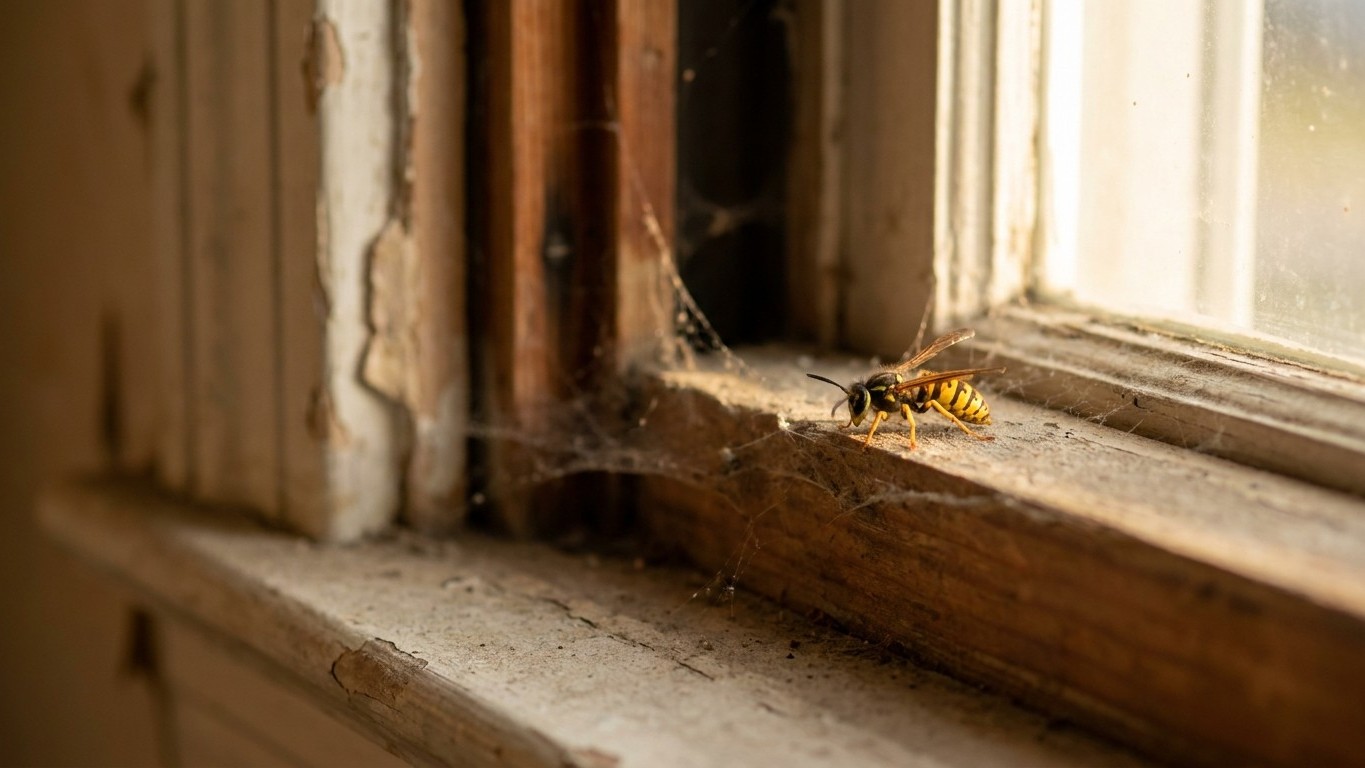

Wasps come indoors for one of two reasons, and almost never for the reason people assume. They are not hunting your kitchen scraps. Most indoor wasp encounters trace back to a queen looking for a dry, sheltered cavity to spend the winter, or to worker wasps chasing a sugar source as their colony’s food supply changes late in the season. Knowing which one applies changes what actually stops them.
What they are actually looking for

Every pest that shows up inside a house is after one of three things: food, water, or shelter. For wasps, water is rarely the draw, and food matters only in a narrow window. The dominant motive is shelter, specifically the kind of tight, insulated, undisturbed cavity that a wall void, attic corner, or window frame provides. Overwintering queens, the only members of most wasp colonies to survive from one year to the next, go looking for exactly this kind of space once their colony disbands in fall. A house offers dozens of candidates a hollow tree never could.
The second driver is sugar, and it shows up on a different calendar. Earlier in the season, worker wasps are hunting protein, mostly other insects, to feed larvae back at the nest. As summer winds down and the colony stops producing new larvae, that protein demand drops off and workers switch to carbohydrates for their own energy. That is the point at which a soda can on a porch table or an open trash bin starts to matter. It is also why the same species can seem uninterested in food for months and then aggressively interested in a picnic almost overnight.
This distinction is the whole reason prevention works or fails. A species that is indoors for water is not going to be deterred by wiping counters. A species that is indoors for shelter is not going to be deterred by covering the fruit bowl. Wasps fall firmly into the shelter-and-late-season-sugar category, which means the fixes that matter most are sealing cavities and managing outdoor food sources in late summer, not general kitchen hygiene.
The U.S. Environmental Protection Agency frames this as the starting point for any pest issue, not an afterthought: “As a first line of pest control, IPM programs work to manage the crop, lawn, or indoor space to prevent pests from becoming a threat.” For wasps specifically, managing the indoor space means thinking like a queen looking for a cavity, not like someone looking for crumbs.
How they get in
Wasps do not need much of an opening, and the size of gap they can use surprises most homeowners. A queen searching for a winter cavity, or a worker following a scent trail to something sweet, will exploit whatever access point is available rather than create one. Working through a house in this order catches the entry points that actually matter:
- Gaps around pipes and cables where they pass through exterior walls, especially near dryer vents, hose bibs, and utility lines. These gaps are often larger than they look from outside and rarely get sealed during original construction.
- Door sweeps that have worn down or were never adjusted to the threshold. A wasp can walk through a gap that looks too thin to matter.
- Window screens with tears, loose frames, or gaps at the corners where the screen no longer meets the sash.
- Vents, including soffit vents, attic vents, and gable vents, many of which are covered with mesh too coarse to stop a wasp, or mesh that has degraded over time.
- Gaps under siding and at roof lines, where a small void can lead directly into a wall cavity or attic space that a queen will treat as ideal shelter.
What surprises people most is how small the opening can be relative to the insect. Wasps are more flexible-bodied than their rigid appearance suggests, and a gap that looks barely wide enough for a pencil can be enough. That is why sealing has to be thorough rather than selective. A homeowner who seals the obvious gaps around a door but leaves a quarter-inch void where a cable enters the wall has not solved the problem, just relocated the entry point.
It is worth noting that wasps do not typically arrive carrying anything the way some pests do. There is no comparable route through firewood or shipping boxes the way there is for certain other insects. The entry is almost always structural: a gap in the building envelope that a queen or worker finds and uses directly.
When they come, and why
The timing of indoor wasp encounters tracks the life cycle of the colony more closely than it tracks the weather on any given day. Through the active part of the season, colonies are growing, workers are foraging for protein, and indoor sightings tend to be incidental, a wasp that wandered in through an open door rather than one actively seeking the house. The pattern shifts as the colony’s year winds down. Once a colony stops rearing new larvae, workers pivot toward sugar sources, which is when kitchens, trash areas, and outdoor eating spaces start attracting more attention. Around the same time, newly mated queens begin searching for overwintering shelter, which is when the wall-void and attic sightings tend to start.
Weather plays a role at the margins. A stretch of cold snaps that arrive early can push queens to seek shelter sooner than usual, while a mild, extended fall can stretch the sugar-seeking phase out longer than expected. Drought can concentrate wasp activity around any remaining water or food sources, and heavy rain can flood underground or ground-level nests, sending survivors looking for a new site with little warning. None of these triggers land on the same date two years running, and they do not land at the same time in every part of the country. A driver that pushes queens indoors in one region in early fall might not do the same thing for another month somewhere with a longer warm season.
This is exactly why a general timeline is not much use to an individual homeowner. The useful version of this information is regional: what triggers the shift where you actually live, and roughly when it tends to happen there. The site’s territory pages cover that breakdown by region, which is a more reliable guide to timing than any single calendar date could be.
What stays constant regardless of region is the sequence: protein-focused activity gives way to sugar-focused activity, and sugar-focused activity overlaps with queens searching for shelter. Recognizing which phase is underway tells you which entry points and which attractants deserve attention first.
Fixing the reason rather than the symptom
A house that offers no cavity worth overwintering in and no sugar worth foraging for gets fewer wasps, full stop. That is the point this whole page has been building toward. Every treatment applied to a house that still has open gaps around its pipes, worn door sweeps, and an uncovered trash bin has to be repeated, because the conditions that brought the wasps in the first place are still there waiting for the next queen or the next hungry worker.
The EPA’s own description of Integrated Pest Management makes prevention the starting point, not a chemical response: “Integrated Pest Management (IPM) is an effective and environmentally sensitive approach to pest management that relies on a combination of common-sense practices.” The agency is explicit about the order those practices follow. First comes a threshold decision: “Before taking any pest control action, IPM first sets an action threshold, a point at which pest populations or environmental conditions indicate that pest control action must be taken.” Then comes identification: “IPM programs work to monitor for pests and identify them accurately, so that appropriate control decisions can be made.” Only after prevention and identification does control enter the picture, and even then the least aggressive option comes first: “Effective, less risky pest controls are chosen first, including highly targeted chemicals, such as pheromones to disrupt pest mating, or mechanical control, such as trapping or weeding.” Spraying is explicitly the last option, not the first: “Broadcast spraying of non-specific pesticides is a last resort.”
That order matters for a practical reason beyond doctrine. The EPA notes that pesticides are designed to be toxic to the pests they target, and that toxicity does not stop being relevant once a product is indoors near people. Children, older adults, and people with compromised immune systems are named specifically as more vulnerable to improper use. A homeowner unsure whether a particular product is appropriate for their situation has a direct resource: the National Pesticide Information Center takes calls from the public at 1-800-858-7378, and it is a better source for that decision than guesswork.
Some situations go beyond what sealing and cleanup can handle on their own, particularly an established nest inside a wall void or attic space, where removal without professional equipment risks disturbing a large colony. For that kind of active problem, the site’s control page walks through what to do right now. This page is what keeps it from being a problem again next year.
Common questions
Do wasps come inside looking for food the way ants do?
Rarely, and only in a narrow late-season window. Most wasp colonies spend the bulk of their active season hunting protein outdoors for larvae. Indoor food-seeking becomes more likely once the colony stops rearing young and workers shift to sugar sources for their own energy, which typically overlaps with the season’s later stretch.
Why do I find wasps in my walls or attic specifically?
That pattern points to shelter-seeking rather than foraging. Mated queens look for dry, insulated cavities to overwinter in once their original colony disbands, and wall voids and attics resemble the hollow, protected spaces they would use outdoors.
Are wasp stings a health concern beyond the pain?
For most people a sting is a localized, painful reaction that resolves on its own. Some people have allergic reactions that go well beyond that, and a severe reaction after a sting warrants prompt medical attention rather than a wait-and-see approach.
Can sealing gaps really stop wasps without a spray?
For the shelter-seeking phase, sealing is the more relevant fix, since there is no cavity to defend if there is no cavity to find. The EPA’s own framework treats prevention and mechanical measures as the first line, with broadcast spraying reserved as a last resort rather than a starting point.