
Low water pressure almost always traces back to one of four places: the fixture itself, a shut-off valve that isn’t fully open, a clogged aerator or showerhead, or a problem shared by the whole house, like a partially closed main valve or a failing pressure regulator. The fastest way to find the cause is to test one tap at a time before touching anything else. A single weak faucet points to a local blockage. Weak pressure everywhere points upstream, toward the meter, the main valve, or the regulator that serves the entire house.
What is actually happening
Water arrives at your house under pressure, either pushed by the municipal system or by a pump and pressure tank if you’re on a well. That pressure travels through one main line, splits into branches for each fixture, and narrows at every faucet, showerhead, and appliance connection along the way. Anything that reduces the diameter of that path, mineral scale inside a pipe, a valve that’s only partly open, a clogged screen, reduces how much water can move through it. The water doesn’t disappear. It just backs up, and what reaches the tap comes out weaker.
This is why the single-fixture-versus-whole-house distinction matters more than anything else you’ll check. If one faucet is weak while every other tap in the house runs fine, the restriction is local, almost certainly inside that fixture, its supply line, or its shut-off valve. If every fixture is weak, hot and cold, upstairs and down, the restriction sits further back, somewhere shared by the whole system: the main shut-off valve, the water meter, a pressure-reducing valve if the house has one, or, on a well, the pressure tank and pump themselves.
Hot-only weakness is its own category and worth separating out. If cold water runs strong everywhere but hot water is weak at more than one fixture, the problem usually sits at the water heater: a partially closed valve on its inlet, or sediment that has built up inside the tank and is restricting flow on the way out. That’s a different repair path than a whole-house pressure problem, and confusing the two wastes time.
Municipal supply itself isn’t perfectly constant, either. Utilities adjust pressure for maintenance, fire flow demand, or elevation changes in the distribution system, and a temporary dip that affects your whole street isn’t something inside your house at all. That’s part of why the order of checks below starts with the cheapest, most local explanations and only moves toward the shared systems once those are ruled out. Understanding the mechanism, restriction versus shared supply, lets you interpret what you find at each step instead of just following instructions that may not fit your particular fittings.
What to check, in order
Work through these in sequence. Each one tells you something specific, and a positive result at any step usually means you can stop there.
- Clean the aerator or showerhead. Unscrew the small mesh screen at the tip of the faucet, or the showerhead itself, and look for a white or greenish crust. That’s mineral buildup, and it’s the single most common cause of one weak fixture. Soak the piece in a description you can rinse clean, then reattach. If pressure returns to normal, you’ve found it.
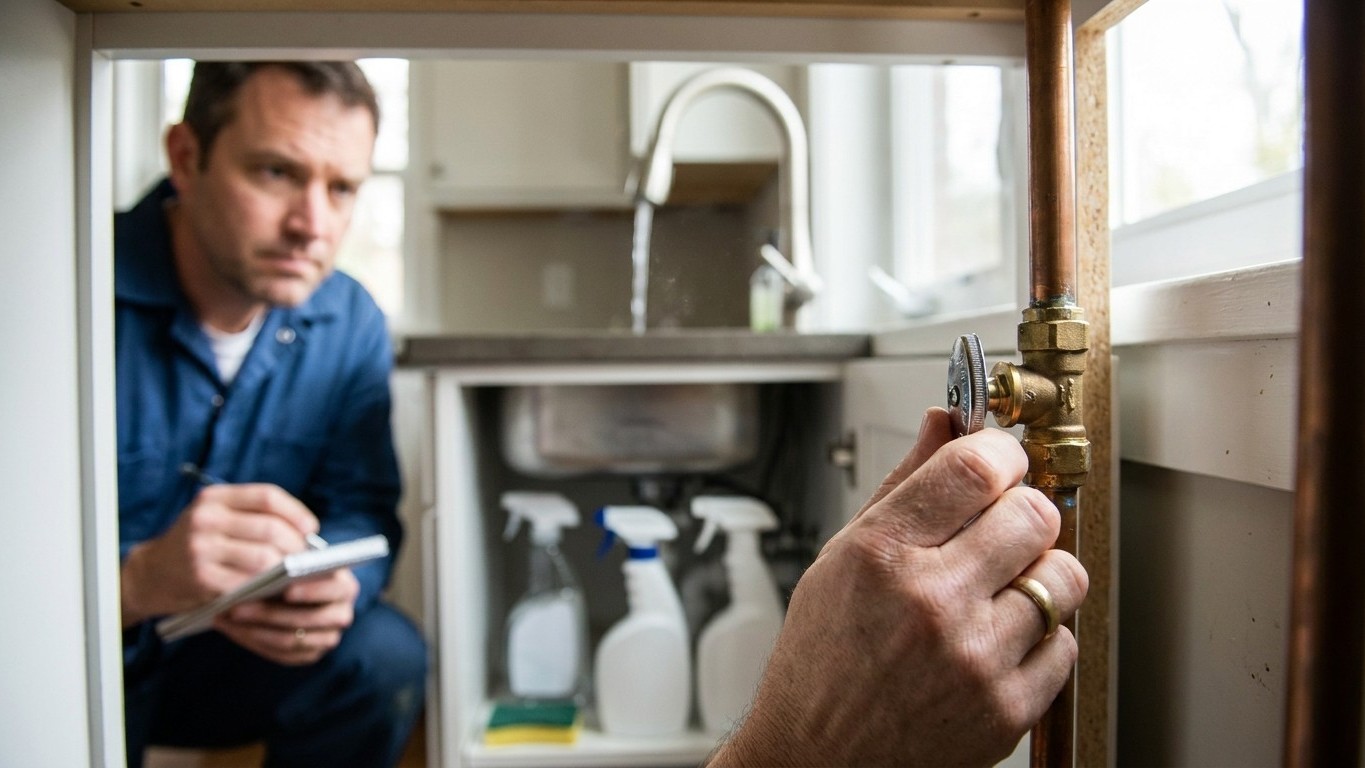
- Check that fixture’s own shut-off valve. Under the sink or behind the toilet, there’s usually a small valve. Confirm it’s turned fully open, not just cracked. These get bumped or intentionally throttled during repairs and then forgotten.
- Compare hot and cold at more than one fixture. If cold runs fine everywhere but hot is weak in more than one place, the restriction is likely at the water heater’s inlet valve or from sediment inside the tank, not in the fixture you started with.
- Check the main shut-off valve for the house. This is usually near where the supply line enters, in a basement, utility closet, or crawlspace. It should be fully open. A valve that’s only partly open will reduce pressure at every fixture equally.
- Look for a whole-house pressure-reducing valve. Some homes have one where the main line enters. If pressure has dropped gradually over months rather than suddenly, a worn regulator is a common cause, and it’s worth having it checked rather than guessed at.
- Ask a neighbor. If the house next door has the same weak pressure at the same time, the cause is upstream of both properties, on the utility side, and no amount of checking inside your house will fix it.
- Listen and look for a leak you haven’t noticed. A drop in pressure that shows up alongside a higher water bill, a damp spot, or a hissing sound behind a wall points toward a leak rather than a simple restriction. A water meter test, checking whether the meter’s leak indicator moves with everything in the house turned off, is the most reliable way to confirm this, and it’s covered in detail on our hidden leak detection guide.
What it costs to leave it
Weak pressure and hidden leaks often show up together, because a slow leak reduces the volume available at the tap while also running up the water bill in the background. The scale of that waste, nationally, is larger than most homeowners assume. According to the U.S. EPA WaterSense program, “Household leaks can waste nearly 1 trillion gallons of water annually nationwide,” and “The average household’s leaks can account for more than 9,300 gallons of water wasted every year.” The program also notes that “nine percent of homes have leaks that waste 50 gallons or more per day.”
Some of the smaller sources add up faster than people expect. WaterSense reports that “A leaky faucet that drips at the rate of one drip per second can waste more than 3,000 gallons per year,” and “A showerhead leaking at 10 drips per minute wastes more than 500 gallons per year.” A worn toilet flapper is its own quiet drain: “An old or worn flapper can cause your toilet to flush on its own or silently leak thousands of gallons a year.” On the upside, WaterSense estimates that “Fixing easily corrected household water leaks can save homeowners about 10 percent on their water bills.”
These figures come from a national conservation campaign, aggregated across millions of homes, and they’re useful for one thing only: showing how much waste tends to hide in an average house. They can’t tell you what your house is losing. Two homes with the same weak pressure at the kitchen sink could have completely different causes, one a $4 aerator, the other a leak losing hundreds of gallons a month, and no national average distinguishes between them. Your own water meter is the only measurement that actually belongs to you, and the hidden leak detection guide walks through how to read it.
When to stop and call a plumber
Most of the checks above involve nothing more than a wrench, a valve, and a few minutes. Some situations fall outside that, and pushing further tends to turn a small problem into an expensive one.
Anything located behind a finished wall is the first line to draw. If cleaning the aerator, checking valves, and comparing hot and cold at other fixtures haven’t explained the pressure drop, and you suspect the restriction or the leak is inside a wall cavity, that’s a job for a licensed plumber. Opening drywall without knowing exactly where the pipe runs causes more damage than it prevents.
Anything on the main supply line is the second boundary. The pipe between the street and your house, and the main shut-off valve itself, are not places to experiment with fittings you don’t fully understand. If that valve is stuck, corroded, or won’t fully close when you need it to, that’s exactly the kind of failure covered on our shut-off valve guide, and it’s worth reading before you attempt anything on that line yourself.
A gas water heater changes the calculation entirely. If your pressure investigation leads you to suspect a problem at the water heater, sediment buildup, a failing inlet valve, or something more serious, and the unit runs on gas, stop. Working around a gas appliance without the right training risks a leak that has nothing to do with water.
Finally, any leak that has already wetted structure, a damp subfloor, a stained ceiling, a soft spot in drywall, needs a professional regardless of how minor the original pressure complaint seemed. Water that’s already reached wood or insulation invites mold within days, and by the time you can see the damage, it’s usually been happening longer than the pressure drop that first got your attention.
Common questions
Why did my water pressure drop suddenly instead of gradually?
A sudden drop usually points to something mechanical changing all at once, a valve bumped closed, a sediment chunk breaking loose and lodging in a fixture, or a utility-side event affecting your street. A gradual drop over weeks or months points more toward mineral buildup accumulating inside pipes or a slowly failing pressure-reducing valve.
Does low pressure always mean I have a leak?
No. Most low-pressure cases trace back to a clogged aerator, a partly closed valve, or sediment in the water heater, none of which involve water escaping the system. A leak is one possible cause among several, and the water meter test is the way to rule it in or out rather than guess.
Can hard water actually cause low pressure?
Yes, indirectly. Hard water leaves mineral deposits inside aerators, showerheads, and eventually inside pipe walls themselves, narrowing the path water travels through. This tends to build slowly, which is why homes with hard water often notice pressure fading over months rather than dropping overnight.
Should I check my water pressure at every fixture, or just the one that seems weak?
Check more than one, on purpose. Testing just the fixture that first caught your attention can’t tell you whether the cause is local or shared by the whole house, and that distinction determines almost everything about where to look next.