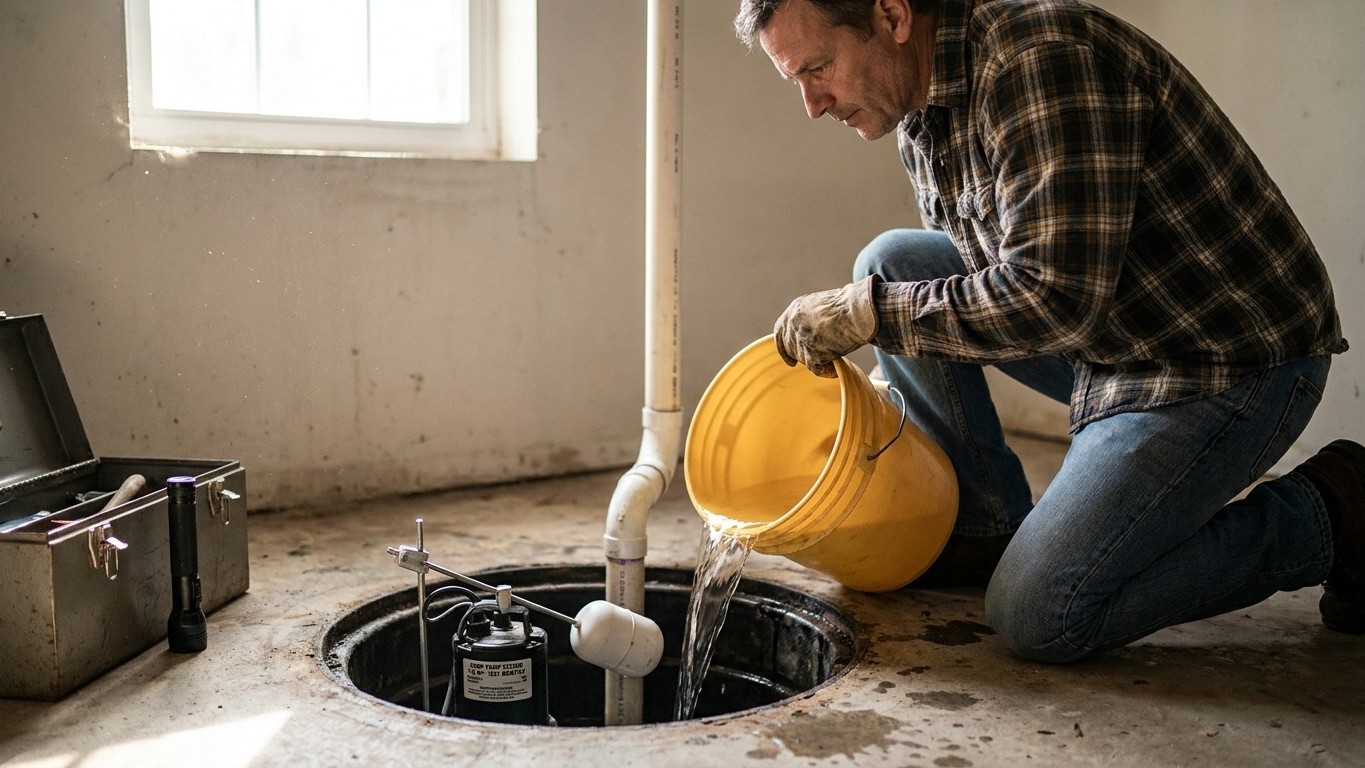

A sump pump that hums along fine on a dry September afternoon can fail completely the moment a real storm rolls through. The only way to know which one you have is to test it before you need it: pour a few gallons into the pit, watch the float rise, and confirm the motor kicks on and pushes the water out. Twice a year, ideally before spring thaw and before hurricane season, is enough. Do it dry, and a failure costs you nothing but five minutes.
What is actually happening
A sump pump sits in a pit dug into the lowest point of a basement or crawlspace, waiting for groundwater to rise. Inside that pit, a float switch, essentially a small buoy attached to a rod or a sealed arm, rides up with the water level. Once it clears a set height, it closes an electrical contact and the motor engages. The impeller inside starts spinning, pulling water in through the base and pushing it up a discharge pipe that exits the house, usually well away from the foundation. Cut the water off, or cut the float switch’s ability to move freely, and none of that sequence starts.
The reason dry testing matters comes down to timing. A sump pump only earns its keep during the two or three days a year when the water table actually rises past that pit. Every other day, it sits idle. Idle equipment corrodes, seals dry out, floats get wedged against the pit wall by shifted gravel or a stray zip tie left from installation, and check valves stick partway open. None of that shows up as a warning light. It shows up as silence during the one moment silence is expensive.
Most residential units fall into one of two designs. A pedestal pump keeps its motor up on a shaft above the pit, out of the water, with only the intake down low, which makes it easier to inspect but often louder. A submersible pump sits the whole sealed unit underwater, quieter and generally longer-lived, but harder to eyeball for wear since you cannot see the impeller without pulling it out. Either design depends on the same three things working together: a float that moves freely, a motor that gets power reliably, and a discharge path that is not blocked, frozen, or flowing backward into the pit through a failed check valve.
Some homes add a battery backup system or a water-powered backup tied to the municipal supply, precisely because the single most common failure mode for any sump pump is not mechanical at all. It is a power outage during the exact storm that also raises the water table. A pump that tests perfectly on household power will do nothing during a blackout unless it has a working alternate power source behind it.
What to check, in order
Run through these checks from cheapest and quickest to more involved. Each one tells you something specific, and there is no reason to move to the next until the current one gives you a clear answer.
- Confirm the outlet has power. Look at the cord and the outlet it plugs into. If the pump is on a ground-fault circuit and that outlet has tripped, the pump has effectively been off since whenever the trip happened, possibly weeks. A tripped GFCI outlet with no obvious cause is itself a signal something nearby is drawing moisture it shouldn’t.
- Watch the float switch move by hand. Lift it gently and let it settle back down. It should swing or slide freely, without catching on the pit wall, a discharge pipe, or debris that has settled in the basin. A float that sticks halfway is the single most common reason a pump never engages when it should.
- Pour water into the pit and watch the full cycle. A bucket or two is usually enough. The float should rise, the motor should engage within a few seconds, and you should hear water moving through the discharge line. If the motor runs but no water appears to be leaving, the impeller may be clogged or the discharge line blocked.
- Check the discharge point outside the house. Walk outside while the pump is running, if possible, and confirm water is actually exiting and draining away from the foundation, not just trickling out or pooling right back toward the house.
- Listen for the check valve. After the motor shuts off, water sitting in the discharge pipe above the pump should not be allowed to fall back into the pit. A short thud or a small backflow trickle right after shutoff usually means the check valve is failing to seal.
- Test the battery backup, if you have one, on its own. Unplug the primary pump’s power source temporarily (with the water still in the pit) and confirm the backup unit takes over. A backup that has never been tested is a battery you are trusting blind.
If every one of those checks passes, the pump is doing its job today. Repeat the sequence on a schedule rather than waiting for a weather forecast to remind you.
What it costs to leave it
A sump pump that quietly stops working does not usually announce itself with a dramatic flood on day one. More often, water finds a slow way in first, through a hairline foundation crack or a floor drain that backs up under pressure, long before the pit fully overwhelms the space. That slow intrusion sits in the same category water-conservation researchers have spent years measuring at the household level, even though a sump failure and a dripping faucet look nothing alike on the surface.
The scale researchers use for ordinary household leaks is worth knowing, if only as a reminder of how much water moves through a home without anyone noticing. The U.S. EPA’s WaterSense program has found that “household leaks can waste nearly 1 trillion gallons of water annually nationwide,” and that “the average household’s leaks can account for more than 9,300 gallons of water wasted every year.” The program also notes that “nine percent of homes have leaks that waste 50 gallons or more per day,” which is the range where a homeowner usually starts noticing a water bill that does not match their habits.
None of those figures describe your basement specifically, and none of them should be used to guess at what a failed sump pump might cost you in a given storm. They are national aggregates built to make the case for fixing leaks broadly, not a calculator for one household’s damage. What they do make clear is that water loss at scale is common, underestimated, and rarely obvious until someone goes looking. The same logic applies to a sump pit: the only number that means anything for your house is what your own water meter and your own basement tell you, not a national average.
For the plumbing that is already inside your walls, running quietly whether or not you’re paying attention, a slow drip is easy to miss for the same reason a failed float switch is easy to miss: nothing about it demands your attention until the damage is already done. If you want to check whether your own home has one of those hidden leaks, the hidden leak detection guide walks through reading your own meter, which is the only measurement that actually applies to your house.
When to stop and call a plumber
Testing and maintaining a sump pump is reasonable homeowner territory. The pit is visible, the float is accessible, and the discharge line is usually easy to trace. But a handful of situations move past what any test-and-check routine should cover, and it is worth knowing the line before water forces you to find it under pressure.
Anything behind a finished wall, whether that is a discharge pipe that disappears into drywall or a suspected leak you can hear but not see, is past the point of a flashlight and a bucket. Anything touching the home’s main water supply line, as opposed to the isolated sump circuit, carries risk that goes beyond a wet basement. A gas water heater anywhere near the affected area changes the calculation entirely: water and gas lines close together are not a do-it-yourself situation, full stop. And any leak, from a sump failure or otherwise, that has already soaked drywall, subfloor, or framing has moved from a plumbing problem into a structural and mold problem, and it needs a professional assessment regardless of what fixed it originally.
None of this needs to be dramatic to be serious. A pump that fails during a two-inch rainfall can put several inches of water across a finished basement floor in under an hour, and by the time carpet, drywall, and stored belongings are wet, the repair bill has very little to do with the pump itself. The first move in any of these situations is not to diagnose the pump further. It is to find your main shut-off and know how to close it, so that if the situation involves the main supply rather than just the sump circuit, you are not searching for a valve while water keeps rising. The shut-off valve guide covers exactly where to look and how to confirm it turns before you ever need it in an emergency.
Common questions
How often should a sump pump actually be tested?
Twice a year is a reasonable baseline for most homes, timed before the seasons when groundwater typically rises, such as spring thaw or the start of heavy rain season in your region. Homes with a history of basement moisture may warrant a quicker monthly glance at the float and power connection.
Is it normal for a sump pump to run constantly?
Frequent, repeated cycling with only a small amount of water each time often points to a float switch set too sensitively or a check valve letting water fall back into the pit after each cycle, rather than a genuinely high water table. Constant running without a clear stop is worth investigating rather than ignoring.
Does a sump pump need a battery backup?
It depends on how often your area loses power during the same storms that raise groundwater. If those two things tend to happen together, a pump with no independent power source is only reliable as long as the lights stay on, which is precisely when it is least likely to.
Can a sump pump prevent all basement flooding?
No single pump handles every scenario. A sump pump manages rising groundwater through the pit it is installed in, but it does nothing for water entering through a different path, such as a window well, a cracked wall higher up, or a sewer backup, all of which call for separate solutions.